50-30-20 Rule: Does It Work in Real Life?
The 50-30-20 rule has become one of the most popular budgeting frameworks in personal finance. Popularized by Senator Elizabeth Warren in her book “All Your Worth: The Ultimate Lifetime Money Plan,” this simple formula promises to bring order to your financial chaos. But does this one-size-fits-all approach actually work in the complex realities of modern life? Let’s dive deep into the mechanics, psychology, and practical application of this rule.
What Exactly Is the 50-30-20 Rule?
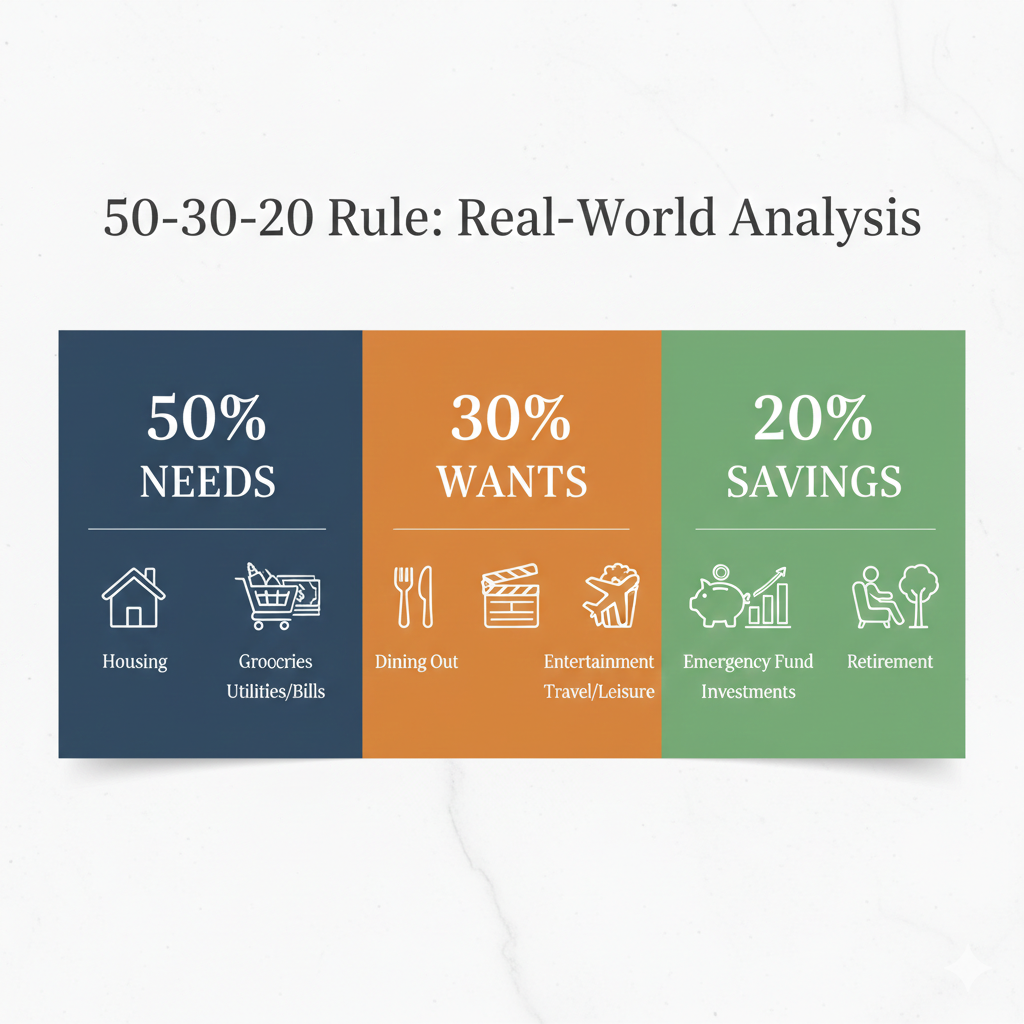
The 50-30-20 rule is a budgeting framework that suggests dividing your after-tax income into three categories:
Essentials you cannot avoid: housing, utilities, groceries, transportation, insurance, minimum debt payments, and basic clothing.
Discretionary spending: dining out, entertainment, hobbies, vacations, luxury items, and non-essential purchases.
Future financial security: emergency fund, retirement accounts, investments, and extra debt payments beyond minimums.
Key Insight: The brilliance of the 50-30-20 rule lies in its simplicity. Unlike detailed budgeting methods that require tracking every penny, this framework provides mental guardrails for spending without micromanagement.
The Psychological Foundation: Why Simplicity Works
Behavioral economics teaches us that complexity is the enemy of execution. The 50-30-20 rule succeeds where detailed budgets fail because it respects cognitive limitations. Research shows that people are more likely to stick with financial plans that are easy to understand and implement.
The rule also addresses the scarcity mindset. By allocating 30% to “wants,” it prevents the feeling of deprivation that often derails restrictive budgets. This psychological permission to spend on enjoyment increases long-term adherence.
Real-World Application: Where the Rule Shines
Case Study 1: The Urban Professional
Situation: Alex, 28, earns $65,000 annually in a metropolitan area. After taxes: $4,200/month.
Application:
– Needs (50%): $2,100 covers rent ($1,400), utilities ($200), groceries ($300), transportation ($150), insurance ($50)
– Wants (30%): $1,260 for dining, entertainment, hobbies
– Savings (20%): $840 to retirement and emergency fund
Result: The rule works well for Alex, providing structure while allowing urban lifestyle expenses.
Case Study 2: The High-Cost Area Family
Situation: The Chen family, with dual income of $120,000 in a high-cost city. After taxes: $7,000/month.
Challenge: Mortgage alone takes $2,800 (40% of income). The 50% for needs is insufficient for their housing market.
Adaptation: They adjust to a 55-25-20 split, reducing wants to accommodate essential housing costs.
The Limitations: When 50-30-20 Doesn’t Fit
Pros of the 50-30-20 Rule
- Simple to understand and implement
- Provides clear spending boundaries
- Balances present enjoyment with future security
- Works well for average income earners
- Reduces decision fatigue in daily spending
- Teaches fundamental budgeting concepts
Cons and Limitations
- Doesn’t account for income variability (gig workers, freelancers)
- Struggles in high-cost-of-living areas
- Ignores debt levels (high-interest debt may need more than 20%)
- Assumes consistent after-tax income calculation
- May not work for very low or very high incomes
- Doesn’t consider life stage differences (students, retirees)
Critical Insight: The 50-30-20 rule works best as a starting point rather than a rigid prescription. Its true value is in establishing the mindset of intentional allocation, which can then be customized to individual circumstances.
Modern Adaptations for Today’s Economy
1. The Flexible 50-30-20 Approach
Instead of rigid percentages, use the rule as a directional guide. If you’re in a high-cost area, you might need a 60-20-20 split. If you have aggressive debt repayment goals, consider 50-20-30 until debts are cleared.
2. The Tiered Approach for Different Income Levels
For lower incomes (<$40,000), focus on a survival budget first. For middle incomes ($40,000-$100,000), the standard 50-30-20 often works well. For higher incomes (>$100,000), consider increasing the savings percentage to accelerate financial independence.
3. The Lifecycle Adaptation
Young professionals might benefit from 50-25-25 to build savings faster. Families with children might need 60-20-20. Those nearing retirement could use 40-30-30 to maximize savings in their peak earning years.
The Math Behind the Rule: Does It Actually Build Wealth?
Let’s examine the long-term wealth-building potential. Assuming a 30-year-old earning $60,000 annually with 3% yearly raises:
20% Savings Rate: $12,000 saved in year one, growing at 7% annually, becomes approximately $1.2 million by age 65. This demonstrates the power of consistent saving, even at the 20% level.
However, for true financial independence, many experts now recommend 25-30% savings rates. The 50-30-20 rule provides a foundation that can be built upon as income increases.
Frequently Asked Questions
Always use after-tax (net) income for the 50-30-20 calculation. This represents the money you actually have control over. If you have automatic retirement contributions from your paycheck, you can either include them in the 20% savings category or calculate based on income before those deductions, depending on your preference for tracking.
For irregular income, calculate your average monthly income over the past 6-12 months. Base your percentages on this average. During high-income months, allocate the surplus to your savings category. During low-income months, you may need to dip into your emergency fund or temporarily adjust percentages.
This is common in high-cost areas. First, scrutinize your “needs” to ensure they’re truly essential. If they are, you have two options: 1) Increase your income through career advancement or side income, or 2) Adjust the percentages temporarily, reducing wants and possibly savings until you can reduce essential costs or increase income.
Ready to Take Control of Your Finances?
The 50-30-20 rule is a powerful starting point, but personal finance is deeply individual. The most important step is to begin tracking your income and expenses to understand your current financial reality.
Start Your Budget TodayCommit to 30 days of tracking to discover your personal spending patterns
Conclusion: The Verdict on 50-30-20
The 50-30-20 rule does work in real life, but with important caveats. It serves as an excellent beginner’s framework that introduces fundamental budgeting concepts without overwhelming complexity. For average earners in medium-cost areas, it provides a balanced approach to money management.
However, like any financial rule, it should be adapted to individual circumstances rather than followed rigidly. The true value of the 50-30-20 rule is not in its specific percentages but in its underlying principles:
- Prioritize essential expenses
- Allow for enjoyment and lifestyle
- Consistently save for the future
- Live within your means
In a world of complex financial products and competing advice, the 50-30-20 rule remains relevant because it simplifies a complex topic. Use it as a starting point, customize it to your life, and remember that the best budget is the one you’ll actually stick to.