
12 Lakh Tax Free Rule Explained: What the 2026 Update Actually Means for You
Last Updated: March 2026 | Category: Income Tax, Personal Finance
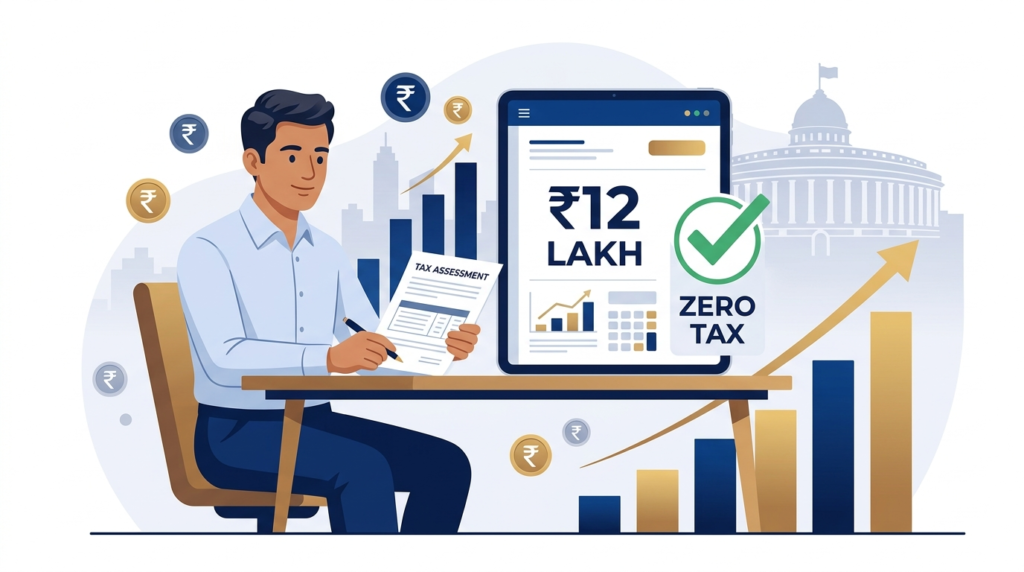
When Finance Minister Nirmala Sitharaman announced in the Union Budget 2025 that Indians earning up to ₹12 lakh would pay zero income tax, it made headlines — and for good reason. For crores of salaried employees, small business owners, and professionals, this was the most significant personal income tax relief in over a decade. Then Budget 2026 came along and confirmed: the rule stays. No rollback. No changes. What was announced in 2025 is now firmly in place for FY 2025-26 and FY 2026-27.
But here is the thing — a lot of people still misunderstand exactly how this works. Is it a blanket exemption? Is it only for salaried people? What if you have mutual fund gains or stock market income on the side? Does the rule apply to NRIs? These are real questions, and getting them wrong could mean either paying tax you do not owe or confidently assuming you owe nothing when you actually do.
This article breaks down the entire 12 lakh tax free rule — the mechanics, the fine print, the marginal relief provision, and the critical exceptions every investor should know before filing their return.
Quick Summary: Under the New Tax Regime for FY 2025-26 (AY 2026-27), resident individuals with taxable income up to ₹12 lakh pay zero income tax, thanks to a Section 87A rebate of ₹60,000. Salaried individuals get an additional standard deduction of ₹75,000, pushing the effective tax-free gross salary to ₹12.75 lakh. Budget 2026 has retained this structure unchanged for FY 2026-27 as well.
What Is the 12 Lakh Tax Free Rule?
The 12 lakh tax free rule is not a flat exemption in the traditional sense. Your income up to ₹12 lakh is not exempt from tax the way, say, agricultural income is. What actually happens is more nuanced: the government calculates your tax liability under the new tax regime slabs, and then cancels it entirely through a rebate under Section 87A of the Income Tax Act — provided your total taxable income does not exceed ₹12 lakh.
The new tax regime slabs for FY 2025-26 (which continue unchanged into FY 2026-27) are structured as follows:
| Annual Taxable Income | Tax Rate |
|---|---|
| Up to ₹4 lakh | Nil |
| ₹4 lakh – ₹8 lakh | 5% |
| ₹8 lakh – ₹12 lakh | 10% |
| ₹12 lakh – ₹16 lakh | 15% |
| ₹16 lakh – ₹20 lakh | 20% |
| ₹20 lakh – ₹24 lakh | 25% |
| Above ₹24 lakh | 30% |
If your total taxable income is, say, ₹10 lakh, the tax calculated under these slabs works out to approximately ₹40,000. The Section 87A rebate of up to ₹60,000 then wipes this out completely. You end up paying zero. That is the 12 lakh rule in practice.
The maximum tax that can be generated on a ₹12 lakh income under these slabs is ₹60,000 — and the rebate is precisely set at ₹60,000 to cancel it out entirely. There is no coincidence here; it is deliberate design by the government.
style=”color:#1A237E; font-size:24px; margin-top:36px; margin-bottom:12px;”> How Does the Section 87A Rebate Work?Section 87A has existed in the Income Tax Act for years, but it used to be a modest benefit — a rebate of ₹12,500 for people earning up to ₹5 lakh. Budget 2025 transformed it into something far more powerful: a rebate of up to ₹60,000 for those earning up to ₹12 lakh under the new tax regime.
Here is how it works in simple terms. After computing your taxable income and applying the slab rates, if your calculated tax liability is less than ₹60,000 and your total income does not cross ₹12 lakh, the rebate kicks in and reduces your tax to zero. If your tax liability is more than ₹60,000 — which means your income exceeds ₹12 lakh — the rebate does not apply, and you pay tax on the full amount under the applicable slabs.
A few conditions apply:
1. You must be a resident individual in India. NRIs cannot claim this rebate.
2. You must opt for the new tax regime. Under the old regime, the 87A rebate limit is still only ₹12,500 for income up to ₹5 lakh.
3. The rebate cannot exceed your total income tax payable before cess.
4. The rebate does not apply to income taxed at special rates — and this is the critical exception that catches many investors off guard.
The Part Investors Often Miss: Capital Gains Are Not Covered
This is probably the single most misunderstood aspect of the 12 lakh tax free rule, especially for people who invest in stocks or mutual funds.
The Section 87A rebate applies only to income taxed at normal slab rates. Income that is taxed at special flat rates — such as short-term capital gains (STCG) under Section 111A and long-term capital gains (LTCG) under Section 112A — is excluded from the rebate calculation. This has been explicitly clarified by the CBDT and codified in the Finance Act 2025.
What this means in practice: suppose you earn ₹8 lakh as salary and ₹2 lakh as short-term capital gains from equity mutual funds. Your total income is ₹10 lakh — which is below the ₹12 lakh threshold. But the ₹2 lakh STCG is taxed at 20% (approximately ₹40,000), and you cannot use the Section 87A rebate to offset this particular tax. You will have to pay ₹40,000 in tax even though your total income is below ₹12 lakh.
If your income includes STCG from listed equity or equity mutual funds (Section 111A) or LTCG from equity above ₹1.25 lakh (Section 112A), you will need to pay tax on those gains separately — even if your total income is below ₹12 lakh. The ₹12 lakh tax free rule does not shelter your capital gains income.
The Salaried Person’s Advantage: ₹12.75 Lakh Tax Free
If you are a salaried employee, you get an extra benefit over and above the ₹12 lakh rebate. The new tax regime allows a flat standard deduction of ₹75,000 from your gross salary. This deduction reduces your taxable income before the slab-based tax calculation even begins.
So if your gross salary is ₹12.75 lakh, the standard deduction of ₹75,000 brings your taxable income down to exactly ₹12 lakh. The tax on ₹12 lakh under the new slabs is ₹60,000, which is fully wiped out by the Section 87A rebate. Your total tax: zero.
In addition, employer contributions to your NPS account (up to 14% of basic salary + DA) are also deductible under Section 80CCD(2) even in the new regime. For those whose employers structure salaries with NPS components, this can push the effective tax-free threshold even higher — potentially up to ₹14.80 lakh or beyond in certain salary structures.
h3 style=”color:#1A237E; font-size:20px; margin-top:28px; margin-bottom:10px;”> How the Tax-Free Threshold Works: A Quick Comparison| Category | Effective Tax-Free Limit |
|---|---|
| Non-salaried resident individual | ₹12,00,000 |
| Salaried individual (with standard deduction) | ₹12,75,000 |
| Salaried + employer NPS contribution (structured) | Up to ~₹14.80 lakh (CTC dependent) |
| NRI | ₹4,00,000 (basic exemption only, no 87A rebate) |
| Old regime (any individual) | ₹5,00,000 (max rebate ₹12,500) |
If you are weighing whether to stay in the old regime because of your 80C investments or home loan interest, you may want to read our detailed comparison: New vs Old Tax Regime: Which One Should You Choose?
Marginal Relief: What Happens When You Earn Just Above ₹12 Lakh?
Here is a scenario that would seem deeply unfair without government intervention: suppose you earn ₹12.10 lakh. Under the new tax slabs, your calculated tax liability jumps to roughly ₹61,500. Meanwhile, your friend earning ₹12 lakh pays zero. You earned only ₹10,000 more, but you owe ₹61,500 more in tax? That cannot be right.
The government recognised this and introduced marginal relief. Under marginal relief, the additional tax you pay cannot exceed the additional income you earned over ₹12 lakh. So in the above example, since you earned ₹10,000 above the threshold, your maximum tax liability is capped at ₹10,000 — not ₹61,500.
Marginal relief applies to individuals earning between ₹12 lakh and ₹12.75 lakh under the new tax regime. Once your income crosses ₹12.75 lakh, you no longer qualify — the full slab-based tax applies with no relief on the rebate side. (Separate marginal relief exists for high-income taxpayers above ₹50 lakh where surcharge kicks in, but that is a different provision.)
Marginal Relief Example:
Income: ₹12,10,000 | Normal tax (slab): ~₹61,500 | Excess income over ₹12L: ₹10,000
Since ₹61,500 > ₹10,000, marginal relief caps tax at ₹10,000 (plus applicable 4% health and education cess).
Final tax payable: approximately ₹10,400.
The 12 Lakh Rule in the New Tax Act 2025 Context
Budget 2026 also marked the arrival of the new Income Tax Act 2025, which comes into effect from 1 April 2026. This replaces the Income Tax Act of 1961 — a law that had been in force for over six decades. The new Act primarily simplifies the language and structure of tax law rather than introducing sweeping changes to rates or slabs.
One notable change in terminology: the familiar terms “Financial Year” and “Assessment Year” are being replaced by a single unified term — “Tax Year”. So what was previously called AY 2026-27 will now simply be Tax Year 2026-27. This does not change any actual tax computation or rates; it is a language and administrative simplification.
For the ITR filing deadline, note that the due date for filing ITR-3 and ITR-4 for non-audit taxpayers has been extended to 31 August from FY 2026-27 onwards, giving professionals and business owners more time to file.
Who Should Stay in the New Regime vs the Old Regime?
The new tax regime is the default from FY 2025-26 onwards. That means if you do not explicitly choose the old regime, the government assumes you are under the new one. You can still switch to the old regime if it works better for you — but you have to actively opt in.
The new regime generally works better if:
1. Your income is ₹12 lakh or below (zero tax, obviously).
2. You do not have major deductions — no HRA, no home loan interest, limited 80C investments, or modest 80D premiums.
3. Your income is between ₹12 lakh and approximately ₹15 lakh and your deductions are under ₹3.75 lakh.
4. You value simplicity and want fewer compliance requirements.
The old regime can still win if you have substantial deductions — particularly home loan interest (Section 24), HRA, heavy 80C investments (PPF, ELSS, life insurance), or significant medical insurance premiums (80D). For someone with a ₹50,000 HRA exemption, ₹1.5 lakh in 80C, and ₹25,000 in health insurance, the old regime can lower their taxable income considerably, and that may outweigh the new regime’s lower slab rates.
Looking to reduce your tax outgo beyond what the regime offers? Start with these investments: Best Tax Saving Investments in India Under Section 80C.
e=”color:#1A237E; font-size:24px; margin-top:36px; margin-bottom:12px;”> When Not to Rely on a Google Search — Talk to a Tax Expert InsteadThe internet is an excellent starting point for understanding general tax rules. But India’s tax law has enough complexity that Google can lead you astray in specific situations. Here are the cases where you genuinely need a qualified tax consultant or chartered accountant, not a search engine:
1. You have multiple income sources — salary, business income, rental income, and capital gains all in the same year. The interaction between these and rebate eligibility can get complicated quickly.
2. You are an NRI or have foreign income. The 87A rebate, the new regime, and DTAA (Double Tax Avoidance Agreements) all interact in ways that require professional advice.
3. You have significant capital gains from stocks or mutual funds. Understanding which gains are rebate-eligible, which are not, and how to time your redemptions for tax efficiency is best done with expert guidance.
4. You switched jobs mid-year. Your Form 16 might not capture everything correctly, and the choice of regime might need to be recalculated based on your complete annual picture.
5. You received ESOPs or RSUs. These are among the most commonly mishandled items in Indian tax filing, with perquisite values, vesting schedules, and capital gains all playing a role.
6. You are filing a revised or belated return. The revised return deadline is now 31 March of the tax year, and filing after 31 December attracts an additional fee — getting these timelines right matters.
7. You are starting or winding down a business. Business closures, asset sales, and goodwill-related transfers involve capital gains considerations that a generic online guide cannot fully cover.
A good CA fee is almost always less than the tax you might overpay — or the penalty you might attract — by relying solely on internet research for complex situations.
Commonly Confused Situations Around the 12 Lakh Rule
“My salary is ₹14 lakh — can I get to zero tax?”
Possibly, but only if your salary package is structured to include employer NPS contributions under Section 80CCD(2). A salaried person with a CTC of ₹14.80 lakh where the employer contributes to NPS can see their taxable income fall below ₹12 lakh after accounting for the standard deduction and the NPS deduction. This requires deliberate salary structuring — it does not happen automatically. Ask your HR or finance department about this option.
“I earn ₹9 lakh salary and ₹4 lakh from stock trading — do I still pay zero?”
Not entirely. Your salary income of ₹9 lakh (after ₹75,000 standard deduction, taxable at ₹8.25 lakh) qualifies for the rebate. But if the ₹4 lakh is short-term capital gains on listed equity under Section 111A, those gains are taxed at 20% and are outside the rebate calculation. You will pay approximately ₹80,000 in tax on those gains even though your salary portion attracts zero tax.
“My total income is ₹11.80 lakh, including ₹1 lakh in LTCG from equity mutual funds”
Since the LTCG amount is ₹1 lakh, which is below the ₹1.25 lakh exemption threshold under Section 112A, you owe no capital gains tax on this. Your remaining income of ₹10.80 lakh (below ₹12 lakh) qualifies for the full 87A rebate. Net result: zero tax. This is one scenario where planning your redemptions to keep LTCG below ₹1.25 lakh can preserve your zero-tax status.
Managing your mutual fund capital gains tax smartly is part of a broader SIP and redemption strategy. Here is more on that: How to Save Tax on Mutual Fund Capital Gains in India.
Benefits of the New Tax Regime’s 12 Lakh Rule
The 12 lakh tax free structure under the new regime offers several meaningful advantages for India’s middle class:
1. Higher take-home pay without needing to lock money into tax-saving instruments. Under the old regime, you had to invest ₹1.5 lakh in 80C instruments to reduce taxable income. Under the new regime, none of that is required if your income is under ₹12 lakh.
2. Simpler compliance. The new regime has fewer deductions to track, fewer investment proofs to submit, and a generally lower documentation burden.
3. Flexibility. Since you are not compelled to invest in 80C instruments for tax savings, you can choose investments purely based on your financial goals — not because of tax benefits.
4. Improved liquidity. Money that would have gone into ELSS lock-in periods or PPF can now flow into more liquid options like diversified equity funds or short-term debt funds based on your needs.
Risks and Limitations of the New Regime
The new regime is not perfect for everyone. There are real trade-offs:
1. No HRA exemption. For salaried individuals living in rented accommodation in metro cities, HRA exemptions under the old regime can be substantial — sometimes ₹2–4 lakh per year. The new regime does not offer this.
2. No home loan interest deduction. If you have a large home loan and are in the repayment phase with significant interest outgo, the old regime’s Section 24 deduction (up to ₹2 lakh for self-occupied property) may serve you better.
3. No 80C benefits. PPF, ELSS, NPS (own contribution), life insurance premiums — none of these qualify as deductions in the new regime. If you are already committed to these investments, you may actually get more tax benefit by sticking with the old regime.
4. Capital gains are not sheltered. As discussed earlier, special-rate income like equity capital gains sits outside the zero-tax umbrella, which can surprise investors who were expecting complete tax freedom.
For a comprehensive government-level reference on the Section 87A rebate and new tax regime, refer to the Income Tax India Portal. You can also use the official ClearTax Income Tax Calculator to compare your liability under both regimes before filing.
Key Takeaways
1. Under the new tax regime, resident individuals with taxable income up to ₹12 lakh pay zero income tax, courtesy of a Section 87A rebate of ₹60,000. This was introduced in Budget 2025 and confirmed in Budget 2026.
2. Salaried employees get an additional standard deduction of ₹75,000, making gross salary up to ₹12.75 lakh effectively tax-free.
3. The rebate does not cover income taxed at special rates — particularly STCG from listed equity/mutual funds (Section 111A) and LTCG from equity above ₹1.25 lakh (Section 112A).
4. NRIs are not eligible for this rebate. It applies only to resident individuals.
5. Marginal relief protects those earning between ₹12 lakh and ₹12.75 lakh from disproportionately high taxes.
6. The new tax regime is now the default. You must opt in to the old regime if you want to claim HRA, 80C, or home loan interest deductions.
7. The new Income Tax Act 2025 takes effect from 1 April 2026, replacing the 1961 Act, with new terminology but broadly similar rules.
Frequently Asked Questions
Is income up to ₹12 lakh completely tax-free in India in 2026?
Yes, for resident individuals under the new tax regime. A Section 87A rebate of ₹60,000 cancels out the tax liability on taxable income up to ₹12 lakh. However, income taxed at special rates — such as capital gains from equity investments — is not covered by this rebate and must be paid separately.
Does the ₹12 lakh tax free rule apply to all types of income?
No. The Section 87A rebate applies to income taxed at normal slab rates — salary, business income, interest income, and similar sources. Income from equity mutual fund STCG (Section 111A), equity LTCG above ₹1.25 lakh (Section 112A), and other special-rate income remains taxable even if your total income is below ₹12 lakh.
Can NRIs claim the ₹12 lakh tax free benefit?
No. The Section 87A rebate is available exclusively to resident individuals in India. Non-resident Indians (NRIs) are taxed from the first rupee of Indian income beyond the basic exemption limit of ₹4 lakh under the new regime, with no access to the rebate.
What is marginal relief and who benefits from it?
Marginal relief is a provision that ensures taxpayers earning just above ₹12 lakh do not pay more tax than the incremental income they earned. It caps additional tax liability at the amount by which income exceeds ₹12 lakh. Marginal relief applies under the new regime for incomes between ₹12 lakh and ₹12.75 lakh.
Has Budget 2026 changed the 12 lakh tax free rule?
No. Budget 2026 has retained the income tax structure announced in Budget 2025 without any changes. The ₹12 lakh zero-tax threshold, the ₹60,000 Section 87A rebate, the ₹75,000 standard deduction for salaried individuals, and all slab rates remain identical for FY 2026-27.
Should I switch to the new tax regime to benefit from the ₹12 lakh rule?
The new regime is already the default. If you have not actively opted for the old regime, you are already in the new one. For most taxpayers earning up to ₹12 lakh with modest deductions, the new regime results in zero tax. But if you have significant HRA, home loan interest, or 80C deductions, calculate your liability under both regimes — or consult a CA — before deciding.
Conclusion
The 12 lakh tax free rule is genuinely one of the most generous income tax reliefs India has seen in recent memory. For middle-income earners — particularly those without large deductions or equity capital gains — it delivers real, tangible benefit: more money staying in your pocket without having to lock it into any investment scheme to qualify.
But like most things in personal finance, the devil lives in the details. The capital gains exception is real and significant for investors. The NRI exclusion is firm. And the choice between new and old regime is not always obvious, especially as incomes cross ₹12 lakh or when HRA and home loan deductions are in play.
Take the time to understand your complete income picture — salary, interest, rental income, capital gains — before assuming zero tax. And when in doubt, a session with a chartered accountant before filing season is almost always worth the fee.
Disclaimer: This article is for educational and informational purposes only. Tax laws are subject to change. Please consult a qualified chartered accountant or tax advisor for advice specific to your financial situation before making any tax-related decisions.
Leave a Reply