
Big Changes From April 1, 2026: New Income Tax Act, Revised Salary Structure & Everything Every Indian Must Know
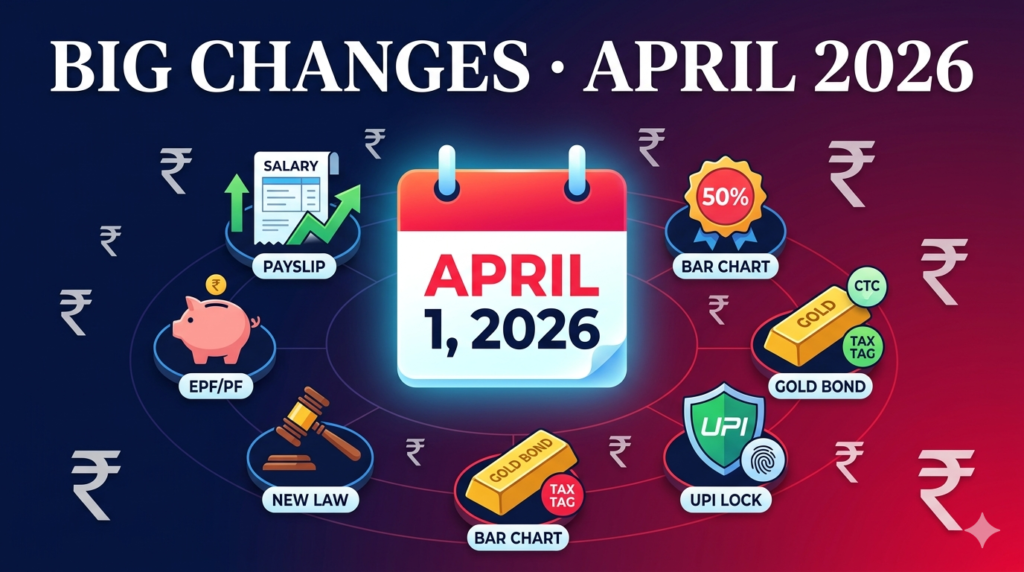
April 1 is not just the beginning of a new financial year — in 2026, it marks one of the most sweeping overhauls of India’s financial, tax, and labour landscape in decades. From the death of the 65-year-old Income Tax Act, 1961 to radical changes in your salary slip, EPF contributions, HRA exemptions, SGB taxation, UPI security rules, and even how you use your PAN card — nearly every Indian is affected.
If you earn a salary, invest in mutual funds or gold bonds, pay rent, or simply use UPI for daily payments, this guide will walk you through every major change effective April 1, 2026 — in plain, simple language. Bookmark this page; you’ll need it for Tax Year 2026 planning.
📋 Table of Contents
- Salary Structure Is Changing — What Happens to Your Take-Home?
- In-Hand Salary vs. Retirement Corpus: The EPF Trade-Off
- Full & Final Settlement: From 90 Days to 2 Days
- New Income Tax Act 2025: Replacing a 65-Year-Old Law
- Introduction of “Tax Year” — No More Assessment Year Confusion
- New Income Tax Rules 2026: Allowances, HRA & More
- Revised PAN Usage Limits for Financial Transactions
- SGB Taxation & STT Hike for Traders
- New RBI Rules: BSBD Accounts & Online Payment Security
- Other Minor But Important Changes
- Real-Life Case Study: How These Changes Hit Rahul’s Wallet
- Common Mistakes to Avoid
- FAQs
- Conclusion & Action Plan
1 Salary Structure Is Changing — What Happens to Your Take-Home?
This is probably the most impactful change for salaried professionals in the private sector. Under the new wage code rules effective April 1, 2026, the definition of “wages” has been standardised across India.
Until now, most companies structured your CTC so that the basic salary was just 25–40% of your total CTC. The rest was packed into various allowances (HRA, LTA, special allowance, etc.) to keep EPF and gratuity contributions artificially low — which benefited both the company and, somewhat, the employee in terms of take-home pay.
That era is over. The new uniform wage definition mandates:
Wages = Basic Pay + Dearness Allowance (DA) + Retaining Allowance must be at least 50% of your total CTC. Since DA and retaining allowance are rare in private sector jobs, this effectively means your Basic Salary must be at least 50% of CTC.
| Earlier | Now (From April 1, 2026) | Impact on You |
|---|---|---|
| Basic salary = 25–40% of CTC | Wages (Basic + DA) must be ≥ 50% of CTC | Basic salary jumps to 50% of CTC for most private sector employees |
| PF & gratuity calculated on low basic | PF & gratuity calculated on higher base | Your PF deduction and employer’s PF contribution both increase |
Example: If your CTC is ₹12 lakh per year, your basic salary must now be at least ₹6 lakh per annum (₹50,000/month), regardless of how the company structures the rest of your pay.
Ask your HR department for a revised salary breakup sheet. Many companies are restructuring CTCs. Don’t assume your old payslip is still valid from April 2026 onwards.
2 In-Hand Salary vs. Retirement Corpus: The EPF Trade-Off
The direct consequence of a higher basic salary is a change in your EPF (Employee Provident Fund) contribution. EPF is calculated at 12% of your basic salary — both from you and from your employer.
| Earlier | Now (From April 1, 2026) | Impact |
|---|---|---|
| Lower basic → lower EPF deduction → higher take-home | Higher basic → higher EPF deducted monthly | Monthly take-home may drop slightly, but retirement savings grow significantly faster |
Let’s crunch real numbers. Say you earn a CTC of ₹10 lakh/year:
- Old structure: Basic = ₹30,000/month → EPF (employee share) = ₹3,600/month
- New structure: Basic = ₹41,667/month (50% of ₹10L/12) → EPF (employee share) = ₹5,000/month
- Your take-home drops by approximately ₹1,400/month, but your PF corpus grows ₹1,400 faster every month — plus your employer contributes equally.
A higher EPF corpus earns 8.25% interest (tax-free at maturity if withdrawn after 5 continuous years of service). Over a 30-year career, this compounding effect can add tens of lakhs to your retirement wealth. Think of it as a forced, tax-efficient SIP into your future.
Gratuity calculation also benefits. Since gratuity = (15 × Last Basic Salary × Years of Service) / 26, a higher basic means a significantly larger gratuity payout when you leave or retire.
3 Full & Final Settlement: From 90 Days to Just 2 Working Days
If you’ve ever left a job in India, you know the pain of waiting endlessly for your Full & Final (F&F) settlement. It could take anywhere from 30 to 90 days — sometimes even longer — to receive your last salary, leave encashment, and other dues.
Under the new labour codes, effective April 1, 2026: Companies must process and pay Full & Final settlement within 2 working days of the employee’s last working day.
This is a massive worker-friendly reform. It means:
- No more chasing your ex-employer for pending salary
- Leave encashment, pending reimbursements, and gratuity dues must be cleared promptly
- Companies that delay face penalties under the new wage code
This rule applies once the new wage codes are fully implemented. Ensure you have a documented last working day letter from your employer before serving notice, as the 2-day clock starts from that date.
4 New Income Tax Act 2025: Replacing a 65-Year-Old Law
This is historic. From April 1, 2026, India’s 65-year-old Income Tax Act, 1961 stands officially replaced by the new Income Tax Act, 2025.
The old Act had accumulated over six decades of amendments, provisos, explanations, and sub-sections — making it notoriously complex for taxpayers and professionals alike. The new Act is designed to be simpler, cleaner, and more taxpayer-friendly.
The new Income Tax Act 2025 aims to consolidate, simplify, and modernise India’s direct tax framework — reducing ambiguity, improving compliance, and making the law accessible to ordinary citizens.
Key structural changes include streamlined sections, plain-language drafting, and the removal of redundant provisions. The tax slabs under the new regime (which became the default regime in FY 2023–24) remain unchanged, but the administrative framework around them is significantly modernised.
Your tax liability calculations remain largely the same. However, references like “Section 80C,” “Section 10(14)” will now have new numbering under the new Act. Your CA or tax software will handle this transition, but be aware that forms and references are changing.
5 Introduction of “Tax Year” — No More Assessment Year Confusion
One of the most confusing aspects of Indian income tax has always been the dual terminology: Previous Year (the year you earn income) and Assessment Year (the year you file taxes for the previous year’s income). This created perpetual confusion — “Am I filing for AY 2025–26 or FY 2024–25?”
| Earlier | Now (From April 1, 2026) | Practical Meaning |
|---|---|---|
| Two terms: Previous Year (income earned) + Assessment Year (tax filed) | Single unified term: Tax Year | Tax Year = the year you earn income AND file taxes for it |
| Filing FY 2024–25 income in AY 2025–26 was confusing | Tax Year 2026 = income earned April 2025 – March 2026 | Simpler, cleaner, far less confusing for everyone |
If you earned income between April 2025 and March 2026, you’re filing your Tax Year 2026 return. Simple.
6 New Income Tax Rules 2026: Allowances, HRA & More
On March 20, 2026, the government approved the new income tax rules 2026, effective April 1. These bring major relief in several exemption categories that hadn’t been revised in decades.
6a. Education & Hostel Allowance — Massive Jump
| Feature | Earlier | Now (From April 1, 2026) |
|---|---|---|
| Education Allowance exemption limit | ₹100/month per child (up to 2 kids) | ₹3,000/month per child (up to 2 kids) |
| Hostel Allowance exemption limit | ₹300/month per child (up to 2 kids) | ₹9,000/month per child (up to 2 kids) |
The old limits of ₹100 and ₹300 per month were set decades ago and were completely meaningless in today’s school fee environment. The revised limits — ₹3,000 and ₹9,000 — finally reflect reality.
6b. HRA Exemption Now Covers 8 Cities
| Feature | Earlier | Now (From April 1, 2026) |
|---|---|---|
| 50% HRA exemption cities | 4 cities: Mumbai, Delhi, Chennai, Kolkata | 8 cities: Added Bengaluru, Hyderabad, Ahmedabad, Pune |
| Rent scrutiny | No landlord relationship disclosure | Must declare relationship with landlord if annual rent > ₹1 Lakh |
If you live in rented accommodation in Bengaluru, Hyderabad, Pune, or Ahmedabad and pay rent above ₹8,333/month, you now qualify for the higher 50% HRA exemption — same as Mumbai and Delhi employees. This can meaningfully reduce your taxable income.
6c. Gift Vouchers, Meal Coupons & Employer Loans
| Particulars | Earlier | Now (From April 1, 2026) |
|---|---|---|
| Gift Voucher Exemption | ₹5,000 per year | ₹15,000 per year |
| Meal Coupon Exemption | ₹50/meal → ~₹26,400/year | ₹200/meal → ~₹1,05,600/year |
| Interest-Free Loan from Employer | ₹20,000 exemption | ₹2,00,000 exemption |
The meal coupon revision is particularly significant. If your company offers a meal benefit through tools like Zeta or Sodexo, your annual tax-free meal benefit has jumped from ₹26,400 to over ₹1 lakh. Optimise your salary structure accordingly with your HR team.
7 Revised PAN Usage Limits for Financial Transactions
PAN card thresholds for mandatory quoting in financial transactions have been significantly revised under the new Income Tax Act 2025. This is aimed at rationalising compliance while also enhancing tracking of large transactions.
| Transaction | Earlier (PAN Required) | Now (From April 1, 2026) |
|---|---|---|
| Cash Deposits | > ₹50,000 per day | ₹10 Lakh per year (aggregate) |
| Vehicle Purchase | All (excluding 2-wheelers) | Value > ₹5 Lakh |
| Hotel / Event Bills | > ₹50,000 | > ₹1 Lakh |
| Property Purchase | > ₹10 Lakh | > ₹20 Lakh |
The shift from per-day to per-year aggregate for cash deposits is more nuanced — it captures large depositors who spread deposits across multiple days to avoid the old ₹50,000 threshold. Routine small cash transactions are largely unaffected.
8 SGB Taxation & STT Hike: What Investors Need to Know
8a. Sovereign Gold Bond (SGB) Taxation Changes
| Particulars | Earlier | Now (From April 1, 2026) |
|---|---|---|
| SGB Maturity Gains (Tax) | 100% tax-free for all investors | Tax-free only for original RBI-issue buyers |
| Secondary Market SGB Buyers | Tax-free at maturity | Pay 12.5% LTCG or applicable STCG (whichever applies) |
This is an important change for gold investors who buy SGBs from the secondary market (via NSE/BSE). If you bought SGBs at a discount in the open market and were hoping for tax-free maturity proceeds — that benefit is now gone. Only those who subscribed directly through RBI issuances can still claim tax-free maturity.
8b. STT Hike for F&O Traders
| Segment | Earlier STT Rate | New STT Rate (From April 1, 2026) |
|---|---|---|
| Equity Futures | 0.02% | 0.05% |
| Equity Options | 0.125% | 0.15% |
The STT hike will directly increase your trading costs. High-frequency options traders will feel this most acutely. Factor in the new STT rates when calculating break-even points and strategy profitability.
8c. Revised Return Timeline
The deadline for filing a Revised Return has been extended from 9 months to 12 months from the end of the relevant Tax Year. This gives taxpayers more time to correct errors in their original returns.
Even though the extended deadline is 12 months, filing a revised return after 9 months will attract a late fee. The sweet spot remains filing your revised return within 9 months to avoid penalties.
8d. New Taxation Form Names
| Old Form Name | New Form Code | Description |
|---|---|---|
| Form 16 | Form 130 | Salary TDS certificate from employer |
| Form 26AS / AIS | Form 168 | Summary of all taxes linked to your PAN |
| Form 16A | Form 131 | TDS certificate for non-salary income |
| Form 26Q | Form 140 | TDS return for non-salary payments |
While the forms have been renumbered, the information they contain remains the same. Your employer’s payroll team and your tax software providers will generate the new form numbers automatically.
9 New RBI Rules: BSBD Accounts & Online Payment Security
9a. Upgraded Basic Savings Bank Deposit (BSBD) Account Rules
The RBI has issued new directions governing Basic Savings Bank Deposit (BSBD) accounts — the zero-balance savings accounts designed for financial inclusion. The upgraded rules bring BSBD accounts in line with modern banking needs.
| Feature | Earlier | Now (From April 1, 2026) |
|---|---|---|
| Digital Banking (Internet/Mobile) | Often restricted or paid | Mandatory & Free |
| Debit Card | Only ATM card (sometimes paid) | Free ATM-cum-Debit Card (no issuance/annual fee) |
| Cheque Book | Not guaranteed | Minimum 25 free leaves/year (on request) |
| Digital Payments (UPI, NEFT, IMPS) | Counted as “withdrawals” (limited) | Unlimited & Free (don’t count as withdrawals) |
| Cash Withdrawals | 4 free per month (total) | 4 free cash/ATM withdrawals (digital payments are separate & unlimited) |
If you or someone you know has a Jan Dhan or BSBD account, these upgrades are significant. Free unlimited UPI transactions, a proper debit card, and internet banking at zero cost are now rights, not privileges.
9b. Mandatory Multi-Factor Authentication for Online Payments
The RBI is significantly tightening security for all digital payments — UPI, cards, wallets, and net banking. Every payment will now require at least two distinct layers of verification from different categories:
- Something you know — PIN, password, or pattern
- Something you have — your registered mobile/device or card
- Something you are — fingerprint or face recognition (biometrics)
| Feature | Current Rules | New Rule (From April 1, 2026) |
|---|---|---|
| Required Factors | Often just a PIN or a single OTP | Must use at least two factors from different categories |
| Dynamic Security | Static PINs reused for every transaction | At least one factor must be dynamic (unique to that transaction) |
| Biometric Integration | Optional for most apps | Encouraged as primary inherence factor to prevent SIM-swap fraud |
SIM-swap fraud — where criminals clone your SIM to receive OTPs — has been rising. The new multi-factor authentication requirement means a stolen OTP alone will no longer be enough to authorise a payment. Your physical device or biometric confirmation adds a crucial second layer.
For more information, refer to the Reserve Bank of India’s official website for the full circular on payment security guidelines.
10 Other Minor But Important Changes
FASTag Annual Pass Price Revision
The FASTag Annual Pass price has been revised upward from ₹3,000 to ₹3,075. A modest increase, but worth noting if you’re a frequent highway user.
TCS on Overseas Tour Packages — Simplified
| Earlier | Now (From April 1, 2026) |
|---|---|
| Below ₹7L → 5% TCS; Above ₹7L → 20% TCS | Uniform 2% TCS on all overseas tour packages (regardless of amount) |
This is a massive relief for international travellers. The earlier 20% TCS for packages above ₹7 lakh was a significant cash-flow burden (even though it was creditable against your tax liability). The flat 2% rate is far more manageable.
Crypto Asset Disclosure — New Penalties
- Crypto assets not properly disclosed: ₹200 penalty per day
- Wrong details reported and not corrected: ₹50,000 penalty
If you hold cryptocurrency or virtual digital assets, ensure your ITR Schedule VDA is accurately and completely filled. The penalties for non-compliance are now explicitly defined.
📊 Real-Life Case Study: How April 2026 Changes Hit Rahul’s Finances
Rahul is a 32-year-old software engineer in Bengaluru earning a CTC of ₹15 lakh per year. He lives in a rented flat (₹25,000/month rent), has two school-going children, invests in SGBs, and trades options occasionally.
Here’s how April 1, 2026 changes affect him:
- Salary Restructuring: His basic salary jumps from ₹45,000 to ₹62,500/month (50% of ₹15L/12). His EPF deduction increases by ~₹2,100/month, reducing take-home slightly but building his retirement corpus faster.
- HRA Benefit: Bengaluru is now in the 50% HRA exemption category. Rahul’s HRA exemption increases — saving him approximately ₹12,000–₹18,000 in annual taxes depending on his actual HRA amount.
- Children’s Allowances: Rahul claims ₹3,000/month education allowance (₹36,000/year tax-free) and ₹9,000/month hostel allowance for his child in a boarding school — saving significant tax.
- Meal Coupons: His employer offers a meal benefit — now up to ₹1,05,600 per year is tax-free. He opts for the maximum, saving roughly ₹21,000–₹33,000 in taxes depending on his slab.
- SGB Holding: Rahul has some SGBs bought from the secondary market. He now knows his maturity proceeds will be subject to 12.5% LTCG — factors this into his gold investment planning.
- Options Trading: His STT per trade increases. He recalculates his break-even for options strategies accordingly.
- Tax Year Filing: No more confusion — he’ll simply file his Tax Year 2026 return (income April 2025 – March 2026) by July 2026.
Net outcome for Rahul: A slightly lower monthly take-home but significantly higher HRA savings, allowance benefits, and long-term retirement corpus growth.
💡 Key Insights & Expert Tips for April 2026
- Revisit your salary structure immediately. Meet your HR and ask for a revised CTC breakup. Maximise tax-free components — meal coupons, education allowance, hostel allowance, interest-free loans, and gift vouchers.
- If you’re in Bengaluru, Hyderabad, Pune, or Ahmedabad: Make sure your employer’s payroll team is now using the 50% HRA exemption for your city rather than the old 40%.
- SGB investors: Clearly identify whether your SGBs are from primary RBI issuance (tax-free at maturity) or secondary market purchases (now taxable). Maintain separate records.
- F&O traders: Recalculate your net strategy returns factoring in the new STT rates. High-frequency option sellers will feel the pinch more than occasional buyers.
- Crypto holders: Ensure your VDA schedule in ITR is accurately filled. The penalty for non-disclosure is now ₹200 per day — an amount that compounds quickly.
- Update biometrics on your banking apps. The new MFA requirements mean your fingerprint or face ID will be your most secure payment tool.
- Plan overseas travel early. The TCS on travel packages drops to a flat 2% — significantly better for big-ticket international trips. But remember, this is still creditable against your tax, so keep documentation.
🚫 Common Mistakes to Avoid in FY 2026
- Assuming your old payslip is still valid. Companies are restructuring CTCs. Always get a new salary breakup from your HR after April 1, 2026.
- Missing out on enhanced allowance exemptions. Many employees don’t submit declarations to their employer. You must actively claim meal coupons, education allowance, and hostel allowance.
- Treating all SGBs as tax-free. Only primary market (RBI issuance) SGBs are tax-free at maturity. Secondary market buys are taxable. Don’t make this error in your ITR.
- Filing a revised return after 9 months thinking you have 12 months without penalty. The extension to 12 months comes with a late fee after the 9-month mark.
- Not declaring crypto assets. The ₹200/day penalty for non-disclosure accumulates fast. Disclose all VDAs in your ITR, regardless of whether you made a profit or loss.
- Not updating landlord details for rent above ₹1 lakh per year. The new rules require you to declare your relationship with your landlord for high rents. Failing to do so could trigger scrutiny.
- Ignoring the F&F settlement 2-day rule. When leaving a job, give a written last-working-day notice. The 2-day settlement clock starts from your documented last day.
📚 Related Articles on Investopedia India
🔗 Useful External Resources
- Income Tax India — Official Portal (incometaxindia.gov.in) — File returns, check Form 168 (ex-26AS), TDS details
- Reserve Bank of India (rbi.org.in) — BSBD account directions and payment security circulars
- Ministry of Labour & Employment (labour.gov.in) — New wage code implementation details
- SEBI (sebi.gov.in) — STT changes and securities market regulations
- EPFO (epfindia.gov.in) — Check your revised PF contributions and passbook
❓ Frequently Asked Questions (FAQs)
✅ Conclusion & Your April 2026 Action Plan
April 1, 2026 is not just a new financial year — it’s a genuine inflection point for millions of Indians. The changes span your salary slip, your tax filing experience, your investment returns, and even how you verify a UPI payment.
The good news is that most of these changes are either neutral or net-positive for regular Indians: higher HRA benefits for more cities, massively improved allowance limits, faster F&F settlement, better BSBD account features, and a simplified tax law.
The areas that require careful attention are: the SGB taxation change for secondary market buyers, the STT hike for F&O traders, and the crypto disclosure penalties.
Here’s your 5-step action plan:
- 📋 Request a revised salary breakup from your HR team
- 🏠 Recalculate your HRA exemption if you’re in Bengaluru, Hyderabad, Pune, or Ahmedabad
- 📜 Check whether your SGBs are primary or secondary market — plan tax accordingly
- 💻 Ensure your banking app has biometrics enabled for payment security
- 🗂️ Start your Tax Year 2026 documentation early — new forms, new terminology
Leave a Reply