
How to Improve Your CIBIL Score from 600 to 750+ Fast — Complete Guide for Indians
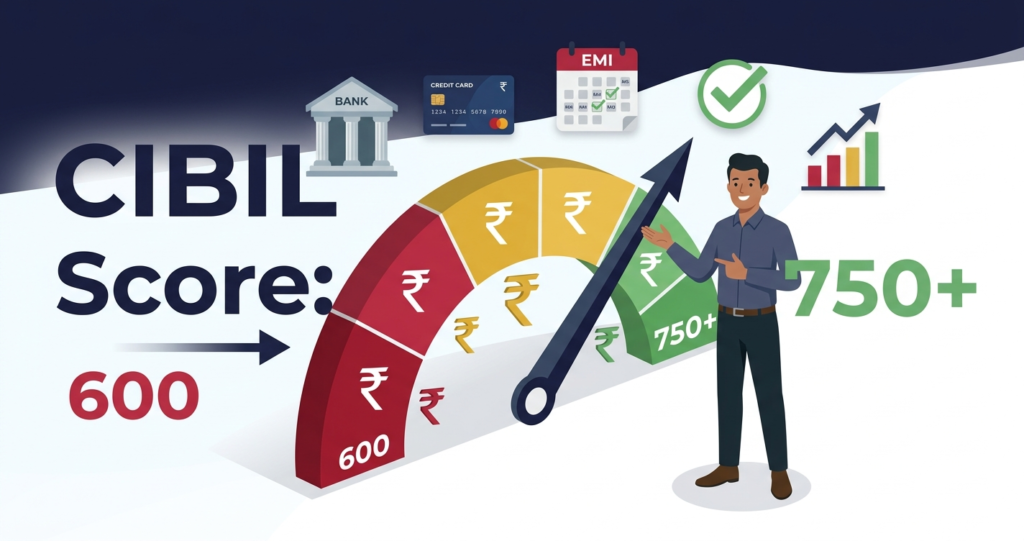
Stuck with a low CIBIL score? Loan rejections, high interest rates, no credit card approvals — it’s frustrating. This guide gives you a clear, step-by-step roadmap to go from 600 to 750+ and unlock the financial opportunities you deserve.
📋 Table of Contents
- What Is a CIBIL Score and Why Does It Matter?
- CIBIL Score Ranges Explained
- 5 Key Factors That Determine Your CIBIL Score
- Step-by-Step: How to Improve CIBIL Score from 600 to 750+
- Realistic Timeline: When Will Your Score Improve?
- Expert Tips to Boost Your Score Faster
- Real-Life Case Study: Ravi’s Journey from 590 to 762
- Common Mistakes That Destroy Your CIBIL Score
- Frequently Asked Questions
- Conclusion
What Is a CIBIL Score and Why Does It Matter?
Your CIBIL score (also called a credit score) is a three-digit number ranging from 300 to 900, calculated by TransUnion CIBIL — India’s most trusted credit bureau. It tells lenders — banks, NBFCs, and fintech companies — how creditworthy you are. The higher your score, the more trustworthy you look to a lender.
Think of it as your financial report card. When you apply for a home loan, car loan, personal loan, or even a credit card, the very first thing a bank checks is your CIBIL score. A score of 750 or above is generally considered excellent, while a score below 650 can lead to instant rejections or sky-high interest rates.
In India today, with credit becoming central to financial life — from EMI-based purchases on Amazon to business loans — your CIBIL score is not just a number. It directly impacts your quality of life, your ability to buy a home, and even how much you pay in interest over decades.
A difference of just 50 points in your CIBIL score can mean a difference of 0.5% to 1% in home loan interest rates. On a ₹50 lakh loan over 20 years, that translates to ₹3–6 lakhs in additional interest payments. Your credit score is one of the most valuable numbers you’ll ever manage.
CIBIL Score Ranges Explained
Before we dive into how to improve your score, let’s understand what different score ranges mean for you as a borrower in India.
| CIBIL Score Range | Category | Loan Eligibility | Typical Interest Rate |
|---|---|---|---|
| 750 – 900 | 🟢 Excellent | Easily approved, best deals | Lowest rates available |
| 700 – 749 | 🟡 Good | Mostly approved | Slightly higher rates |
| 650 – 699 | 🟠 Fair | Conditional approval | Higher rates, stricter terms |
| 600 – 649 | 🔴 Poor | Often rejected or limited | Very high rates, if approved |
| 300 – 599 | ⛔ Very Poor | Mostly rejected | Not applicable |
If your score is around 600, you’re in the “Poor” zone — loans are hard to get, credit cards even harder. But the good news? Moving from 600 to 750 is entirely achievable within 12–18 months with the right approach.
5 Key Factors That Determine Your CIBIL Score
Understanding what goes into your CIBIL score is the foundation of improving it. Here’s a breakdown of the five components and their approximate weightage:
1. Payment History (35% Weightage)
This is the single biggest factor. Every time you miss a loan EMI, delay a credit card payment, or default on a debt, it gets recorded in your credit report and pulls your score down significantly. Conversely, a clean track record of on-time payments is the fastest way to signal creditworthiness to lenders.
2. Credit Utilisation Ratio (30% Weightage)
This is the percentage of your total available credit limit that you’re currently using. If you have a credit card with a ₹1 lakh limit and you’ve spent ₹80,000 on it, your utilisation is 80% — which is too high. Lenders prefer a utilisation rate below 30%. Anything above 50% starts hurting your score noticeably.
3. Length of Credit History (15% Weightage)
The longer your credit history, the better. CIBIL considers the age of your oldest account, the age of your newest account, and the average age across all accounts. This is why closing your oldest credit card — even if you don’t use it — can actually hurt your score.
4. New Credit Enquiries (10% Weightage)
Every time you apply for a new loan or credit card, the lender does a “hard inquiry” on your CIBIL report. Multiple hard inquiries in a short period signal financial desperation and can reduce your score by 5–10 points each time. Apply for credit only when genuinely needed.
5. Credit Mix (10% Weightage)
Having a healthy mix of both secured loans (home loan, car loan) and unsecured credit (credit cards, personal loans) is viewed positively. If all your credit is unsecured, diversifying with a secured loan can improve your score over time.
Step-by-Step: How to Improve CIBIL Score from 600 to 750+
Here is your complete, actionable roadmap. Follow these steps in order and consistently, and you will see significant improvement within 6–18 months.
Get Your Free CIBIL Report & Identify Errors
Before doing anything else, download your free CIBIL report from www.cibil.com (you’re entitled to one free report per year). Read it carefully. Look for accounts you don’t recognise, wrong loan amounts, incorrect “settled” or “written-off” status, or outdated negative entries. Errors in credit reports are more common than you think, and disputing them can give your score an immediate boost of 20–50 points. File a dispute directly through CIBIL’s online portal. Banks are mandated to respond within 30 days.
Never Miss an EMI or Credit Card Payment — Ever
This is non-negotiable. Set up auto-debit mandates for all your loan EMIs and at least the minimum payment on your credit cards. Even a single missed payment can drop your score by 50–100 points. If you’re currently behind on any payments, prioritise clearing overdue amounts immediately. Once you have 6 consecutive months of zero missed payments, you will start seeing a steady improvement in your score.
Reduce Your Credit Card Utilisation Below 30%
If you’re using more than 30–40% of your credit card limit, you need to either pay it down aggressively or request a credit limit increase (without increasing spending). For example, if your credit limit is ₹50,000 and you’ve spent ₹35,000, pay it down to under ₹15,000. This single step alone can add 30–60 points to your score within one billing cycle. If you have multiple credit cards, spread the spending across cards rather than maxing out one.
Clear Outstanding Dues & Negotiate Settlements Carefully
If you have any overdue loans or credit card bills that are more than 90 days past due (marked as NPAs), you need a strategy. Option 1: Pay them in full — this is the best approach for your credit score. Option 2: Negotiate a settlement with the bank. However, be aware that a “settled” status in your CIBIL report is still viewed negatively by lenders (better than a “written off” status, but worse than “closed”). Always try to get accounts marked as “closed” rather than “settled.” After clearing dues, request the bank to update CIBIL accordingly.
Don’t Apply for New Credit Unnecessarily
Every loan or credit card application triggers a hard inquiry that can shave 5–10 points off your score. When you’re in recovery mode (score below 700), be very selective. Stop applying for new credit cards, personal loans, or “buy now pay later” schemes until your score crosses 700. Each hard inquiry stays on your report for 2 years, though its impact fades after 6 months.
Get a Secured Credit Card or Credit-Builder Loan
If you have no credit or very thin credit history, a secured credit card (backed by a Fixed Deposit) is an excellent tool. Banks like SBI, HDFC, and Axis offer secured credit cards against FDs as small as ₹10,000–₹20,000. Use the card for small, regular purchases (groceries, fuel) and pay the full bill every month. This creates a positive payment history without any debt risk. Alternatively, a small personal loan paid back consistently can also build your score effectively.
Keep Old Credit Cards Active (Don’t Close Them)
Many people make the mistake of closing unused credit cards to “simplify” finances. This can actually hurt your score in two ways: it reduces your total available credit (raising your utilisation ratio) and it shortens your average credit history age. Instead, keep old cards active by making one small purchase every 3–6 months and paying it off immediately. If there’s an annual fee, call the bank to waive it or downgrade to a no-fee variant.
Monitor Your CIBIL Score Monthly
Use apps like BankBazaar, PaisaBazaar, CRED, or OneScore to check your CIBIL score for free every month. These platforms do only a “soft inquiry” which doesn’t affect your score. Monthly monitoring helps you track progress, spot any sudden drops (which could indicate fraud or errors), and stay motivated. Set a reminder on the first of every month to check your score and review what’s changed.
Credit card balances are typically reported to CIBIL on your statement date. So even if you pay your full bill by the due date, a high balance on the statement date can temporarily raise your utilisation. Try paying your credit card balance twice a month — once mid-cycle and once before the due date. This keeps your reported balance low and can improve your score faster.
Realistic Timeline: When Will Your CIBIL Score Improve?
Patience is key. Credit score improvement is not instant — it’s a compounding process. Here’s a realistic timeline if you follow all the steps above consistently:
Dispute errors in your credit report. Set up all auto-debits. Clear any overdue amounts. Your score may not change much yet — this is groundwork. You might even see a slight dip if you’re making loan payments that hadn’t been reflected yet.
Consistent on-time payments start reflecting. Disputed errors get corrected. Reduced credit card utilisation starts showing up. Expect your score to rise by 20–40 points from your starting point, moving from ~600 to 620–640.
Six months of clean payment history is a significant milestone. Banks begin to view you more favourably. Your credit utilisation is now consistently below 30%. Score should be in the 650–680 range. Some lenders may start approving secured loans or basic credit cards.
One year of consistent positive behaviour creates a strong track record. Your score should cross 700 comfortably. You may start receiving pre-approved loan offers from banks. At this point, you can selectively apply for one good rewards credit card to further diversify your credit mix.
Eighteen months of disciplined credit behaviour puts you firmly in the excellent zone. Score of 750 and above unlocks the best home loan rates, premium credit cards, and instant loan approvals. Banks will compete for your business rather than the other way around.
Beware of companies claiming to “fix your CIBIL score in 30 days” for a fee. There is no legal shortcut to a good credit score. Only the credit bureaus can update information, and only banks can provide accurate data. Anyone promising overnight fixes is likely a scam. Report such entities to RBI’s consumer grievance portal.
Expert Tips to Boost Your CIBIL Score Faster
🎯 Become an Authorised User on a Family Member’s Card
If a family member (spouse, parent, sibling) has a credit card with a good history and low utilisation, ask to be added as an authorised user. Their positive credit history will appear on your report too, giving your score a meaningful lift without you needing to take on any direct credit responsibility. This is one of the fastest and most underused strategies in India.
🎯 Use the Snowball or Avalanche Method for Multiple Debts
If you have multiple outstanding debts, use the avalanche method: pay off the highest-interest debt first (usually credit card debt at 36–42% p.a.) while making minimum payments on others. Or use the snowball method: pay off the smallest balance first for psychological wins. Either way, the goal is to eliminate high-utilisation, high-cost debt as quickly as possible.
🎯 Request a Credit Limit Increase (Without Spending More)
Call your credit card bank and request a credit limit increase. If approved (and your spending stays the same), your utilisation ratio automatically drops. For example, if you spend ₹20,000/month and your limit goes from ₹50,000 to ₹80,000, your utilisation drops from 40% to 25% — a significant improvement.
🎯 Don’t Use 100% of Your Credit Card Limit Even if You Can Afford It
Just because you can pay the full amount doesn’t mean maxing out your card is fine. CIBIL captures your outstanding balance on the statement date, not whether you paid in full. Always aim to keep your usage below 30% of your limit at all times — including during the statement cycle.
🎯 Consolidate Multiple Small Loans into One
If you have 3–4 small personal loans or BNPL (Buy Now Pay Later) outstanding amounts, consolidating them into a single personal loan with a lower EMI can reduce your “number of open credit accounts” and simplify repayment, reducing the risk of missing any payment.
A lesser-known strategy: ask your employer if they offer salary advances or interest-free loans. Under the new Income Tax Rules effective April 1, 2026, the exemption for interest-free loans from employers has increased from ₹20,000 to ₹2,00,000. Using such a loan to pay off high-interest credit card debt improves your utilisation ratio and saves you significant interest — a double win for your finances and your CIBIL score.
Real-Life Case Study: Ravi’s Journey from 590 to 762
How a 34-Year-Old IT Professional in Bengaluru Fixed His CIBIL Score
Ravi, a software developer earning ₹85,000/month in Bengaluru, had a CIBIL score of 590590 in January 2025. He had two personal loans, three credit cards (two maxed out), and had missed 3 EMIs the previous year due to a medical emergency.
He followed this systematic approach over 14 months:
- Month 1: Downloaded CIBIL report, found one error (a loan marked “written off” that he had actually paid). Disputed it — corrected in 6 weeks. Score: 590 → 618.
- Month 2–3: Negotiated a balance transfer — moved ₹1.2 lakh of credit card debt to a lower-interest personal loan. Set up auto-debit for all EMIs. Score: 618 → 641.
- Month 4–6: Reduced credit card utilisation from 78% to 28% by allocating ₹15,000/month extra towards cards. Stopped all new credit applications. Score: 641 → 683.
- Month 7–12: 12 consecutive months of on-time payments. Requested credit limit increase on one card (approved: ₹50,000 → ₹90,000). Score: 683 → 730.
- Month 13–14: Applied for and received a premium rewards credit card. Continued disciplined usage. Score: 730 → 762.
Ravi’s story is not exceptional — it’s replicable. The key ingredients were: identifying and fixing an error, reducing debt systematically, maintaining zero missed payments, and being patient with the process.
Common Mistakes That Destroy Your CIBIL Score
Knowing what NOT to do is just as important as knowing the right steps. Here are the most common credit score killers that Indians make:
When you “settle” a loan by paying less than the outstanding amount, banks report it to CIBIL as “settled” — not “closed.” This status stays on your report for 7 years and signals to future lenders that you couldn’t repay your full obligation. Always try to pay the full amount or negotiate a “full closure” even if it takes more time.
Your oldest credit account is precious — it establishes your credit history length. Closing it reduces the average age of your credit accounts and can drop your score by 15–40 points. If the card has no annual fee, keep it open with minimal, periodic usage.
When you co-sign or guarantee someone else’s loan, you are equally responsible. If they miss payments, it appears on YOUR CIBIL report too. Many well-intentioned Indians have seen their scores drop 80–150 points because they co-signed a relative’s loan that later defaulted.
Paying just the “minimum amount due” on your credit card bill keeps you in the lender’s good books for the current month but doesn’t actually reduce your debt. Interest compounds at 3–3.5% per month (36–42% annually) on the remaining balance. This keeps your utilisation high and costs you a fortune. Always pay the full statement amount by the due date.
When you apply at 5 different banks simultaneously hoping one will approve you, each triggers a hard inquiry. This signals desperation to lenders and can drop your score by 30–50 points in a short period. Always research before applying and target lenders whose criteria you meet.
A ₹500 unpaid credit card fee from 3 years ago, a forgotten ₹1,200 BNPL balance — these small, forgotten debts can tank your score significantly. Review your CIBIL report annually and clear any outstanding amounts, no matter how small.
Studies suggest a significant percentage of credit reports contain errors. These could be accounts that don’t belong to you (identity fraud), wrong loan amounts, or closed accounts still showing as open. Not checking your report regularly means you could be silently suffering for someone else’s mistake or an administrative error.
Frequently Asked Questions (FAQs)
Conclusion: Your 750+ CIBIL Score Is Within Reach
Improving your CIBIL score from 600 to 750+ is not magic — it’s math, discipline, and time. The framework is simple: pay on time, reduce utilisation, fix errors, avoid unnecessary credit applications, and keep old accounts open. Repeat for 12–18 months and you will get there.
Every point you add to your CIBIL score saves you money in interest, opens more financial doors, and gives you greater control over your financial life. In a world where even renting a premium apartment may require a good CIBIL score, treating your credit score as a valuable asset isn’t optional — it’s essential.
Start today. Download your free CIBIL report, identify the first fix, and begin your journey to 750+.
Leave a Reply