
Big Changes from April 1, 2026: New Tax Rules, Salary Restructuring & RBI Updates Every Indian Must Know
April 1, 2026 is not just the start of a new financial year — it is arguably the most transformative policy reset India has seen in decades. From a brand-new Income Tax Act replacing a 65-year-old law, to salary structures being redrawn, to tighter RBI rules on digital payments — the changes from April 1, 2026 will directly hit your take-home pay, your tax filings, and your investments.
In this in-depth guide, we break down every major change in plain language — what it was before, what it is now, and most importantly, what it means for your wallet. Whether you are a salaried employee, a trader, an investor, or simply someone with a bank account, this article is written for you.
📋 Table of Contents
- Salary Structure Change — Your CTC is Being Restructured
- Take-Home vs. Retirement Corpus — The Trade-Off
- Full & Final Settlement — Now in 2 Working Days
- New Income Tax Act 2025 Replaces 1961 Act
- Introduction of “Tax Year” — No More Confusion
- New Income Tax Rules 2026 — Education, HRA, Perks
- STT Hike, SGB Tax, TCS on Travel & More
- PAN Card Usage — Limits Revised
- New RBI Rules — BSBD Accounts & Digital Payment Security
- Key Expert Tips
- Real-Life Case Study
- Common Mistakes to Avoid
- FAQs
- Conclusion
1. Salary Structure Change — Your CTC is Being Restructured BIG CHANGE
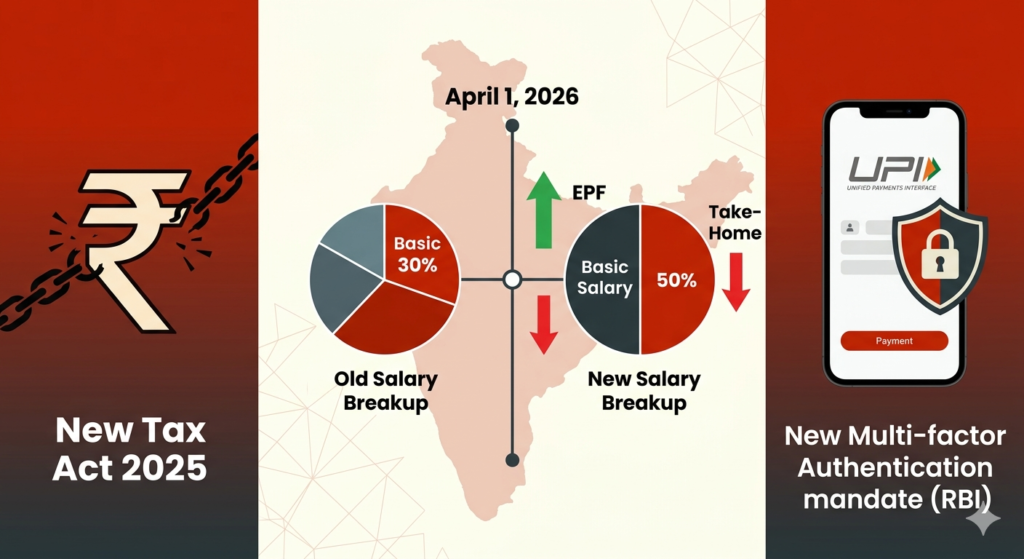
This is perhaps the change that will affect the most Indians immediately. Under the new Labour Code / Wage Code, the definition of “wages” has been standardised, and it will now mandate that Base Salary + DA + Retaining Allowance must equal at least 50% of your CTC.
In the past, most private sector companies kept the basic salary component at just 25–40% of CTC. This was done to reduce statutory obligations like PF, gratuity, and bonus — all of which are calculated on the basic component. With the new rule, this loophole is effectively closed.
| Component | Earlier (Before April 1) | Now (From April 1, 2026) |
|---|---|---|
| Basic Salary | 25–40% of CTC | Minimum 50% of CTC |
| Wage Definition | Varies company to company | Uniform: Base + DA + Retaining Allowance |
| PF Calculation | On lower basic (saving employer money) | On higher base — more PF deducted |
| Gratuity Calculation | On lower basic | On higher base — larger gratuity corpus |
If your current CTC is ₹12 lakhs and your basic is ₹3.5 lakhs (29%), your employer will need to revise the salary structure. Your basic may be pushed to ₹6 lakhs (50%), increasing your PF deduction but also your long-term retirement savings and gratuity eligibility.
Why Were Companies Keeping Basic Low?
PF is computed at 12% of basic salary by both the employee and the employer. A lower basic meant lower PF outflow for companies, and higher in-hand salary for employees (since allowances are often tax-exempt or partially exempt). The new rule disrupts this arrangement in a fundamental way.
2. Take-Home Salary vs. Retirement Corpus — The Trade-Off
Here is the inevitable flip side of the salary restructuring: your monthly take-home may decrease, but your EPF corpus and gratuity will grow significantly faster.
| Aspect | Earlier | Now (April 2026) |
|---|---|---|
| EPF Deduction | Lower — based on 25–40% basic | Higher — based on 50% basic |
| Monthly In-Hand | Higher (due to more allowances) | Slightly lower |
| Retirement Corpus | Smaller (lower EPF contributions) | Much larger over 20–30 years |
| Gratuity Payout | Smaller | Significantly larger |
Rahul earns ₹10 lakh CTC. Old basic: ₹3L → EPF contribution: ₹36,000/year. New basic: ₹5L → EPF contribution: ₹60,000/year. Over 25 years at 8.15% interest, this difference alone could add ₹18–22 lakh to his retirement corpus.
3. Full & Final Settlement — Now Mandatory in 2 Working Days EMPLOYEE WIN
One of the most frustrating experiences for any Indian employee leaving a job was waiting endlessly for their Full & Final (F&F) settlement. Companies would routinely take 30 to 90 days — sometimes even longer — to process the final paycheck, even though the employee had already left.
The new Labour Code changes this completely. From April 1, 2026, companies are legally required to clear all dues — including pending salary, leave encashment, gratuity, reimbursements, and any bonuses owed — within just 2 working days of the employee’s last working day.
If you resign or are terminated, your employer must settle your full dues within 2 business days. Non-compliance can attract penalties. Keep a written record of your last working day, serve your full notice period, and follow up in writing if payment is delayed beyond 2 days.
4. New Income Tax Act 2025 Replaces the 65-Year-Old 1961 Act HISTORIC CHANGE
India’s Income Tax Act, 1961 — a law enacted when India was still finding its economic footing — is being retired. From April 1, 2026, the new Income Tax Act 2025 comes into force, replacing the old legislation that had grown to over 800 sections, thousands of amendments, and countless circulars.
The new Act aims to be simpler, cleaner, and more citizen-friendly. Key structural improvements include:
- Simpler language: The new Act is written in plain English, avoiding the complex legal jargon that made the old Act hard to comprehend without a CA.
- Logical restructuring: Provisions are organized logically, making it easier to navigate your tax obligations.
- Reduced litigation: Ambiguous provisions have been clarified to reduce disputes between taxpayers and the government.
- Digital-first approach: The new Act has been drafted keeping e-filing, AI-powered compliance, and faceless assessments at its core.
The tax rates, slabs, and basic deductions under the New Tax Regime (announced in Budget 2025) remain the same — zero tax up to ₹12 lakh income. What changes is the structure and language of the law itself, along with several specific provisions covered below.
5. Goodbye “Assessment Year” — Hello “Tax Year” SIMPLIFICATION
Every Indian who has filed an ITR knows the confusion: Is this the Assessment Year or the Previous Year? For decades, taxpayers had to grapple with two separate time references when filing their returns.
| Concept | Old System | New System (April 2026) |
|---|---|---|
| Terminology | Previous Year (you earn) + Assessment Year (you file) | Single “Tax Year” |
| Example | Income earned in FY 2025-26 → Filed in AY 2026-27 | Tax Year 2026 = income earned Apr 2025–Mar 2026 |
| Complexity | Two different year references to track | One unified term — simpler for everyone |
This seemingly small change has a big practical impact: tax notices, ITR forms, and official communication will now all refer to the same “Tax Year,” reducing clerical errors and confusion for millions of first-time filers.
6. New Income Tax Rules 2026 — Perks, HRA & More TAXPAYER FRIENDLY
On March 20, 2026, the government notified the New Income Tax Rules 2026, effective April 1. These rules contain several taxpayer-friendly updates — particularly for salaried employees.
Education & Hostel Allowance
| Allowance | Old Exemption Limit | New Exemption Limit |
|---|---|---|
| Education Allowance | ₹100/month per child (up to 2) | ₹3,000/month per child (up to 2) |
| Hostel Allowance | ₹300/month per child (up to 2) | ₹9,000/month per child (up to 2) |
HRA Exemption Expanded to 8 Cities
Previously, the higher 50% HRA exemption was available only in 4 metro cities: Mumbai, Delhi, Chennai, and Kolkata. From April 2026, four more cities have been added:
- ✅ Bengaluru
- ✅ Ahmedabad
- ✅ Pune
- ✅ Hyderabad
Employees in these cities can now claim up to 50% of their basic salary as HRA exemption, instead of the earlier 40% limit that applied to non-metro cities. This is a significant saving for IT professionals in Bengaluru and Hyderabad especially.
Rent Scrutiny — Relationship Disclosure
If you pay rent exceeding ₹1 lakh per year to a landlord who is also a relative (parent, sibling, spouse), you must now declare the relationship in your ITR. The exemption is still available, but transparency is now mandatory to prevent misuse.
Perquisite Limits Revised Upward
| Benefit | Old Limit | New Limit |
|---|---|---|
| Gift Voucher Exemption | ₹5,000/year | ₹15,000/year |
| Meal Coupon Exemption | ₹50/meal (~₹26,400/year) | ₹200/meal (~₹1,05,600/year) |
| Interest-Free Loan from Employer | ₹20,000 exemption | ₹2,00,000 exemption |
If your employer offers a cafeteria plan or meal card (like Sodexo/Zeta), make sure they’ve updated the limit to ₹200/meal. This alone can save you up to ₹25,000+ in annual taxable income.
New Taxation Forms — Renamed
| Old Form Name | New Form Code | Purpose |
|---|---|---|
| Form 16 | Form 130 | Salary TDS certificate from employer |
| Form 26AS / AIS | Form 168 | Summary of all taxes linked to PAN |
| Form 16A | Form 131 | TDS certificate for non-salary income |
| Form 26Q | Form 140 | TDS return for non-salary payments |
7. STT Hike, SGB Taxation, TCS on Travel & Return Deadline
Securities Transaction Tax (STT) Hike — Traders Beware
STT has been hiked significantly for derivatives traders:
| Instrument | Old STT | New STT |
|---|---|---|
| Equity Futures | 0.02% | 0.05% (2.5x increase) |
| Options | 0.125% | 0.15% |
For active F&O traders, this is a direct cost increase. A trader doing ₹1 crore in futures volume daily now pays ₹500 per day in STT instead of ₹200 — nearly 150% more. Factor this into your trading strategy.
Sovereign Gold Bond (SGB) — New Tax Treatment
Earlier, all SGB investors enjoyed tax-free gains at maturity. From April 1, 2026, this benefit is restricted:
- Original RBI subscribers: Maturity gains remain 100% tax-free.
- Secondary market buyers (those who bought SGBs from the stock exchange): Gains are now taxable — 12.5% LTCG if held long-term, or STCG at applicable slab rates.
If you bought SGBs from the secondary market (NSE/BSE), you are no longer in the tax-free zone. Keep track of your holding period and plan your redemption accordingly.
TCS on Overseas Tour Packages — Simplified
| Travel Spend | Old TCS Rate | New TCS Rate |
|---|---|---|
| Below ₹7 Lakh | 5% | Flat 2% |
| Above ₹7 Lakh | 20% |
This is a huge relief for frequent international travellers. The old 20% TCS on packages above ₹7 lakh was a major cash-flow burden. The flat 2% rate makes overseas travel booking much more straightforward.
Revised Return Deadline Extended — But with a Catch
The deadline to file a revised ITR has been extended from 9 months to 12 months. However, there’s a catch: filing after the 9-month mark (even within the 12-month window) will still attract a late fee. So the penalty-free window remains 9 months — the extension only gives you extra time with a fee.
8. PAN Card Usage — Threshold Limits Revised
PAN is mandatory for many financial transactions in India. The Income Tax Rules 2026 have revised when PAN must be quoted or provided:
| Transaction | Old Threshold | New Threshold |
|---|---|---|
| Cash Deposits | ₹50,000/day | ₹10 Lakh/year |
| Vehicle Purchase | All vehicles (excl. 2-wheelers) | Value > ₹5 Lakh only |
| Hotel/Event Bills | ₹50,000 | ₹1 Lakh |
| Property Purchase | ₹10 Lakh | ₹20 Lakh |
The daily limit for cash deposits has been replaced with an annual limit — meaning small daily deposits won’t trigger PAN requirements, but cumulative deposits crossing ₹10 lakh in a year will. This rationalises the compliance burden for small businesses and farmers.
9. New RBI Rules — BSBD Accounts & Stronger Digital Payment Security
#1 — Basic Savings Bank Deposit (BSBD) Account Upgraded
The Reserve Bank of India has revamped the rules for BSBD accounts — the zero-balance, no-frills savings accounts primarily designed for financial inclusion. The upgraded rules ensure these accounts keep pace with India’s digital economy.
| Feature | Earlier | From April 1, 2026 |
|---|---|---|
| Digital Banking | Often restricted or paid | Mandatory & Free (Internet/Mobile banking) |
| Debit Card | Only ATM card (sometimes paid) | Free ATM-cum-Debit Card (no annual fee) |
| Cheque Book | Not guaranteed | Min. 25 free leaves/year (on request) |
| Digital Payments (UPI/NEFT/IMPS) | Counted as withdrawals | Unlimited & Free (don’t count as withdrawals) |
| Cash Withdrawals | 4 free per month (all types) | 4 free cash/ATM withdrawals (digital is extra & unlimited) |
Over 50 crore Jan Dhan account holders and rural banking customers will now get free internet banking, a free debit card, and unlimited UPI transactions — bringing them fully into the digital payments ecosystem at zero cost.
#2 — Mandatory Multi-Factor Authentication for All Digital Payments
The RBI is strengthening the security framework for every digital payment — UPI, cards, and wallets. The new rules mandate at least two distinct verification factors from different categories:
- 🧠 Something you know — PIN or password
- 📱 Something you have — your registered phone or card
- 🖐 Something you are — fingerprint or face ID
| Feature | Old Rule | New Rule |
|---|---|---|
| Required Factors | Often just a PIN or single OTP | At least two factors from different categories |
| Dynamic Security | Static PINs reused for every transaction | At least one factor must be transaction-specific |
| Biometric | Optional | Encouraged as primary inherence factor |
Other Minor Updates
- FASTag Annual Pass: Price revised from ₹3,000 to ₹3,075.
- Crypto Asset Disclosure: Not disclosing virtual digital assets properly now attracts a ₹200/day penalty. Wrong details not corrected attract a ₹50,000 lump-sum penalty.
10. Key Expert Tips — What You Should Do Right Now
Ask your HR to share the revised salary breakup. If your basic hasn’t been updated to 50% of CTC yet, follow up — companies have to comply, and higher basic means higher PF, gratuity, and potentially better loan eligibility.
If you’re under the new tax regime, don’t plan investments for 80C deductions — focus on maximising NPS (80CCD1B still gives ₹50,000 deduction even in new regime), employer PF, and health insurance.
Log into your demat account and verify whether your SGBs were bought directly from RBI or from the secondary market. If secondary, plan your exit and tax liability carefully.
If you live in one of the four newly added cities and pay rent, update your HRA declaration with your employer immediately. You can claim 50% (vs 40% earlier) of basic salary as HRA exemption.
Even though the revised return window is now 12 months, filing after 9 months attracts a fee. Set a reminder to file by December 31, 2026 for Tax Year 2026.
Case Study: How April 2026 Changes Affect Priya, a Bengaluru-based Software Engineer
Profile: Priya earns ₹18 LPA CTC, rents a 2BHK in Koramangala for ₹25,000/month, has two children in school, and bought SGBs on NSE last year.
Before April 2026:
- Basic salary: ₹5.4L (30% of CTC). EPF deduction: ₹54,000/year.
- HRA exemption capped at 40% of basic = ₹2.16L/year.
- Education allowance: ₹100 × 2 kids × 12 = ₹2,400/year exempt.
- SGB maturity gains: 100% tax-free.
After April 2026:
- Basic salary revised to ₹9L (50% of CTC). EPF deduction: ₹1.08L/year. Higher PF, lower take-home by ~₹4,500/month.
- HRA exemption now 50% of basic = ₹4.5L/year. Annual tax saving of ~₹28,000 more.
- Education allowance: ₹3,000 × 2 × 12 = ₹72,000/year exempt. Additional saving.
- SGB maturity gains now taxable at 12.5% LTCG as she bought from NSE. Plan exit timing carefully.
Net Impact: Priya’s monthly take-home drops by ~₹3,000 but her annual tax liability reduces by ~₹35,000 and her retirement corpus will be ₹15–20 lakh richer over the next 20 years.
12. Common Mistakes to Avoid in FY 2026–27
- ❌ Assuming your salary slip is already compliant. Many companies haven’t updated salary structures yet. Verify with HR proactively.
- ❌ Confusing “Tax Year” with “Assessment Year.” For any official form or notice issued after April 1, 2026, the reference is “Tax Year 2026” — not AY 2026-27.
- ❌ Claiming 50% HRA without updating your declaration. If you’re in Bengaluru, Pune, Hyderabad, or Ahmedabad, submit a fresh HRA declaration form to your employer immediately.
- ❌ Not disclosing crypto assets. The ₹200/day penalty kicks in from the first day of non-disclosure. File proper Schedule VDA in your ITR.
- ❌ Treating SGB secondary purchases as tax-free. Check your demat statement — secondary market SGB buyers are now taxable.
- ❌ Waiting till the 12th month to file revised returns. The fee kicks in after 9 months, not 12. Don’t be fooled by the extended deadline.
- ❌ Not updating your F&O trading cost assumptions. STT has gone up 2.5x for futures. Recalculate breakeven levels for all your open strategies.
13. Frequently Asked Questions (FAQs)
Q1. Will my take-home salary definitely decrease after April 1, 2026?
Not necessarily for everyone. If your employer restructures your salary to comply (50% basic), your EPF deduction will increase, which reduces take-home. However, the revised HRA exemption (50% for 8 cities), higher perquisite limits, and increased education allowances may offset part of this reduction in tax liability. The actual impact depends on your CTC, city, and salary structure.
Q2. Is the new Income Tax Act 2025 applicable from April 1, 2026?
Yes. The Income Tax Act 2025 officially replaces the Income Tax Act, 1961 effective April 1, 2026 (Tax Year 2026). However, it is largely a structural and language overhaul. Tax slabs, deductions, and rates announced in Budget 2025 remain in effect. The most notable practical change is the replacement of “Previous Year/Assessment Year” with the unified “Tax Year” concept.
Q3. I bought Sovereign Gold Bonds on the NSE. Will my maturity gains be taxed?
Yes. If you purchased SGBs from the secondary market (stock exchanges like NSE/BSE), your maturity gains are now taxable from April 1, 2026 onward. Gains held for over 12 months attract 12.5% LTCG tax. Short-term gains are taxed at applicable slab rates. Original RBI subscribers still enjoy tax-free maturity proceeds.
Q4. What is the last date to file ITR for Tax Year 2026 without penalty?
Under the new Income Tax Act 2025, the revised return window is 12 months from the end of the Tax Year. Tax Year 2026 ends March 31, 2026, so the absolute deadline is March 31, 2027. However, filing after 9 months (i.e., after December 31, 2026) will attract a late fee even within the 12-month window. To avoid penalty, file your ITR by December 31, 2026.
Q5. How do the new BSBD account rules affect me if I have a Jan Dhan account?
The new RBI rules are excellent news for Jan Dhan and BSBD account holders. Your bank must now provide you with free internet banking, a free ATM-cum-Debit Card, unlimited UPI/NEFT/IMPS transactions (not counted as withdrawals), and a minimum of 25 cheque leaves per year on request — all at zero cost. Only physical cash/ATM withdrawals remain capped at 4 free per month.
Q6. I live in Bengaluru and pay rent. Should I resubmit my HRA declaration?
Absolutely yes. Since Bengaluru has been added to the list of cities eligible for the 50% HRA exemption (up from 40%), you should immediately submit a fresh HRA declaration to your employer. This will reduce your TDS deduction going forward and increase your in-hand salary. If you don’t do this, you’ll need to claim the excess deduction while filing your ITR.
Q7. What are the new penalties for not disclosing crypto assets?
From April 1, 2026, failing to disclose Virtual Digital Assets (VDA/crypto) in your ITR attracts a penalty of ₹200 per day for each day the information is not provided. If incorrect details are reported and not corrected after notice, a lump-sum penalty of ₹50,000 applies. Always file Schedule VDA accurately and on time.
Conclusion — What You Must Do Starting April 2026
The financial changes of April 1, 2026 are not cosmetic — they are structural, deep, and will affect your paycheck, your taxes, your investments, and your banking experience for years to come.
Here is your action checklist:
- ✅ Verify your revised salary breakup with HR — ensure basic is at least 50% of CTC
- ✅ Submit fresh HRA declaration if you live in Bengaluru, Pune, Hyderabad, or Ahmedabad
- ✅ Check whether your SGBs were purchased from RBI or secondary market — plan taxes accordingly
- ✅ Update F&O trading cost models for higher STT
- ✅ File ITR for Tax Year 2026 before December 31, 2026 to avoid late fee
- ✅ Ensure your bank has upgraded your BSBD/Jan Dhan account features
- ✅ Disclose all crypto assets in Schedule VDA of your ITR
- ✅ Understand the new Form numbers (Form 130 = old Form 16, Form 168 = old 26AS)
The best financial move you can make right now is to not ignore these changes. Stay informed, adapt your financial planning, and if in doubt, consult a qualified Chartered Accountant.
Leave a Reply