
FD vs Mutual Funds: 25-Year Return Comparison (Real Data)
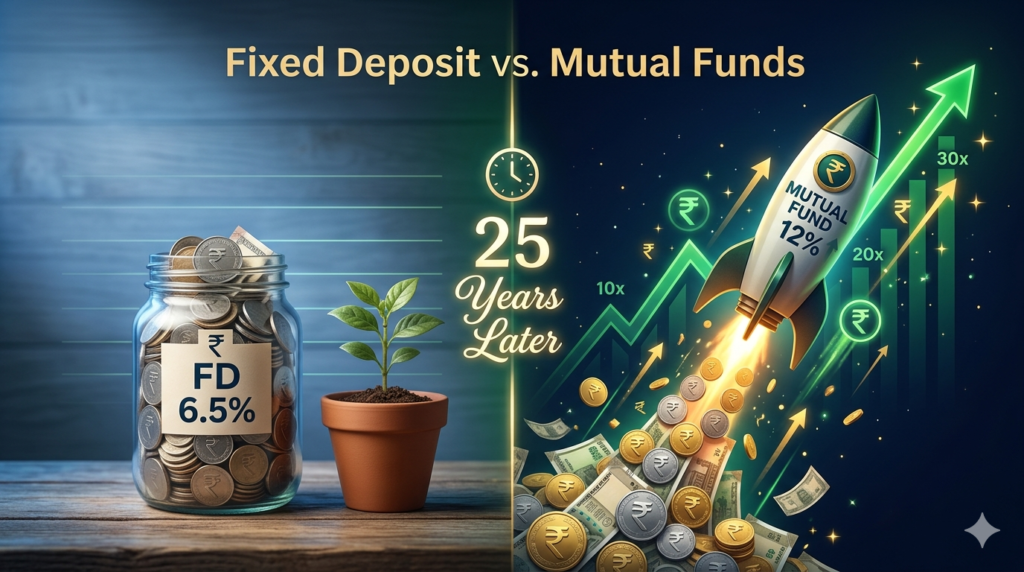
- ₹1,00,000 in an FD at 6.5% CAGR grows to ~₹4.83 lakh in 25 years. The same amount in an equity mutual fund at 12% CAGR grows to ~₹17 lakh — a 3.5x difference.
- After adjusting for India’s average 6% inflation, FDs deliver near-zero or negative real returns — especially for investors in the 30% tax bracket.
- Post-tax equity mutual fund returns (LTCG at 12.5%) are significantly higher than FD interest taxed at your income slab (up to 30%).
- FDs are best for capital preservation, emergency funds, and short-term goals of 1–3 years.
- Equity mutual funds via SIP are the superior vehicle for long-term wealth creation over 5–30 year horizons.
- A smart portfolio uses both — FDs for stability, mutual funds for growth. The right mix depends on your age and goals.
- Why Every Indian Investor Faces This Question
- What is a Fixed Deposit (FD)?
- What are Mutual Funds?
- 25-Year Return Comparison (Real Data)
- Inflation Impact — The Silent Wealth Killer
- Risk Comparison
- Taxation in India (FY 2026–27)
- Liquidity Comparison
- Scenario-Based Analysis
- Pros and Cons
- When to Choose FD
- When to Choose Mutual Funds
- Expert Insight & Portfolio Allocation
- Final Verdict & Conclusion
Why Every Indian Investor Faces This Question
Ask any middle-class Indian family where their savings are parked and the answer remains predictably consistent: “We have an FD at SBI.” Fixed Deposits have dominated Indian household savings psychology for decades. Safe, guaranteed, and simple — the FD was the financial bedrock of a generation that lived through high inflation, economic instability, and limited investment choices.
But in April 2026, the investment landscape looks starkly different. The Nifty 50 has delivered approximately 11.5% CAGR over the last 25 years. Diversified equity mutual funds have, in many cases, done even better. Meanwhile, FD rates — after cycling through 9%, 5%, and back to 7% — have rarely crossed inflation on a post-tax basis for high-bracket earners.
The question of FD vs Mutual Funds is not just about returns. It is about real wealth — money that retains its purchasing power, grows above inflation, and helps you achieve goals like retirement, your child’s education, or buying a home without falling short. In this article, we examine 25 years of real data to answer this question for Indian investors once and for all — not with opinions, but with numbers.
All figures are based on RBI published deposit rate data, AMFI-reported mutual fund category performance, BSE Sensex/Nifty 50 historical returns, and Income Tax rules as per the Finance Act 2025 and New Income Tax Act 2025 effective April 2026. For the latest rule changes, see our detailed article: Big Financial Changes from April 1, 2026: 9 Rules Every Indian Must Know.
What is a Fixed Deposit (FD)?
A Fixed Deposit is a financial instrument offered by banks and NBFCs in India where a lump-sum amount is deposited for a fixed tenure at a pre-agreed interest rate. The bank guarantees full return of principal with interest at maturity. Unlike market-linked products, an FD’s return is known the day you open it.
Key Features of Fixed Deposits
- Guaranteed Returns: Interest rate is locked at the time of deposit and immune to market movements.
- Capital Safety: DICGC insures deposits up to ₹5 lakh per depositor per bank.
- Flexible Tenures: Available from 7 days to 10 years across most scheduled banks.
- TDS Deduction: Banks deduct TDS at 10% when annual interest crosses ₹40,000 (₹50,000 for senior citizens).
- Premature Exit: Permitted with a 0.5%–1% penalty on the applicable interest rate.
- Loan Facility: You can borrow up to 90% of the FD value without breaking the deposit.
- Senior Citizen Benefit: Banks typically offer 0.25%–0.75% higher rates for depositors aged 60+.
Historical FD Interest Rates in India (25-Year Trend)
| Period | Approx. FD Rate (1–3 yr) | Key Economic Driver |
|---|---|---|
| 1999–2003 | 9%–11% | Tight RBI monetary policy, high fiscal deficit |
| 2004–2008 | 6%–8.5% | India growth boom, controlled inflation |
| 2009–2013 | 7%–9.5% | Post-GFC recovery, persistent food inflation |
| 2014–2019 | 6.5%–7.5% | RBI inflation targeting, gradual rate cuts |
| 2020–2022 | 4.9%–5.5% | COVID-era repo cuts, historic 40-year lows |
| 2023–2024 | 6.5%–7.25% | Post-COVID rate hike cycle |
| 2025–2026 | 6.5%–7.0% | RBI calibrated easing; repo at 6.25% |
Over 25 years, India’s average bank FD rate has been approximately 6.5% CAGR. We use this as our baseline for the 25-year comparison. Source: RBI Handbook of Statistics on Indian Economy.
Current FD rates of 7%+ are cyclically high. Assuming this rate will continue for 25 years is unrealistic. Long-term FD planning must use historical averages — not current peak rates — to avoid being misled about actual wealth accumulation potential.
What are Mutual Funds?
A mutual fund pools money from thousands of investors and deploys it into a diversified portfolio of securities — equities, bonds, or a blend — managed by professional fund managers. They are regulated by SEBI (Securities and Exchange Board of India) and distributed through AMFI-registered intermediaries. Unlike FDs, returns are market-linked — they fluctuate but, over long periods, have significantly outpaced fixed-income instruments.
Types of Mutual Funds (Relevant to This Comparison)
Historical CAGR
Historical CAGR
Historical CAGR
Equity Mutual Funds
These invest primarily in stocks listed on BSE/NSE. They carry short-term volatility but historically deliver the highest long-term returns. Nifty 50 has delivered ~11.5% CAGR over 25 years (source: AMFI India). Diversified equity funds have matched or beaten this. Sub-types include Large Cap, Mid Cap, Flexi Cap, and ELSS (tax-saving under Section 80C).
Debt Mutual Funds
These invest in government securities, corporate bonds, and money market instruments. Lower risk, lower return — 6%–8% CAGR. Post April 2023 tax changes, debt funds are taxed at slab rate (similar to FD), reducing their earlier tax advantage. Suitable for short-to-medium-term needs.
Hybrid Mutual Funds
These blend equity and debt. Balanced Advantage Funds (BAFs) and Aggressive Hybrid Funds dynamically manage allocation, delivering 7%–9% CAGR with lower volatility than pure equity. Ideal for moderate-risk investors seeking a one-fund solution.
How Mutual Fund Returns Are Generated
Mutual fund returns come from: (1) Capital Appreciation — rise in underlying asset values reflected in NAV growth; (2) Dividend/Interest Income — passed to investors; and (3) Compounding — reinvested gains generating exponential, non-linear growth over decades. The longer your horizon, the more dramatically compounding separates mutual fund outcomes from FD outcomes.
25-Year Return Comparison: Real Data Analysis
This is the most important section. We use conservative, historically grounded figures — not best-case or cherry-picked numbers — to show exactly what ₹1,00,000 would grow into across different instruments over 25 years.
Assumptions
- Initial Investment: ₹1,00,000 (lump sum)
- Horizon: 25 years (2001–2026 as a reference window)
- FD Rate: 6.5% p.a. compounded annually (25-yr historical average)
- Equity MF: 12% CAGR (conservative; Nifty 50 delivered ~11.5%, top diversified funds 13%–15%)
- Hybrid MF: 9% CAGR
- Debt MF: 7% CAGR
- Pre-tax figures (taxation covered separately)
CAGR (Compound Annual Growth Rate) is the smoothed annual rate at which an investment grows over a period. Formula: CAGR = [(Final Value ÷ Initial Value)^(1/n)] − 1. A 12% CAGR means your investment grows by 12% per year, compounded — the gains of year 1 become the base for year 2, creating exponential, not linear, growth.
Growth of ₹1,00,000 Over 25 Years — Year-by-Year
| Year | FD @ 6.5% | Debt MF @ 7% | Hybrid MF @ 9% | Equity MF @ 12% |
|---|---|---|---|---|
| Start | ₹1,00,000 | ₹1,00,000 | ₹1,00,000 | ₹1,00,000 |
| Year 5 | ₹1,37,009 | ₹1,40,255 | ₹1,53,862 | ₹1,76,234 |
| Year 10 | ₹1,87,714 | ₹1,96,715 | ₹2,36,736 | ₹3,10,585 |
| Year 15 | ₹2,57,184 | ₹2,75,903 | ₹3,64,248 | ₹5,47,357 |
| Year 20 | ₹3,52,365 | ₹3,86,968 | ₹5,60,441 | ₹9,64,629 |
| Year 25 | ₹4,82,757 | ₹5,42,743 | ₹8,62,308 | ₹17,00,006 |
after 25 years
after 25 years
after 25 years
The gap is not a margin — it is a chasm. An equity mutual fund delivers 3.52x more wealth than an FD on the same ₹1 lakh over 25 years. The reason is not just a higher rate — it is the exponential mathematics of compounding applied consistently over decades.
SIP Comparison: ₹5,000/Month Over 25 Years
Most Indian investors use the SIP (Systematic Investment Plan) route. Here is what ₹5,000/month over 25 years (total invested: ₹15,00,000) becomes:
| Instrument | Total Invested | Return Assumed | Maturity Value | Wealth Created |
|---|---|---|---|---|
| Recurring Deposit | ₹15,00,000 | 6.5% | ₹33,87,000 | ₹18,87,000 |
| Debt MF SIP | ₹15,00,000 | 7% | ₹38,11,000 | ₹23,11,000 |
| Hybrid MF SIP | ₹15,00,000 | 9% | ₹58,34,000 | ₹43,34,000 |
| Equity MF SIP | ₹15,00,000 | 12% | ₹1,00,20,000 | ₹85,20,000 |
A disciplined ₹5,000/month SIP in equity mutual funds over 25 years has historically crossed ₹1 crore — turning the same ₹15 lakh that a recurring deposit converts to ₹33.87 lakh into a retirement-grade corpus. The power of SIP is not just rate — it is the discipline of rupee-cost averaging through bull and bear markets alike.
Equity SIP projections use a 12% CAGR — conservative relative to AMFI’s reported 25-year average for diversified equity funds. The BSE Sensex has delivered ~14.4% CAGR since inception (1979) and approximately 11.5% over the last 25 years (source: BSE India). We use 12% after accounting for typical expense ratios of 0.5%–1.5% in actively managed funds.
Inflation Impact: Why FD Returns Can Be Dangerously Deceptive
Here is the financial reality most Indian FD investors are never shown: nominal returns are not your real returns. Inflation is money’s silent tax. If your FD earns 6.5% and inflation runs at 6%, your real return is merely 0.5%. In years when inflation outpaced FD rates — which happened consistently from 2009 to 2014 — FD investors were actively losing purchasing power while believing they were earning.
Real vs Nominal Returns Comparison
| Instrument | Nominal Return | Avg. Inflation | Real Return | 25-Year Verdict |
|---|---|---|---|---|
| Fixed Deposit | 6.5% | 6.0% | 0.5% | Barely Preserving Wealth |
| Debt MF | 7.0% | 6.0% | 1.0% | Marginal Real Gains |
| Hybrid MF | 9.0% | 6.0% | 3.0% | Moderate Real Growth |
| Equity MF | 12.0% | 6.0% | 6.0% | Strong Real Wealth Creation |
After 25 years of 6% average inflation, ₹1,00,000 in purchasing power terms shrinks to approximately ₹22,811 in today’s money. The FD’s ₹4.83 lakh, while nominally impressive, buys far less than it appears. The equity mutual fund’s ₹17 lakh represents approximately ₹3.87 lakh in real April 2026 purchasing power — a genuinely meaningful result.
For an investor in the 30% tax bracket: FD at 6.5% → post-tax return = 4.55%. Subtract 6% inflation → real post-tax return = −1.45%. This was not a hypothetical during 2009–2013. Millions of Indian FD holders were losing real wealth every year while thinking they were “saving safely.”
Risk Comparison: Safety vs Volatility vs Inflation Risk
The perception of FDs as “safe” and mutual funds as “risky” is only partially accurate. There are different types of risk, and ignoring inflation risk — arguably the most dangerous for long-term investors — is what leads to suboptimal outcomes.
Fixed Deposit Risk Profile
- Credit Risk: Very low for scheduled commercial banks (SBI, HDFC, ICICI). Moderate for small co-operative banks and certain NBFCs not covered under DICGC.
- Interest Rate Risk: High over the long term. You cannot lock in 7% for 25 years. Each renewal faces prevailing rates — which could be 5% in a low-rate cycle.
- Inflation Risk: Very high. FDs have consistently failed to outpace inflation + tax for high-bracket investors.
- Reinvestment Risk: Quarterly/monthly interest payouts (if chosen) get reinvested at lower prevailing rates, reducing effective compounding.
Mutual Fund Risk Profile
- Market/NAV Risk (Equity): High in the short term. NAV can drop 20%–40% in bear markets. Negligible over 15+ years for disciplined SIP investors.
- Credit Risk (Debt): Moderate. The Franklin Templeton debt fund crisis (2020) showed that even debt funds can face credit events.
- Inflation Risk: Low for equity funds. Historically, equity has outpaced inflation by 5–7% annually over 15+ year periods in India.
- Liquidity Risk: Minimal for open-ended funds. Most allow redemption within 1–3 business days.
Taxation Comparison: India-Specific Rules (FY 2026–27)
With the New Income Tax Act 2025 fully effective from April 1, 2026, taxation on financial instruments has been restructured. Understanding these rules is critical because tax treatment — not just gross returns — determines your actual wealth outcome.
Taxation on Fixed Deposits (FY 2026–27)
- Interest Income: Added to your total income and taxed at applicable slab rate (0%, 5%, 10%, 15%, 20%, 25%, or 30% under the new tax regime slabs).
- TDS: Banks deduct TDS at 10% when annual interest exceeds ₹40,000 (₹50,000 for senior citizens). Differential tax (if in higher slab) must be paid via advance tax.
- Tax-Saving FD (5-year): Qualifies for Section 80C deduction up to ₹1.5 lakh under the old tax regime only. Interest is still fully taxable.
- Effective Post-Tax Return (30% slab): FD at 7% → post-tax ≈ 4.9%.
Taxation on Equity Mutual Funds (FY 2026–27)
- LTCG (held > 1 year): Gains above ₹1.25 lakh per financial year taxed at 12.5% (as per Finance Act 2024, continuing in FY 2026–27).
- STCG (held < 1 year): Taxed at 20% (revised from 15% in Budget 2024).
- Tax Deferral Advantage: Unlike FDs (taxed annually on accrual), mutual fund gains are taxed only at redemption. Your entire corpus compounds tax-free during the holding period — a massive compounding advantage.
- ELSS Funds: Section 80C deduction up to ₹1.5 lakh (old regime only). 3-year lock-in. LTCG above ₹1.25 lakh taxed at 12.5%.
Taxation on Debt Mutual Funds
Post the April 2023 amendment (maintained in the new tax regime framework), debt mutual funds with <35% equity exposure are taxed at slab rates regardless of holding period — bringing them on par with FDs for taxation purposes. This significantly reduces the debt fund tax advantage that existed pre-2023.
| Parameter | Fixed Deposit | Equity Mutual Fund | Debt MF (Post Apr 2023) |
|---|---|---|---|
| LTCG Rate | Up to 30% (slab) | 12.5% (above ₹1.25L) | Up to 30% (slab) |
| STCG Rate | Up to 30% (slab) | 20% | Up to 30% (slab) |
| TDS | Yes (10% on interest) | No | No |
| When Tax is Paid | Annually (accrual basis) | At redemption only | At redemption only |
| Indexation | Not available | Not available (equity) | Not available |
| 80C Deduction | 5-yr FD only (old regime) | ELSS only (old regime) | No |
| Post-Tax Return (30% slab) | ~4.55%–4.9% | ~10.5%–11% | ~4.9%–5.6% |
This is one of the most underappreciated advantages of equity mutual funds. Consider two investors who earn 12% on ₹1 lakh. Investor A (FD equivalent) pays 30% tax annually — their real compound rate drops to ~8.4%. Investor B (equity MF) pays 12.5% LTCG only at redemption after 25 years. Their corpus compounds at the full 12% for 25 years, resulting in ₹17 lakh — versus Investor A’s ~₹7.2 lakh. Tax timing is not just an accounting detail; it is a wealth creation factor.
Liquidity Comparison
Liquidity — how quickly and at what cost you can convert your investment back to cash — is a practical concern that determines which instrument is right for different financial goals.
| Parameter | Fixed Deposit | Equity Mutual Fund | Debt / Liquid MF |
|---|---|---|---|
| Withdrawal Anytime | Yes (with penalty) | Yes (open-ended) | Yes (open-ended) |
| Penalty on Early Exit | 0.5%–1% rate cut | Exit load 0%–1% | Nil to 0.5% |
| Settlement Time | Same day (online) | T+2 to T+3 days | T+1 day |
| Partial Withdrawal | No (must break full FD) | Any amount | Any amount |
| Systematic Withdrawal (SWP) | Not available | Yes | Yes |
| Lock-in Period | Tenure (breakable) | None (ELSS: 3 yrs) | None |
For true emergency fund needs, FDs remain practical due to same-day online redemption. However, liquid mutual funds (a debt MF sub-category) now offer T+1 settlement — often faster than calling your bank — with returns of 6.5%–7.5%, marginally better than savings accounts. For partial access and systematic monthly withdrawals in retirement, mutual funds are clearly superior.
Scenario-Based Analysis: What Is Right for Your Profile?
🛡️ Conservative Investor
Profile: 55+ years, retired or near-retirement, needs monthly income, low risk tolerance, primary fear is capital loss.
Goal: Capital preservation with steady income.
⚖️ Moderate Investor
Profile: 35–50 years, salaried, 10–15 year horizon, building retirement corpus, can tolerate some NAV dips without panic.
Goal: Balanced wealth creation with downside buffer.
🚀 Aggressive Investor
Profile: 22–35 years, early career, 20+ year horizon, high income growth potential, unbothered by short-term volatility.
Goal: Maximum long-term wealth — ₹2 crore+ corpus.
Pros and Cons: Complete Summary
Fixed Deposits
✅ Pros
- 100% capital safety (DICGC insured up to ₹5L)
- Guaranteed, predictable returns
- No market risk or NAV fluctuation
- Simple to open — no KYC or demat needed
- Same-day liquidity online
- Loan against FD up to 90%
- Higher rates for senior citizens
❌ Cons
- Taxed at full slab rate (up to 30%)
- Usually fails to beat inflation post-tax
- No partial withdrawal — must break entire FD
- Rate risk at renewal — locked in old rate
- Cannot generate meaningful wealth over 20+ years
- No SWP or systematic withdrawal option
Equity Mutual Funds
✅ Pros
- Historically 12%–15% CAGR over 15+ years
- Beats inflation by 5–7% annually
- Tax-efficient: LTCG at 12.5% vs slab tax on FD
- Tax deferral — corpus compounds without annual tax drag
- Partial withdrawal of any amount anytime
- SIP enables disciplined wealth building from ₹500/month
- SEBI-regulated, transparent, audited funds
❌ Cons
- No capital guarantee — NAV can fall significantly
- Requires emotional discipline during bear markets
- Returns not predictable year-on-year
- Requires KYC, PAN, bank account linkage
- Fund selection requires some financial literacy
- Fund manager/style risk over long horizons
When to Choose Fixed Deposits
- 🏥 Emergency Fund: Keep 3–6 months of expenses in a high-interest savings account or short-term FD. Do not risk this money in markets.
- 🎓 Short-Term Goals (1–3 years): School fees, upcoming wedding, car purchase, travel — use FDs. Market volatility is too unpredictable for near-term needs.
- 👴 Retirement Income: Retirees needing predictable monthly or quarterly income benefit from FDs, especially Senior Citizen FDs or SCSS (Senior Citizens’ Savings Scheme) offering up to 8.2% (as of April 2026 — verify current SCSS rates with your bank).
- 🏦 Capital Preservation: When not losing money matters more than growing it — typically for short horizons or when holding proceeds from a property sale.
- 📉 Market Parking: Temporarily parking lump sums in FDs before deploying into equity mutual funds via STP (Systematic Transfer Plan) is a smart tactical move during high market valuations.
When to Choose Mutual Funds
- 🏠 Long-Term Goals (5–30 years): Retirement, child’s education, buying a home. Time is equity’s most powerful ally. Start early, stay invested.
- 💰 Inflation-Beating Growth: When you want your money’s real purchasing power to grow — not just its nominal value. Only equity mutual funds have consistently done this in India.
- 🧾 Tax Efficiency: If you’re in the 20%–30% bracket, LTCG tax at 12.5% on equity MF gains vs slab-rate tax on FD interest is a significant annual advantage.
- 📈 Disciplined Monthly Investing: SIP is India’s most practical wealth-building tool — automated, diversified, and immune to market timing mistakes.
- 🌱 Early Career Wealth Building: A 25-year-old who invests ₹10,000/month in equity mutual funds for 30 years at 12% CAGR accumulates approximately ₹3.52 crore. The same in an RD creates ~₹1.5 crore — less than half.
- 🎯 Tax Saving: ELSS mutual funds offer 80C deduction (up to ₹1.5 lakh, old tax regime), a 3-year lock-in (shortest among 80C instruments), and equity-linked return potential — making them superior to 5-year tax-saving FDs for most investors.
Expert Insight: Building a Portfolio That Actually Works
“The best portfolio for most Indian investors isn’t all-FD or all-equity mutual funds — it’s a purposeful blend where FDs provide your financial floor and equity mutual funds provide your financial engine. The mistake most middle-class Indian families make is keeping 70–80% of savings in FDs ‘for safety,’ not realising that after tax and inflation, they’re slowly losing real wealth. Meanwhile, a disciplined SIP investor who started in 2001 and stayed invested through 2008 crash and 2020 COVID — without panic-selling — would have turned ₹5,000/month into over ₹1 crore by April 2026. Patience and allocation are everything.”
Recommended Portfolio Allocation by Age (April 2026 Framework)
| Age Group | FD / Debt | Hybrid MF | Equity MF | Primary Strategy |
|---|---|---|---|---|
| 20–30 yrs | 10% | 10% | 80% | Aggressive equity accumulation |
| 30–40 yrs | 15% | 20% | 65% | Balanced growth with security |
| 40–50 yrs | 25% | 30% | 45% | Moderate growth + capital safety |
| 50–60 yrs | 40% | 35% | 25% | Preservation + inflation hedge |
| 60+ yrs | 55% | 30% | 15% | Income generation + safety first |
These allocations are inspired by the “100 minus age” equity rule, adapted for Indian market conditions and modified to reflect post-April 2026 tax regime changes. For personalised advice, consult a SEBI-registered investment advisor (RIA). To find one, visit the SEBI RIA database.
Regulatory & Learning Resources for Indian Investors
- 🔗 RBI Official Website — Monetary policy, deposit rates, financial literacy resources
- 🔗 SEBI Investor Education Portal — Mutual fund regulations, RIA directory
- 🔗 AMFI Knowledge Centre — Mutual fund categories, performance data
- 🔗 DICGC — Deposit insurance cover details and eligible banks
- 🔗 ClearTax Mutual Fund Taxation Guide — LTCG, STCG, slab tax explained
🏆 Final Verdict: FD vs Mutual Funds (April 2026)
After 25 years of data, tax analysis, inflation modelling, and scenario comparison — here is the honest, balanced verdict:
✅ FD Wins For
Capital safety, emergency reserves, short-term goals (1–3 years), senior citizen income, and peace of mind. FDs are a necessary financial tool — just not a wealth creation tool.
🚀 Equity MF Wins For
Long-term wealth creation (7–30 years), inflation-beating real returns, tax-efficient compounding, and building a retirement or goal-based corpus. No FD has delivered what equity SIPs have over 25 years.
📊 The Numbers
₹1 lakh in FD = ₹4.83 lakh after 25 years. Same in equity MF = ₹17 lakh. For 30% bracket investors, FD real post-tax return is often negative. Equity LTCG at 12.5% leaves far more in your pocket.
🎯 The Smart Move
Don’t choose one. Build a layered portfolio: FD for your safety net, equity MF for your wealth engine. Review every April when new financial year begins. Increase your SIP by 10% each year using the step-up SIP strategy.
Conclusion
The debate of FD vs Mutual Funds ultimately reveals a deeper truth about how most Indians relate to money. We conflate safety with zero-risk — but the biggest risk in personal finance is not a market downturn that you can outlast. It is a 25-year FD habit that leaves you with a corpus that inflation has quietly hollowed out, and a tax system that has further eroded.
As of April 2026, with the New Income Tax Act changing slab structures and April 1 bringing nine significant financial rule changes, the investment landscape continues to evolve. What doesn’t change is the mathematics of compounding: equity mutual funds that earn 12% CAGR will always, over 25 years, build a corpus that dwarfs an FD at 6.5%. The only requirement is patience, discipline, and starting today — not next year.
Use FDs for what they do best: safety, certainty, and short-term liquidity. Use mutual funds for what they do best: compounding, inflation-beating growth, and long-term wealth. Together, they are the complete financial toolkit every Indian investor needs.
Start by calculating how much your current FD is actually earning after inflation and tax. Then explore how a ₹5,000/month SIP could reshape your financial future. Read: SIP Calculator with Inflation: See Your Real Returns Before It’s Too Late. And if you’re a salaried professional: Best SIP for Salaried Persons in India 2026.
Leave a Reply