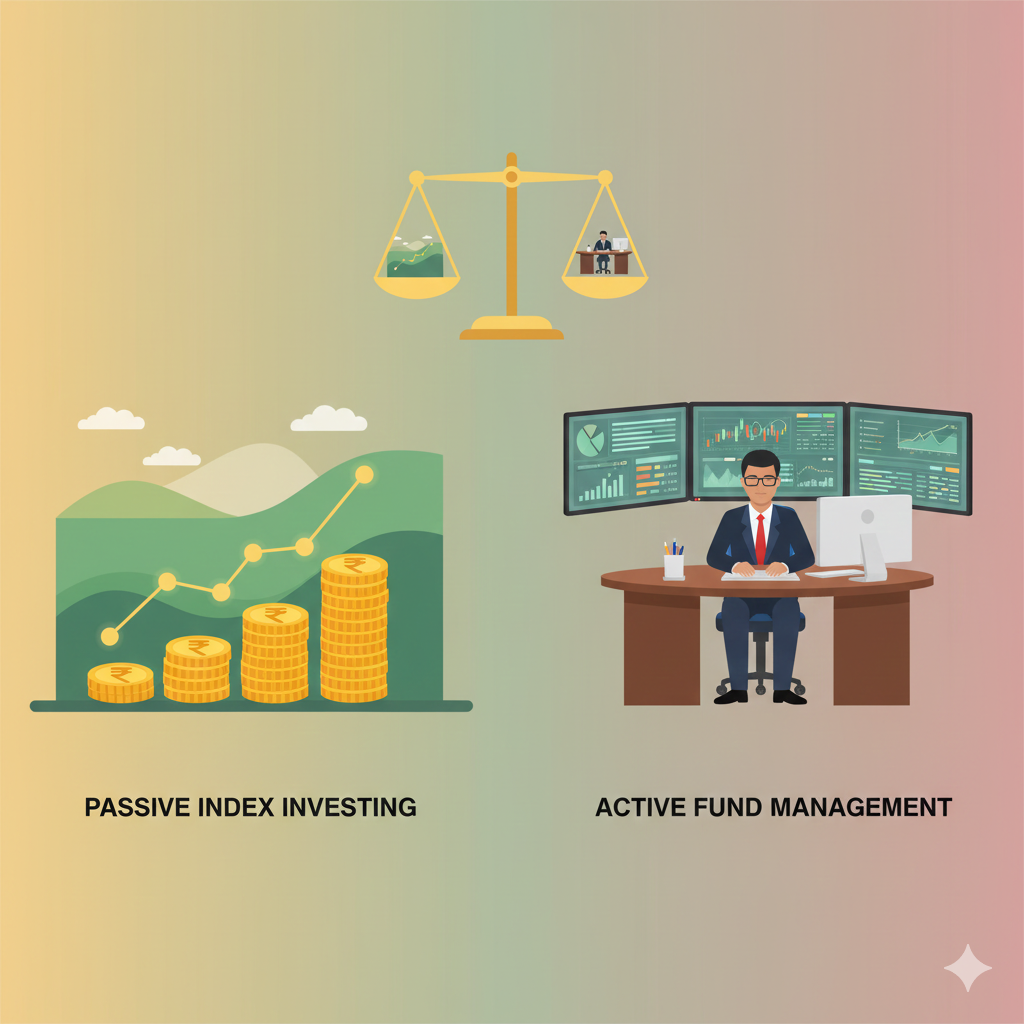
Index Funds vs Actively Managed Funds:
Which One Actually Makes You Richer?
Every investor faces the same fork in the road: do you hand your money to a team of brilliant analysts who pick stocks for a living — or do you simply buy the whole market and let it do its thing? It sounds like a no-brainer that professionals should win. But the data, consistently and stubbornly, tells a different story. Let’s break it down in plain English.
What Exactly Are We Comparing?
Before we dive into numbers, let’s make sure we’re on the same page about what these two investment types actually are.
Index Funds: Buy the Market, Own the Market
An index fund is a type of mutual fund or ETF (exchange-traded fund) that simply tracks a market index — think the S&P 500, the NASDAQ-100, or the FTSE 100. No star fund manager. No stock-picking. No trading frenzy. The fund just mirrors whatever’s in the index.
If Apple makes up 7% of the S&P 500, your index fund holds 7% Apple. Simple, mechanical, and — as we’ll see — remarkably effective.
Actively Managed Funds: The Professionals Take the Wheel
Actively managed funds employ portfolio managers and research teams who study companies, analyse earnings, read economic trends, and make deliberate decisions about what to buy, hold, or sell. The pitch is compelling: smart people should be able to beat a dumb index, right?
The fees reflect that effort. Active funds typically charge significantly more than index funds — and those fees come out of your returns whether the fund does well or not.
The Cost Difference Is Bigger Than You Think
This is where most people underestimate the damage. Fees don’t just reduce your return this year — they compound against you every single year. Let’s make it concrete.
Imagine you invest ₹10 lakhs (or $10,000) for 30 years, earning an average of 8% gross annually. Here’s how fees eat into your wealth:
Almost 10x your investment. Fees cost you roughly ₹50,000 over 30 years.
That 1% fee difference wiped out over ₹25 lakhs in wealth — roughly 25% of your potential gains.
You paid fees that cost you nearly half of what you could have earned.
This isn’t a trick of maths — it’s compound interest working in reverse. Fees are the silent killer of long-term wealth.
— Jack Bogle, Founder of Vanguard and creator of the first index fund
Performance: What Does the Data Actually Say?
S&P Global publishes the SPIVA (S&P Indices Versus Active) scorecard every year — and it is not kind to active managers.
Over a 15-year period ending in 2023, roughly 85–92% of actively managed large-cap US equity funds underperformed the S&P 500. This isn’t a fluke. The numbers are remarkably consistent year after year, across geographies and fund categories.
In emerging markets — where you’d expect information asymmetry to give smart managers an edge — over 70% of active funds still lagged their benchmarks over 10 years.
There are exceptions. Some funds, some managers, do outperform — sometimes by a lot. But the problem is: identifying them in advance is nearly impossible. Past performance, as every fund fact sheet is legally required to tell you, is not a reliable indicator of future results. And it genuinely isn’t.
Head-to-Head: Index vs Active at a Glance
| Factor | Index Funds | Actively Managed Funds |
|---|---|---|
| Annual Fees | 0.03%–0.20% | 0.50%–2.5% |
| Long-Term Performance | Beats ~85% of active funds | Most underperform index |
| Transparency | Very High | Moderate |
| Tax Efficiency | High (low turnover) | Lower (frequent trading) |
| Manager Risk | None | High |
| Flexibility | Limited to index | High |
| Potential to Beat Market | No | Yes (rarely achieved) |
| Minimum Investment | Usually very low | Can be higher |
When Might an Active Fund Actually Make Sense?
It would be intellectually dishonest to call active funds universally bad. There are specific situations where they can add genuine value — you just need to know what those situations are and go in with clear eyes.
Niche or Inefficient Markets
In markets where information is hard to come by — think small-cap stocks in frontier markets, specialist sectors like biotech, or private credit — skilled managers sometimes have a real edge. These markets are less picked-over than large-cap US equities, so there’s more opportunity for genuine alpha.
Capital Preservation Goals
If you’re close to retirement or need to protect a specific sum, an active manager with the flexibility to hold more cash or reduce risk during downturns might suit you better than a passive fund that must stay fully invested in the index regardless of conditions.
You’ve Found a Genuinely Great Manager
They exist. But vetting them properly requires looking at 10+ year track records, understanding their investment process, checking whether past returns were skill or luck (a surprisingly hard statistical problem), and ensuring they haven’t grown so large that their edge is diluted. This is not a research project for evenings and weekends.
Tax Efficiency: The Underrated Advantage of Index Funds
Here’s something most people don’t think about until tax season: actively managed funds trade frequently. Every time a manager sells a winning stock inside the fund, that realises a capital gain — which gets passed through to you as a taxable event, even if you didn’t sell a single unit yourself.
Index funds, by contrast, only trade when the underlying index changes — which is infrequent. The result is far fewer taxable distributions, meaning more of your money stays working for you instead of heading to the taxman each year.
Over a 20-30 year horizon, this tax drag from active funds can add up to a significant chunk of your final portfolio value. It’s not as dramatic as the fee difference, but combined with fees, the total friction becomes substantial.
The Behavioural Factor: The Fund You’ll Actually Stick With
Here’s an honest truth that the finance industry doesn’t love to talk about: the best investment strategy in the world is useless if you abandon it at the first sign of trouble.
Studies by Dalbar and others consistently show that the average investor earns significantly less than the funds they invest in — because they buy after markets rise and sell in panics when they fall. This is the “behaviour gap.”
Index funds, because they’re boring and mechanical, can paradoxically help investors stay the course. There’s no narrative to get excited about, no star manager to worry about losing faith in. You own the market. The market will eventually recover. That’s a simpler story to hold onto during a crash than “I trust my fund manager’s judgement right now.”
How to Choose: A Simple Framework
🚨 When NOT to Rely on Google — Talk to an Expert Instead
The internet is an incredible starting point for financial education. But there are moments when a Google search — or even a blog post like this one — simply cannot give you what you need. Here’s when you must speak to a qualified financial adviser:
- You’re investing a large lump sum (life savings, inheritance, property sale proceeds): Getting this decision wrong has life-altering consequences. General advice doesn’t account for your tax situation, existing assets, or personal risk tolerance.
- You’re near or in retirement: Sequence-of-returns risk is complex and personal. A crash at the wrong time can permanently derail retirement plans. You need a plan tailored to your specific situation, not a blog post.
- You’re choosing between multiple funds for a pension or SIPP: Fund selection inside tax-advantaged accounts has long-term implications that vary hugely by individual circumstances and goals.
- You’ve had a major life event (divorce, inheritance, business sale, redundancy): Your entire financial picture changes. Generalised strategies online won’t fit your new reality.
- You’re feeling emotional about markets (panic-selling urge, euphoric buying): This is the highest-risk moment of all. Talk to a professional before acting, not after.
- Tax planning around investments: CGT, ISA rules, pension allowances, inheritance tax — these interact in complex ways that change year to year. Get personalised advice.
Look for a fee-only or independent financial adviser (IFA) who is legally obligated to act in your best interest. In the UK, check the FCA Register. In India, look for a SEBI-registered investment adviser (RIA). In the US, look for a CFP or fee-only fiduciary.
Find a Qualified Adviser →The Bottom Line
For the majority of investors — especially those with long time horizons, limited time to do deep research, and a preference for simplicity — index funds are a remarkably hard offer to beat. The fee advantage alone is compelling. The track record of passive versus active across decades and geographies makes it even more so.
That doesn’t mean active funds have no place. In the right hands, in the right markets, with the right fee structure, they can add value. But those conditions are rarer than the industry would have you believe.
The most important thing isn’t choosing the “perfect” fund. It’s starting, staying consistent, keeping costs low, and not letting fear or greed hijack the plan. Whether your vehicle is an index fund or a carefully chosen active fund, discipline is the real edge.
📚 Sources & Data References
All data cited in this post comes from publicly available, reputable financial research sources:
- SPIVA U.S. Scorecard (2023) — S&P Global: Active vs. passive fund performance data.
https://www.spglobal.com/spdji/en/research-insights/spiva/ - Vanguard’s “The Case for Index Funds” — Long-term cost and return analysis.
https://investor.vanguard.com/investor-resources-education/index-funds - Morningstar Active/Passive Barometer (2023) — Survivorship bias-adjusted performance.
https://www.morningstar.com/lp/active-passive-barometer - Dalbar QAIB Report (2023) — Investor behaviour gap and average returns.
https://www.dalbar.com/QAIB/Index - Investment Company Institute (ICI) Factbook 2023 — Expense ratio data across fund types.
https://www.ici.org/research/stats/factbook - SEBI (Securities and Exchange Board of India) — RIA registration and investor advisory framework.
https://www.sebi.gov.in