Good Debt vs Bad Debt: The Complete Financial Guide
Master the art of strategic borrowing to build wealth while avoiding common financial pitfalls. Learn how smart investors use debt as a tool for financial growth.
In today’s financial landscape, debt is often portrayed as a four-letter word—something to be avoided at all costs. However, this black-and-white thinking can actually prevent you from building substantial wealth. The truth is, not all debt is created equal. Understanding the difference between good debt and bad debt is one of the most important financial distinctions you can master.
The Fundamental Difference: Wealth-Builder vs Wealth-Destroyer
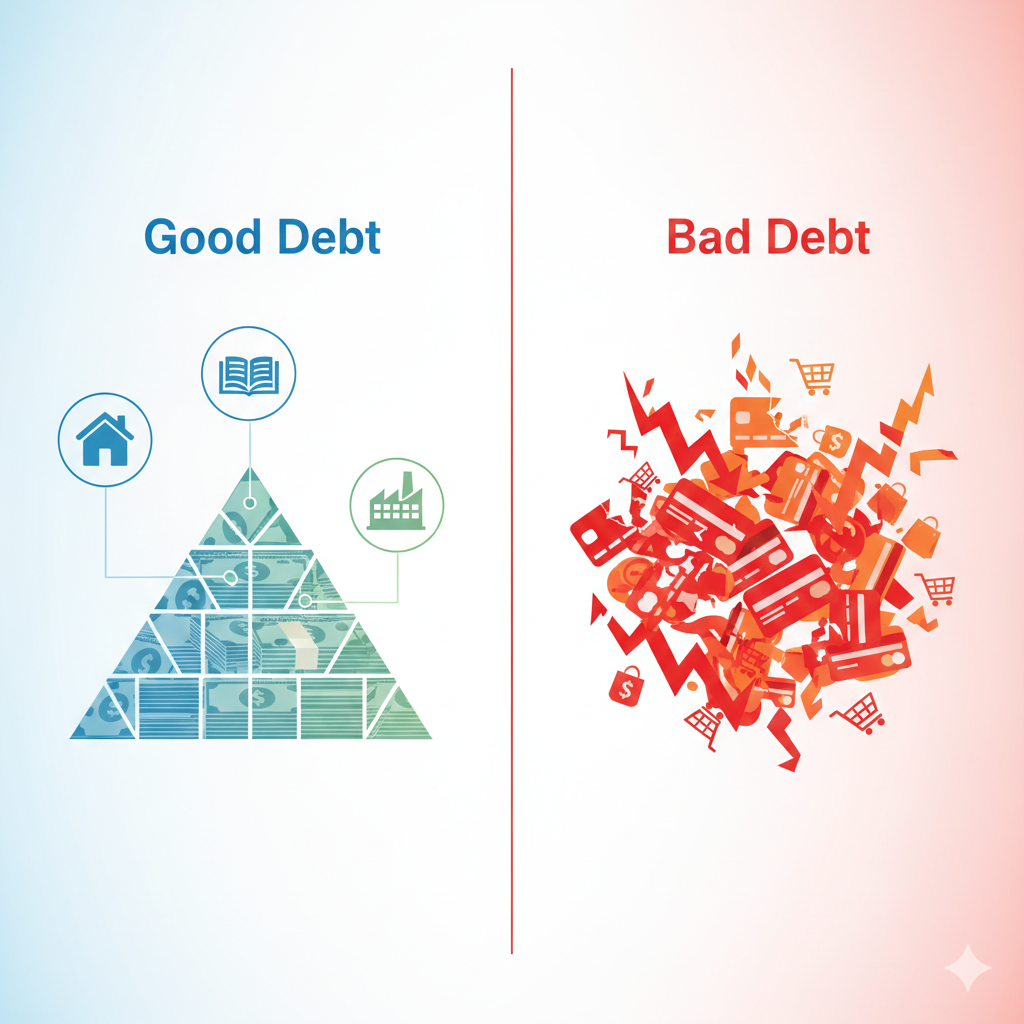
Good debt and bad debt are distinguished by one crucial factor: what the debt does for your net worth over time. Good debt acts as leverage to acquire assets that appreciate or generate income. Bad debt finances consumption and purchases that lose value.
Good debt is strategic borrowing that helps you acquire assets that increase in value or generate income over time. It’s debt that works for you.
- Mortgages for appreciating real estate
- Student loans for high-earning degrees
- Business loans for profitable ventures
- Investment property financing
- Low-interest education loans
Bad debt is expensive borrowing for items that quickly lose value and don’t generate income. It’s debt that works against you.
- High-interest credit card debt
- Payday loans and cash advances
- Auto loans for rapidly depreciating cars
- Consumer loans for luxury items
- Financing for vacations and dining
Good debt acquires assets, bad debt acquires liabilities. Before taking on any debt, ask yourself: “Will this purchase put money in my pocket or take money out of my pocket over time?” If it’s the latter, reconsider or find another way to finance it.
Good Debt in Detail: Smart Leverage Examples
1. Real Estate Mortgages
When you take out a mortgage to buy a property, you’re using the bank’s money to acquire an asset that typically appreciates over time. With only 20% down (or less), you control 100% of the property. If the property appreciates 5% annually, your actual return on invested capital can be 25% or more due to leverage.
2. Education Loans for High-Value Degrees
A degree in medicine, engineering, or technology can increase lifetime earnings by millions of dollars. The $200,000 debt for medical school might seem daunting, but when it leads to a $300,000+ annual salary, the ROI is exceptional.
3. Business Financing
Entrepreneurs regularly use debt to start or scale businesses. A $50,000 business loan that helps generate $200,000 in annual profit represents excellent use of debt. The key is having a solid business plan and understanding your numbers.
Bad Debt in Detail: Common Financial Traps
1. Credit Card Debt for Consumption
Carrying a $5,000 balance on a credit card with 24% APR costs you $1,200 annually in interest alone. That’s money that could be invested. The items purchased (clothes, electronics, meals) are usually consumed or depreciated long before the debt is paid.
2. Auto Loans for New Cars
A new $40,000 car loses about 20% of its value in the first year. If you finance it with a 6% loan, you’re paying interest on a rapidly depreciating asset. After one year, you might owe $38,000 on a car worth $32,000.
3. Payday Loans and Cash Advances
With APRs often exceeding 400%, these create debt traps that are nearly impossible to escape. A $500 payday loan can balloon to $1,000 in just a few months if not repaid immediately.
The Gray Area: When Debt Can Be Both
Some debt exists in a gray area and can be good or bad depending on context:
- Auto Loans: Bad if for a luxury car on modest income, but potentially reasonable if for a reliable used car needed to get to a good job
- Personal Loans: Bad if for a lavish wedding, but potentially good if consolidating high-interest credit card debt
- Home Equity Loans: Bad if for a luxury vacation, but good if for home improvements that increase property value
- Student Loans: Bad if for a degree with poor job prospects, but excellent if for a high-demand field
Calculate the True Cost
Use online calculators to determine total interest paid over the loan’s lifetime. A $30,000 car loan at 7% for 6 years costs $6,700 in interest alone.
Evaluate Return on Investment
For potential good debt: What’s the expected financial return? Will this education increase earnings? Will this property appreciate? Will this business generate profit?
Check Affordability
Will payments stay below 10-15% of your take-home pay for the debt type? Does this fit within your overall budget without sacrificing emergency savings or retirement contributions?
Compare Interest Rates
If the interest rate is higher than what you could reasonably earn by investing (historically 7-10% in stocks), prioritize paying it off. Lower rates might justify carrying the debt.
Consider Alternatives
Can you save up instead? Are there cheaper options? Could you start smaller and grow organically? Sometimes delayed gratification is the wisest financial move.
As a rule of thumb: Debt with interest rates above 7-8% should generally be paid off aggressively. Debt below 4-5% might be worth carrying if the funds could be invested for higher returns. Always consider your risk tolerance and overall financial picture.
The Bottom Line: Debt as a Financial Tool
The wealthiest individuals and most successful businesses don’t avoid debt—they master it. They understand that strategic borrowing can accelerate wealth building when used intelligently.
Your goal shouldn’t be to eliminate all debt, but to eliminate bad debt while strategically using good debt to build assets. Remember: Good debt makes you richer over time; bad debt makes you poorer.
Start today by analyzing your current debt. Categorize each obligation as good or bad. Create a plan to eliminate bad debt while strategically managing good debt. This single exercise can transform your financial future.