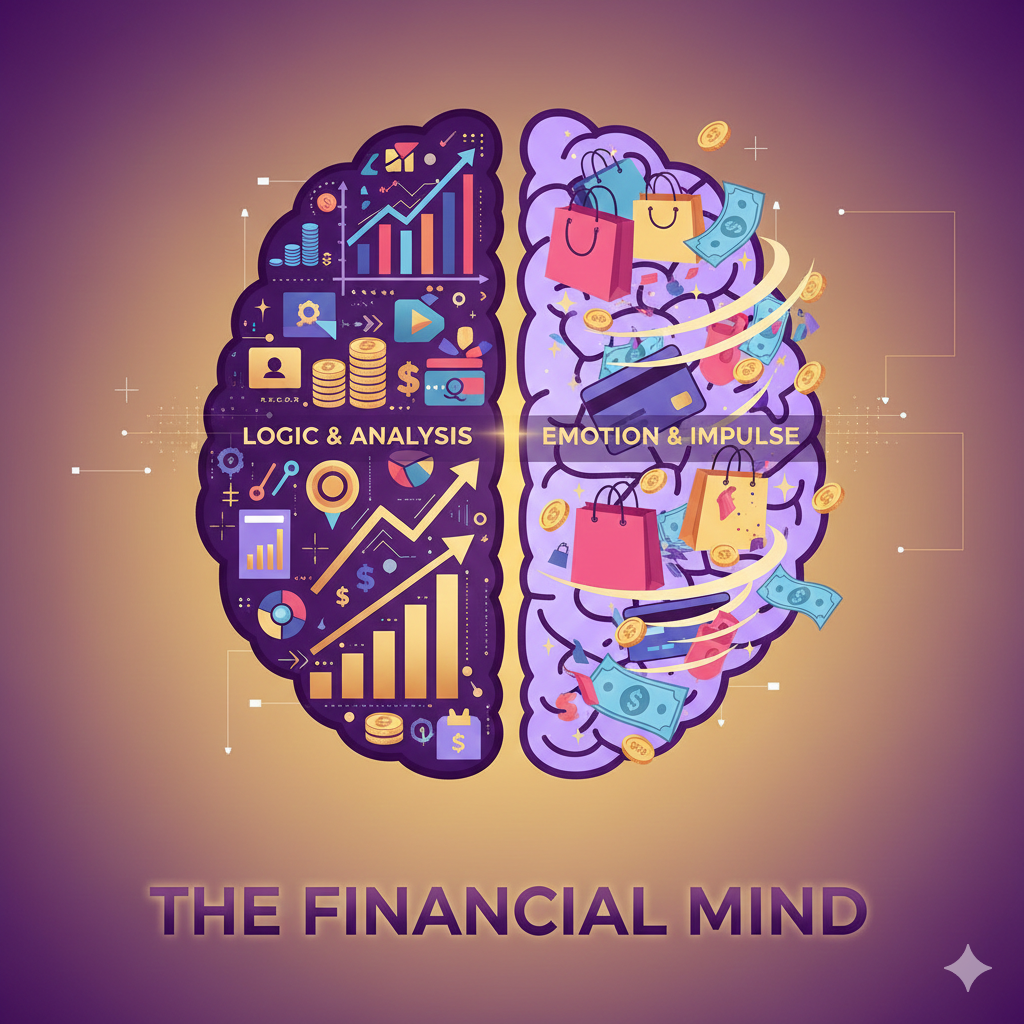
The Psychology Behind Investing and Spending: Understanding Our Financial Minds
The Emotional Foundation of Financial Decisions
At the heart of every financial decision lies emotion. While we like to believe we make logical, calculated choices about money, research consistently shows that emotions drive most of our spending and investing behavior. Fear and greed are the twin forces that dominate investment decisions. When markets rise, greed pushes investors to buy at peak prices, convinced that gains will continue indefinitely. When markets fall, fear triggers panic selling at the worst possible moment. This emotional rollercoaster explains why the average investor consistently underperforms the market indices they’re trying to beat.
Spending decisions are equally emotion-driven. The pleasure centers in our brain light up when we anticipate a purchase, releasing dopamine that creates a temporary high. This neurochemical reward system evolved to motivate survival behaviors, but in our modern consumer society, it drives us toward immediate gratification rather than long-term financial health. Retail therapy is a real phenomenon because shopping can temporarily alleviate stress, sadness, or boredom by providing that dopamine hit our brains crave.
Mental Accounting and the Money Illusion
One of the most fascinating aspects of financial psychology is mental accounting, a concept pioneered by behavioral economist Richard Thaler. We mentally categorize money into different buckets based on its source or intended use, treating each bucket differently even though money is fungible. A tax refund might be spent frivolously on a vacation, while the same amount earned through regular work would be carefully saved. This arbitrary categorization leads to irrational decisions where we might simultaneously carry high-interest credit card debt while maintaining a low-interest savings account.
The money illusion further distorts our perception. We focus on nominal values rather than real purchasing power, failing to account for inflation. A salary increase of three percent feels like progress, but if inflation is running at four percent, we’re actually losing ground. This cognitive quirk makes us feel wealthier than we are and can lead to overspending based on inflated notions of our financial position.
Key Insight: Our brains didn’t evolve to handle modern financial complexity. Evolution optimized us for immediate survival in small groups, not for managing retirement accounts and long-term investment portfolios. This evolutionary mismatch explains many of our financial missteps.
Loss Aversion and Risk Perception
Loss aversion is one of the most powerful forces in financial psychology. Studies show that the pain of losing money is approximately twice as powerful as the pleasure of gaining the same amount. This asymmetry profoundly impacts both investing and spending behavior. Investors hold onto losing stocks too long, hoping to break even, while selling winners too quickly to lock in gains. This pattern, the opposite of sound investing strategy, stems from our desperate desire to avoid realizing losses.
In spending, loss aversion manifests as the sunk cost fallacy. We continue pouring money into failing ventures or keep paying for unused gym memberships because we’ve already invested resources and can’t bear to accept that loss. The rational decision would be to cut our losses, but our psychological wiring makes this incredibly difficult. We also perceive risks inconsistently. We might buy insurance for minor risks we can afford to absorb while taking on major financial risks like inadequate retirement savings without a second thought. The vividness and immediacy of a risk matters more to our emotional brain than its actual probability or magnitude.
The Social Dimension of Financial Behavior
Humans are social creatures, and our financial decisions rarely occur in isolation. Social comparison and status-seeking drive enormous amounts of spending. We buy houses, cars, and consumer goods not just for their utility but to signal our status to others and ourselves. This phenomenon, sometimes called keeping up with the Joneses, can trap people in cycles of overconsumption and debt as they compete with neighbors and colleagues in a race that nobody truly wins.
Social proof also powerfully influences investment decisions. When everyone around us is making money in a particular investment, whether stocks, real estate, or cryptocurrency, the fear of missing out becomes overwhelming. We override our rational doubts and jump in, often near the peak of a bubble. Investment manias throughout history, from tulip bulbs to dot-com stocks, demonstrate how social contagion can override individual judgment on a massive scale.
The rise of social media has amplified these tendencies. We’re constantly exposed to curated highlights of others’ financial success and lifestyle consumption, creating unrealistic benchmarks and fueling dissatisfaction with our own circumstances. This digital keeping-up-with-the-Joneses is particularly pernicious because the comparison group has expanded from neighbors to the entire world, and the presentations are carefully filtered to show only successes and purchases, never debt or struggle.
Cognitive Biases That Undermine Financial Success
A constellation of cognitive biases systematically distorts our financial judgment. Confirmation bias leads us to seek information that supports our existing beliefs while ignoring contradictory evidence. An investor bullish on a particular stock will focus on positive news while dismissing warning signs, setting themselves up for potential losses. Recency bias gives disproportionate weight to recent events, causing investors to extrapolate recent trends indefinitely into the future. After a market crash, we become overly cautious, missing the recovery. After a bull run, we become overconfident and overlook risks.
Overconfidence bias may be the most dangerous of all. We systematically overestimate our knowledge, abilities, and control over outcomes. Most investors believe they’re above average, a mathematical impossibility. This overconfidence leads to excessive trading, inadequate diversification, and risk-taking without appropriate rewards. Day traders and active investors consistently underperform passive index investors, yet overconfidence keeps people convinced they’ll be the exception.
The present bias leads us to heavily discount future benefits in favor of immediate gratification. This temporal myopia makes saving for retirement psychologically difficult because the benefit is decades away while the sacrifice is immediate. Credit cards exploit this bias by making current consumption effortless while pushing the payment pain into the future. By the time the bill arrives, the pleasure of the purchase has faded, but the debt remains.
The Paradox of Choice and Decision Fatigue
Modern financial life presents us with overwhelming choice. Hundreds of investment options in retirement plans, countless credit card offers, unlimited shopping possibilities online. While choice is generally positive, excessive options can paralyze decision-making and lead to worse outcomes. This paradox of choice manifests in multiple ways. Employees presented with too many investment options in their retirement plans often choose none, forgoing valuable employer matching. Investors overwhelmed by choices often default to cash or low-return options rather than making optimal selections.
Decision fatigue compounds this problem. We have a limited reserve of mental energy for making decisions, and financial choices are particularly draining because they involve uncertainty, complexity, and consequences. After making numerous financial decisions, our willpower depletes and we resort to easier default choices or avoid decisions altogether. This explains why important financial planning often gets postponed indefinitely. We’re too mentally exhausted to tackle complex decisions after managing the countless smaller choices that fill our days.
The Role of Identity and Money Scripts
Our financial behavior is deeply influenced by money scripts, the unconscious beliefs about money we absorbed during childhood. These scripts, formed by observing parents, experiencing family financial stress, or internalizing cultural messages, become the operating system for our adult financial lives. Someone who grew up with scarcity might either become an excessive saver out of anxiety or an overspender seeking to finally have enough. Someone raised in affluence might struggle with money management, never having learned the discipline of budgeting.
Financial decisions also become intertwined with our identity. We see ourselves as savers or spenders, as aggressive or conservative investors, as financially responsible or carefree. These self-concepts, once formed, become self-fulfilling prophecies. We make decisions consistent with our financial identity even when circumstances call for different approaches. Breaking these patterns requires not just learning new information but fundamentally reconsidering who we are in relation to money.
Moving Toward Financial Wisdom
Understanding the psychology behind investing and spending doesn’t automatically change behavior, but it’s the essential first step. Recognizing our biases, emotional triggers, and psychological patterns allows us to design systems that work with our psychology rather than against it. Automation can bypass present bias by making saving and investing happen before we can spend. Simple rules can cut through decision paralysis. Mindful awareness of our emotional states during financial decisions can prevent reactive choices we’ll later regret.
The goal isn’t to become perfectly rational economic actors, which is neither possible nor necessarily desirable. Instead, we can develop financial wisdom that acknowledges our psychological realities while building habits and systems that guide us toward better outcomes. By understanding why we make the financial decisions we do, we gain the power to make different choices, ones more aligned with our long-term wellbeing and values. In the complex dance between psychology and money, self-awareness is the first step toward finding better rhythms.