Parag Parikh Flexi Cap Fund: 2025 Detailed Review for Long-Term Investors
The Parag Parikh Flexi Cap Fund has become one of the most popular flexi-cap mutual funds in India thanks to its long-term track record and investor-first reputation.[web:7][web:11] This blog breaks down the fund’s latest performance, key details, how to invest, and competitor flexi-cap funds that have recently beaten it on certain return metrics.[web:11][web:16]
What is Parag Parikh Flexi Cap Fund?
Parag Parikh Flexi Cap Fund is an open-ended equity scheme that can invest dynamically across large-cap, mid-cap and small-cap stocks without any self-imposed limits on sector, market-cap or even geography.[web:9] The scheme aims for long-term capital growth through an actively managed portfolio of equity and equity-related instruments, giving the fund manager full flexibility to move between segments based on valuations and opportunities.[web:9]
The fund was launched on 24 May 2013, which means it now has more than 12 years of live track record across multiple market cycles.[web:6][web:9] Its current benchmark is the Nifty 500 TRI, which covers a broad universe of Indian equities across market caps.[web:6]
Key facts about Parag Parikh Flexi Cap Fund
| Parameter | Details (Direct – Growth) |
|---|---|
| Category | Flexi Cap equity mutual fund (open-ended, dynamic allocation across large, mid, small caps)[web:9] |
| Fund house | PPFAS Mutual Fund (Parag Parikh Financial Advisory Services)[web:9] |
| Date of allotment | 24 May 2013[web:6][web:9] |
| Benchmark | Nifty 500 TRI[web:6] |
| AUM (approx) | ₹1,25,800 crore+ as of 28 November 2025[web:6][web:11][web:12] |
| NAV (Direct – Growth) | ~₹95.0 as of 28 November 2025[web:11][web:12] |
| Expense ratio (Direct) | ~0.63% per annum[web:11][web:12][web:15] |
| Minimum lump sum | ₹1,000 for new purchase and additional purchase[web:9] |
| Minimum SIP | ₹1,000 per month (monthly SIP); ₹3,000 per quarter (quarterly SIP)[web:9] |
| Exit load | 10% of units can be redeemed without exit load; excess redemptions attract 2% if exited within 365 days, 1% between 366–730 days, and nil after 730 days (for purchases post 15 Nov 2021).[web:9] |
In practice, the Parag Parikh Flexi Cap Fund tends to run a diversified portfolio with the flexibility to allocate part of its assets outside India when valuations justify that move, subject to SEBI limits.[web:9] This positioning makes it attractive for investors looking for a single core equity fund with a long-term wealth-creation focus rather than frequent tactical bets.[web:7][web:11]
Parag Parikh Flexi Cap Fund performance (2025)
Over long periods, the Parag Parikh Flexi Cap Fund has delivered returns that comfortably beat typical flexi-cap category averages, although its recent 1-year return looks relatively modest after a very strong multi‑year run.[web:2][web:5][web:11] As of late November 2025, the Direct–Growth option shows high double‑digit annualised returns over 3 and 5 years.[web:11][web:12]
Returns of Parag Parikh Flexi Cap Fund (Direct – Growth)
| Period (as of late Nov 2025) | Fund return (CAGR) | Comment |
|---|---|---|
| 1 year | ~9.9%[web:11] | Moderate 1‑year performance after a strong multi‑year rally.[web:11] |
| 3 years | ~21.8% per annum[web:11] | Healthy compounding across different market phases.[web:11] |
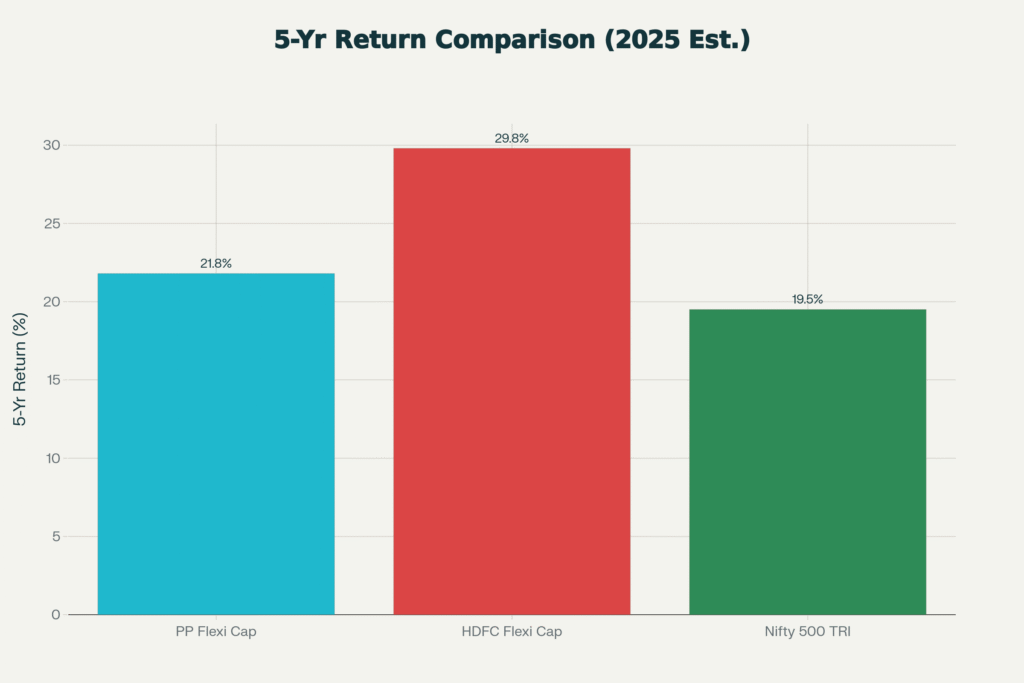
| 5 years | ~21.8% per annum[web:11] | Substantial wealth creation for disciplined SIP and lump sum investors.[web:11][web:12] |
| Since inception (2013) | ~19.7% CAGR[web:2][web:12] | Strong long‑term track record over 12+ years.[web:2][web:12] |
Independent platforms and research tools consistently rate Parag Parikh Flexi Cap Fund among the better-performing flexi-cap funds on a 5–10 year basis, highlighting its ability to protect downside and participate reasonably in bull markets.[web:5][web:11][web:20] The fund has also seen the highest AUM accretion among flexi-cap peers over the last six months, reflecting strong investor trust and inflows.[web:7]
How to invest in Parag Parikh Flexi Cap Fund
Investing in the Parag Parikh Flexi Cap Fund is straightforward for both new and experienced investors, and you can choose either direct or regular plans depending on whether you go through an intermediary. Before you begin, ensure your KYC is complete with a valid PAN, Aadhaar-linked mobile, and a bank account in your name as per SEBI norms.[web:27][web:31]
Step-by-step process to invest
- Complete or update your KYC: Use any KRA, AMC website, or online investment platform to complete KYC with PAN, Aadhaar, address proof and bank details, if not already done.[web:27]
- Choose Direct vs Regular plan: Opt for the Direct plan if you are comfortable investing yourself via the AMC or fee-based platforms; choose the Regular plan if you prefer going through a distributor or bank and are okay paying a higher expense ratio for advice and service.[web:11][web:18]
- Select investment mode (SIP vs lump sum): SIPs start at ₹1,000 per month, which suits salaried investors building wealth gradually; lump sums should typically be staggered if markets are at elevated levels to reduce timing risk.[web:9]
-
Invest via preferred channel:
- PPFAS AMC website or app (Direct plan investment).[web:9]
- Online mutual fund platforms (Groww, ET Money, INDmoney, Paytm Money etc.).[web:2][web:8][web:17][web:18]
- Demat/brokerage accounts that offer mutual funds.[web:11]
- Banks or mutual fund distributors (Regular plan).[web:10]
- Set your time horizon and expectations: Being an equity flexi-cap fund, Parag Parikh Flexi Cap Fund is suitable mainly for long-term goals (ideally 7–10 years or more), and investors should be prepared for short-term volatility.[web:5][web:11][web:20]
For tax purposes, gains from the Parag Parikh Flexi Cap Fund are taxed as equity mutual fund capital gains, with different rates and rules for short-term and long-term holdings under the latest income-tax framework.[web:27][web:28][web:38] Given multiple recent changes in equity mutual fund taxation, it is sensible to cross-check current slabs or consult a tax professional before making large redemptions.[web:27][web:30][web:38]
Competitor flexi cap funds that have outperformed recently
While the Parag Parikh Flexi Cap Fund scores well on consistency and governance, some competing flexi-cap funds have delivered higher returns over specific time frames, especially over the last five years.[web:10][web:13][web:16] “Better” in mutual funds is always relative to your time horizon, risk profile, and return expectations, so raw returns should be only one part of your decision framework.[web:16][web:20]
Key flexi cap competitors vs Parag Parikh Flexi Cap Fund
| Fund | Why it stands out | Where it may be better than Parag Parikh Flexi Cap Fund | Important caveats |
|---|---|---|---|
| HDFC Flexi Cap Fund[web:10][web:16] | Large and established flexi-cap fund with aggressive allocation and strong performance in domestic bull markets.[web:10][web:16] | Over the last 5 years, HDFC Flexi Cap has delivered higher annualised returns (around 29.8% vs about 22.9% for Parag Parikh in one widely cited comparison).[web:16] | Can be more volatile and may underperform in certain market phases; overall 10‑year return still trails Parag Parikh Flexi Cap Fund in that same comparison.[web:16] |
| JM Flexicap Fund[web:10] | Ranked near the top of the flexi-cap category on some platforms based on its 5‑year track record.[web:10] | Has shown strong recent performance numbers, putting it ahead of many larger peers on a pure return basis.[web:10] | Smaller fund size and limited long‑history visibility compared to Parag Parikh Flexi Cap Fund, so investors should evaluate stability and consistency carefully.[web:10][web:13] |
| Bank of India Flexi Cap Fund[web:10] | Features in “best flexi-cap funds” lists by return metrics, particularly over the last few years.[web:10] | Some 5‑year return screens show this fund marginally ahead of Parag Parikh Flexi Cap Fund on CAGR, depending on the evaluation date.[web:10][web:13] | Lower AUM and a shorter history than Parag Parikh Flexi Cap may affect liquidity and long‑term predictability.[web:7][web:10] |
| Other notable flexi-cap funds (Kotak, Motilal Oswal, Franklin India etc.)[web:7][web:10][web:13] | These funds have also delivered competitive returns and attract meaningful investor flows, showing that the category has multiple viable options.[web:7][web:10][web:13] | Some may outperform Parag Parikh Flexi Cap Fund over 3–5 years depending on style (value vs growth, mid-cap bias, etc.).[web:10][web:13][web:20] | Differences in risk levels, portfolio concentration and fund philosophy mean these are not like‑for‑like replacements and require deeper analysis.[web:10][web:13][web:20] |
Over a 10‑year window, Parag Parikh Flexi Cap Fund still compares very favourably against most peers, even when some rivals pull ahead in the most recent 5‑year slice.[web:2][web:12][web:16] For many investors, the choice often comes down to whether they prefer a slightly more aggressive domestic‑heavy flexi-cap fund, such as HDFC Flexi Cap, or a relatively conservative, valuation‑conscious approach as followed by Parag Parikh Flexi Cap Fund.[web:5][web:11][web:16]
Is Parag Parikh Flexi Cap Fund right for you?
The Parag Parikh Flexi Cap Fund works well as a core equity holding for long-term investors who want one diversified fund instead of juggling multiple schemes across market caps.[web:5][web:11] Its track record, large AUM and focus on flexibility across sectors and geographies make it suitable for patient investors who can handle equity volatility and are investing for goals 7–10 years away.[web:7][web:9][web:12]
- It is more suitable for SIP‑based, long‑term accumulation than for short‑term speculative investing, given the equity risk and exit load structure up to two years.[web:9][web:11]
- Conservative or near‑term goal investors should combine or replace it with safer fixed‑income instruments instead of relying purely on this fund.[web:5][web:20]
- Investors comparing it with “better” flexi-cap funds should look beyond just 1‑ or 5‑year returns and evaluate downside protection, consistency, fund manager style and their own risk tolerance.[web:10][web:16][web:20]
FAQ on Parag Parikh Flexi Cap Fund
1. Is Parag Parikh Flexi Cap Fund good for SIP?
Yes, the Parag Parikh Flexi Cap Fund is widely used as a long-term SIP fund because of its strong 5‑year and since‑inception performance, along with a disciplined, valuation‑driven investing approach.[web:2][web:5][web:11] With a minimum SIP of ₹1,000 per month, it is accessible to new investors while still being robust enough for large, long‑term portfolios.[web:9]
2. What is the risk level of Parag Parikh Flexi Cap Fund?
Being an equity flexi-cap fund, Parag Parikh Flexi Cap Fund carries high market risk, and its NAV can fluctuate significantly in the short term based on stock prices and overall sentiment.[web:5][web:11][web:20] Investors should be prepared for temporary drawdowns and ideally keep an investment horizon of at least 7–10 years to reduce the impact of volatility.[web:5][web:20]
3. What is the exit load structure?
On each purchase or switch‑in, up to 10% of units can be redeemed without exit load, while redemptions above that limit attract 2% if sold within 365 days, 1% if sold between 366–730 days, and no exit load after 730 days for investments made on or after 15 November 2021.[web:9] This structure nudges investors to stay invested for at least two years and discourages frequent short‑term churn.[web:9]
4. How is Parag Parikh Flexi Cap Fund taxed?
Taxation of the Parag Parikh Flexi Cap Fund follows the equity mutual fund rules for capital gains, with different rates for short‑term and long‑term gains under the latest income‑tax framework.[web:27][web:28][web:38] Because tax rules for equity mutual funds have changed recently, investors should verify the latest STCG and LTCG slabs or consult a tax advisor before planning large redemptions.[web:27][web:30][web:38]
5. Is Parag Parikh Flexi Cap Fund better than HDFC Flexi Cap Fund?
Over the last 5 years, HDFC Flexi Cap Fund has delivered higher returns than Parag Parikh Flexi Cap in at least one published comparison, while Parag Parikh Flexi Cap leads on a 10‑year basis in that same study.[web:16] Which is “better” depends on your risk appetite and holding period: HDFC Flexi Cap has historically been more aggressive, whereas Parag Parikh Flexi Cap emphasizes valuation discipline and long‑term compounding.[web:5][web:11][web:16]
6. Can Parag Parikh Flexi Cap Fund be the only equity fund in my portfolio?
Many investors use the Parag Parikh Flexi Cap Fund as a single core equity holding because its flexible mandate allows exposure across caps and, when appropriate, international markets.[web:7][web:9][web:12] However, investors with very high risk appetite may still add dedicated mid-cap or small-cap funds, while very conservative investors might prefer combining it with balanced or hybrid funds.[web:5][web:20]
7. What is the minimum investment in Parag Parikh Flexi Cap Fund?
The minimum lump sum investment is ₹1,000 for new and additional purchases in the Parag Parikh Flexi Cap Fund.[web:9] For SIPs, the minimum is typically ₹1,000 per month for monthly SIPs and ₹3,000 for quarterly SIPs as per the AMC’s latest scheme details.[web:9]
8. How does Parag Parikh Flexi Cap Fund manage downside risk?
The fund house emphasizes investing based on valuations, diversification and a flexible mandate that allows shifting across market caps and, when needed, across geographies, which has historically helped during market corrections.[web:5][web:9][web:12] Ratings from independent research firms highlight its relatively good risk‑adjusted returns and behaviour across market cycles compared with category peers.[web:5][web:11][web:20]
9. How do Direct and Regular plans of Parag Parikh Flexi Cap Fund differ?
The Direct plan of Parag Parikh Flexi Cap Fund has a lower expense ratio (around 0.63%) compared with the Regular plan, which includes distributor commissions built into the cost.[web:11][web:15][web:18] Over long periods, this cost difference can translate into noticeably higher net returns in the Direct plan for the same underlying portfolio.[web:11][web:18]
10. Where can I track the latest performance of Parag Parikh Flexi Cap Fund?
You can monitor latest NAVs, returns and portfolio data on the PPFAS AMC website as well as platforms like Groww, ET Money, INDmoney, Paytm Money, Tickertape and similar fintech portals.[web:2][web:8][web:11][web:17][web:18] These sites usually provide updated performance charts, risk metrics and category comparisons that help you review whether the fund is still aligned with your goals.[web:2][web:5][web:20]