Imagine spending years carefully spreading your money across five different mutual funds. Large-cap funds. Mid-cap funds. Blue-chip equity funds. You feel confident. Diversified. Protected.
Then the market drops 20%. And every single one of your funds falls — almost in lockstep.
What happened? Portfolio overlap happened. And for millions of investors in India and across the world, it’s silently eating away at the very diversification they think they have.
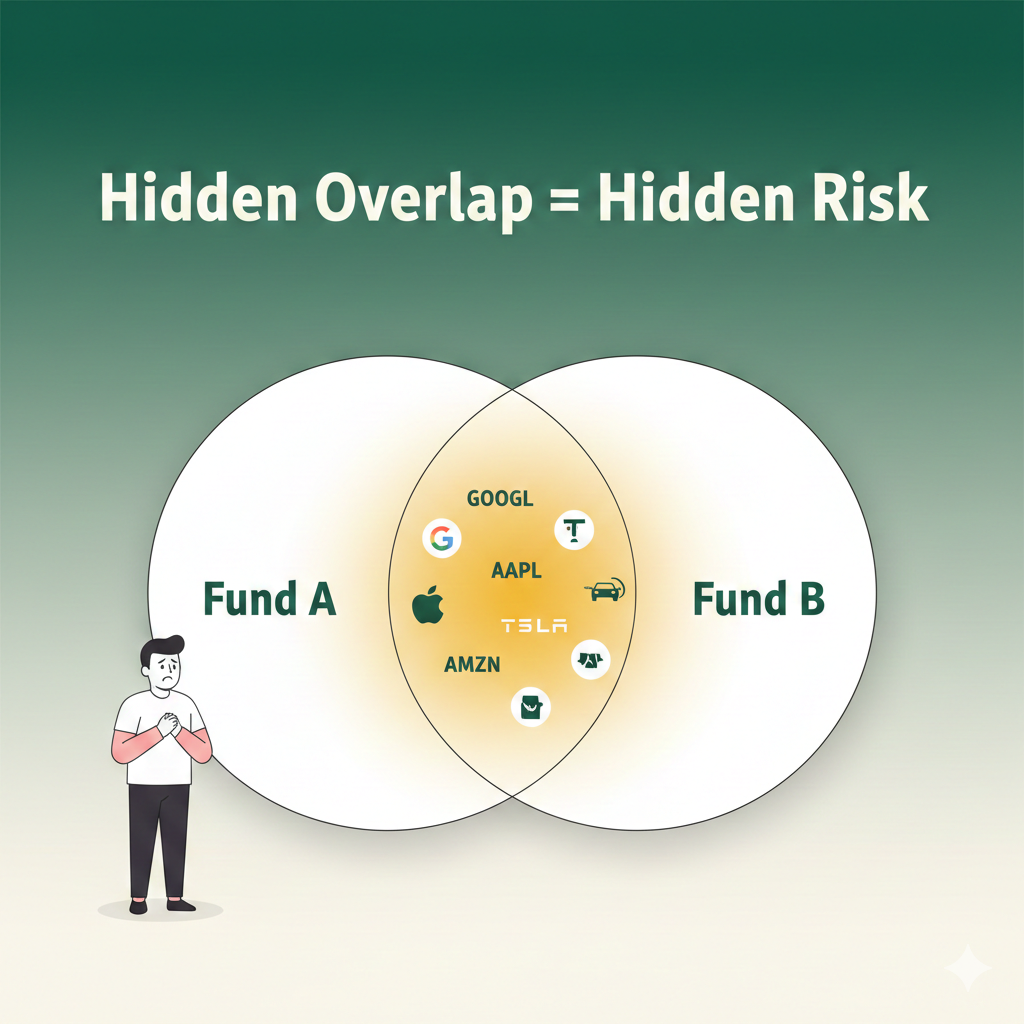
Portfolio overlap occurs when two or more funds or investments you hold contain the same underlying stocks or assets, creating hidden concentration risk disguised as diversification.
What Exactly Is Portfolio Overlap?
Portfolio overlap is when multiple mutual funds or ETFs in your portfolio share common holdings. On the surface, owning four different equity funds sounds smart. But if three of them hold HDFC Bank, Infosys, and Reliance Industries as their top positions — you’re not as diversified as you think.
Your money is effectively making the same bet, multiple times. When those shared stocks go up, great. But when they fall, your entire portfolio takes a magnified hit.
Think of it like this: you order a “Thali” at a restaurant expecting variety, but every dish is paneer. The presentation looks different, but the core ingredient is the same.
Why Portfolio Overlap Is a “Silent” Wealth Killer
The word “silent” is key here. Unlike a bad stock pick or a market crash, portfolio overlap doesn’t announce itself. There’s no red alert on your brokerage app. No fund manager warning you. It quietly does its damage over years — and by the time you notice, it’s usually too late.
Here’s how the damage plays out in practice:
1. False Sense of Diversification
The most dangerous part of portfolio overlap is the false confidence it breeds. Investors who hold multiple funds often believe they’re well-diversified — but concentration risk is hiding under the surface. True diversification means spreading risk across different companies, sectors, and asset classes.
2. Amplified Downside Risk
When your overlapping stocks fall, every fund in your portfolio takes a hit — simultaneously. The result is that your losses are multiplied, not cushioned. This is the exact opposite of what diversification is supposed to do.
3. Paying Double (or Triple) Fees for the Same Exposure
Each mutual fund charges an expense ratio. If three of your funds are investing in the same 15 stocks, you’re effectively paying three sets of fees for what is essentially one investment. Over a 10–20 year period, those wasted fees can amount to lakhs of rupees.
4. Poor Capital Allocation
The capital you think is working diversely is actually stacked in the same corner. This means less money is going into truly different opportunities — mid-caps, international funds, debt instruments, or alternative assets that could genuinely reduce your risk profile.
An investor holding HDFC Flexi Cap, Mirae Asset Large Cap, and SBI Bluechip Fund might appear diversified across fund houses — but studies show these three funds share up to 55–65% of their top holdings, particularly in stocks like HDFC Bank, ICICI Bank, Infosys, and Reliance.
How to Check If Your Portfolio Has Overlap
The good news is that portfolio overlap is fully detectable — if you know where to look. Here are four practical ways to find out:
Use a Free Overlap Checker Tool: Platforms like Morningstar (X-Ray feature), Value Research Online, or Kuvera in India allow you to enter your fund holdings and instantly see how much overlap exists between them. These tools visualise common holdings in minutes.
Read the Fund Fact Sheets: Every mutual fund publishes a monthly fact sheet listing its top 10 holdings. Download two or three of your funds’ fact sheets and compare them manually. If the same names keep appearing — you have overlap.
Check the Fund Mandate and Benchmark: Two funds with the same benchmark (e.g., Nifty 50) are very likely to hold similar stocks. If your funds track or compete against the same index, overlap is almost guaranteed.
Correlation Analysis: More advanced investors can track the monthly NAV movements of their funds. If two funds move almost identically — rising and falling together — they are likely overlapping. High correlation = hidden concentration.
How Much Overlap Is Too Much?
There’s no universal rule, but here’s a widely accepted framework among financial planners:
| Overlap Level | What It Means | Action Required? |
|---|---|---|
| Below 30% | Healthy diversification between funds | No Action |
| 30% – 50% | Moderate overlap — monitor closely | Review |
| Above 50% | High overlap — you are doubling up on risk | Act Now |
| Above 70% | Near-identical funds — one should be replaced | Consolidate |
5 Proven Ways to Eliminate Portfolio Overlap
Once you’ve identified overlap in your portfolio, here’s how to fix it without disrupting your entire investment strategy:
Consolidate Duplicate Fund Categories
If you hold three large-cap funds, there’s no point. Pick the best performer (or the one with the lowest expense ratio and highest consistency) and exit the others gradually to avoid tax implications.
Diversify Across Fund Categories
True diversification means mixing fund categories — a large-cap fund, a mid-cap fund, a small-cap fund, a debt fund, and perhaps an international fund. Each category naturally holds different stocks, which automatically reduces overlap.
Add Non-Equity Assets
Bonds, gold ETFs, REITs (Real Estate Investment Trusts), and international equity funds offer exposure to markets that are structurally different from Indian equities. Adding even 10–20% of your portfolio here can dramatically cut correlation.
Choose Funds With Different Benchmarks
A Nifty 50 index fund and a Nifty 500 index fund overlap significantly. But pairing a Nifty 50 fund with a Nifty Midcap 150 fund or a Nifty IT fund creates genuine diversification. Different benchmarks typically mean different underlying stocks.
Review Your Portfolio Annually
Overlap is not static. As fund managers rebalance their portfolios, new overlap can emerge over time. Making an annual check-up a habit — ideally every January or after major market events — keeps your diversification genuine rather than cosmetic.
When building a portfolio from scratch, start with funds from different market-cap segments and asset classes before adding a second fund from the same category. This “category-first” approach naturally prevents overlap at the foundation level.
The Real Cost of Ignoring Portfolio Overlap
Let’s put some numbers to this. Suppose you invest ₹10,000 per month across five mutual funds that have 60% overlap with each other. Effectively, you’re achieving the diversification of roughly two to three distinct funds, not five.
Now assume the extra expense ratios you’re paying on duplicate exposure cost you 0.5% per year on a ₹30 lakh portfolio. That’s ₹15,000 per year — or ₹3 lakh over 20 years, before compounding. Add to that the missed returns from not investing in genuinely different sectors, and the true cost of overlap compounds dramatically.
Beyond the numbers, there’s an emotional cost too. Investors who discover heavy overlap after a market crash often make panic-driven decisions, further damaging their long-term wealth. Knowing your portfolio is genuinely diversified gives you confidence to stay invested through volatility.
🚨 When NOT to Rely on Google Search — Ask an Expert Instead
Google is a brilliant starting point for financial education. But there are specific situations where searching online can give you a dangerously incomplete or outright misleading picture. Here’s when you must put down the keyboard and call a qualified financial advisor:
When Your Portfolio Is Worth More Than ₹25 Lakhs
At this level, tax-efficiency, estate planning, and fund selection become highly personalised. Generic advice online rarely accounts for your specific tax slab, risk profile, or goals. A SEBI-registered investment advisor (RIA) can give you a tailored strategy that a Google search simply cannot.
When You’re Approaching Retirement
The rules change fundamentally as you approach retirement. Sequence-of-returns risk, withdrawal strategies, and portfolio rebalancing require expert guidance. A mistake here can cost you years of carefully built wealth. Don’t let a blog post (including this one!) be your sole advisor.
When You’re Unsure About Tax Implications
Exiting funds to fix overlap can trigger capital gains taxes. Whether it’s short-term (STCG) or long-term (LTCG), the tax impact needs to be calculated against your actual benefit. A Chartered Accountant or tax-savvy financial planner is essential here.
When You Spot Conflicting Advice Online
Financial advice online is often written for general audiences, not for your situation. When two credible sources say opposite things — and you’re about to make a significant investment decision — trust a professional who knows your full financial picture.
When Dealing With NRI Investments or Cross-Border Taxation
If you’re an NRI investing in Indian markets, or an Indian resident investing in international funds, the regulatory and tax framework is complex. FEMA rules, TDS on redemptions, and DTAA benefits are not topics to navigate alone via search.
Look for a SEBI-registered Investment Advisor (RIA) on the SEBI website, or use platforms like Stable Investor, Scripbox, or a trusted fee-only financial planner. Avoid advisors who earn commissions — they may recommend funds that benefit them, not you.
Final Thoughts: Stop Paying for an Illusion of Diversification
Portfolio overlap is not a dramatic, headline-grabbing risk. It won’t crash your portfolio overnight. But it will quietly, consistently erode the benefits of diversification you’ve worked hard to build — and that makes it one of the most insidious wealth killers in investing.
The fix is not complicated. Check your overlap using free tools. Consolidate duplicate fund categories. Add genuinely different asset classes. And review once a year.
True wealth building isn’t about owning more funds — it’s about owning the right funds that work together purposefully. A portfolio with three well-chosen, non-overlapping funds will almost always outperform a bloated portfolio of eight funds that are all secretly betting on the same handful of stocks.
Your future self will thank you for the audit you do today.
📚 Sources & Further Reading
The data and insights in this post are drawn from the following credible sources. We encourage readers to explore these for deeper research:
India’s leading mutual fund research platform with portfolio overlap checker tool.
Global fund research firm with in-depth holding data and portfolio analysis.
Official regulatory body governing mutual funds and investment advisors in India.
Official monthly AUM data, NAVs, and fund categorization guidelines.
Investment platform offering a free, real-time portfolio overlap analysis tool.
Accessible explainer and overlap analysis backed by actual fund data.
Disclaimer: This article is for educational purposes only and does not constitute financial advice. Please consult a SEBI-registered investment advisor before making any investment decisions.