SIP Step-Up Calculator: How Adding ₹1,000 Yearly Can Double Your Corpus
The smartest trick in Indian personal finance that most investors completely ignore — and why it could be worth lakhs to your retirement.
Imagine you’re investing ₹5,000 per month in a SIP. You’ve been doing it for years. You feel good about it. But here’s a question most people never stop to ask: what if you increased that amount by just ₹1,000 every year?
Sounds small, right? After all, what difference can ₹1,000 make when we’re talking about building a retirement corpus of ₹1 crore or more?
The answer will surprise you. With the power of compounding and a strategy called Step-Up SIP (also called Top-Up SIP), that modest annual increase can literally double your final wealth — sometimes even more. This is the single most underutilised tool in Indian personal finance, and by the end of this article, you’ll know exactly how to use it.
In this guide, you will learn what a SIP Step-Up Calculator is, how step-up SIPs work mathematically, see real numbers with examples in rupees, understand the mistakes to avoid, and get actionable tips to start increasing your SIP today.
📋 Table of Contents
- What Is a Step-Up SIP?
- Interactive SIP Step-Up Calculator
- How the Step-Up SIP Works Mathematically
- Flat SIP vs Step-Up SIP: The Numbers Don’t Lie
- Real-Life Case Study: Priya’s Retirement Plan
- Expert Tips: Getting the Most Out of Step-Up SIP
- Common Mistakes to Avoid
- April 2026 Changes Affecting Your SIP
- Frequently Asked Questions
- Conclusion
What Is a Step-Up SIP?
A Step-Up SIP (also called a Top-Up SIP or SIP with annual increment) is a type of Systematic Investment Plan where you commit to automatically increasing your monthly investment amount at regular intervals — typically every year.
For example, instead of investing a flat ₹5,000 every month for 20 years, you start at ₹5,000 and increase by ₹500 or ₹1,000 every April. By year 5, you’re investing ₹9,000–₹10,000 per month. By year 10, it’s ₹14,000–₹15,000. All without ever feeling a dramatic pinch, because your income typically grows in step with your career.
Two Types of Step-Up SIPs
- Fixed Amount Step-Up: Increase by a fixed rupee amount every year (e.g., ₹500 or ₹1,000 more each year).
- Percentage Step-Up: Increase by a fixed percentage every year (e.g., 10% more each year). This is more aggressive and aligns well with salary growth.
Most major mutual fund platforms in India — including Zerodha Coin, Groww, Paytm Money, Kuvera, and AMC-direct platforms — support step-up SIPs. You can set it up once and forget it; the increments happen automatically.
🧮 SIP Step-Up Calculator
Use this interactive calculator to see the real difference a step-up SIP makes on your investment journey. Enter your details below:
SIP Step-Up Calculator
Your estimated results:
* For illustration only. Actual returns may vary. Mutual fund investments are subject to market risk.
How the Step-Up SIP Works Mathematically
Understanding the math behind a Step-Up SIP isn’t just academic — it helps you trust the strategy and stick with it through market downturns.
The Flat SIP Formula
For a regular flat SIP, the future value (FV) is calculated as:
Where P = monthly investment, r = monthly return rate, n = number of months
The Step-Up SIP Calculation
For a step-up SIP, the calculation is more involved. Each year’s SIP amount is treated as a separate flat SIP series, and all the future values are added together.
If you start with ₹P and add ₹S every year for Y years:
- Year 1: SIP = ₹P for 12 months, grown over (Y-1) years after that
- Year 2: SIP = ₹(P+S) for 12 months, grown over (Y-2) years after that
- Year 3: SIP = ₹(P+2S) for 12 months, grown over (Y-3) years after that
- …and so on
The total corpus is the sum of all these individual series. This is why the difference can be enormous — every incremental rupee you add early on benefits from many more years of compounding.
Flat SIP vs Step-Up SIP: The Numbers Don’t Lie
Let’s look at a concrete comparison. We’ll assume a starting SIP of ₹5,000/month, a 12% annual return, and compare across different step-up amounts and time horizons.
20-Year Comparison (12% Expected Annual Return)
| Strategy | Monthly SIP (Year 1) | Annual Top-Up | Total Invested | Estimated Corpus | Wealth Gain |
|---|---|---|---|---|---|
| Flat SIP | ₹5,000 | ₹0 | ₹12,00,000 | ₹49.96 Lakh | — |
| Step-Up ₹500/yr | ₹5,000 | ₹500 | ₹18,30,000 | ₹73.42 Lakh | +₹23.46 Lakh |
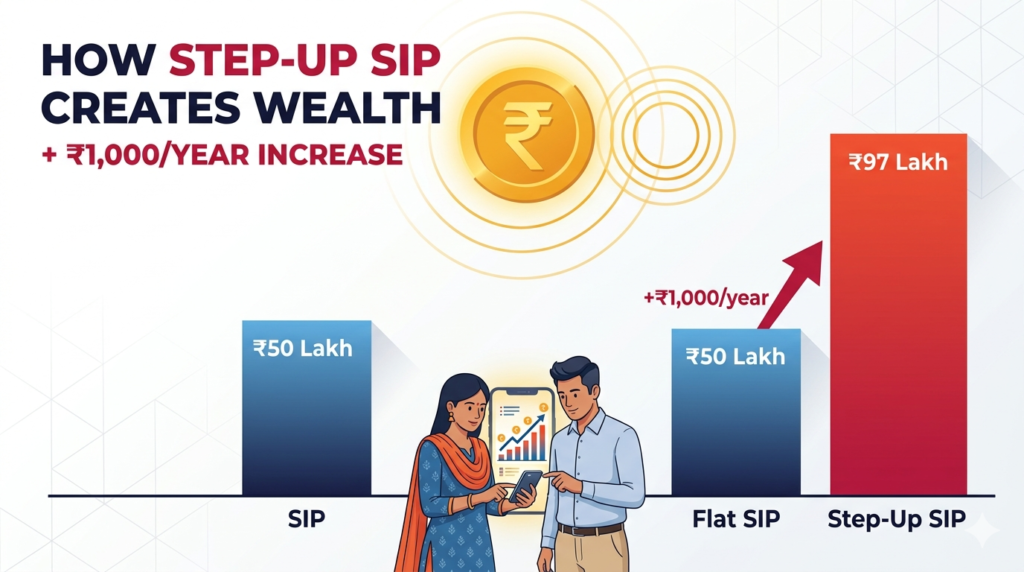
| Step-Up ₹1,000/yr | ₹5,000 | ₹1,000 | ₹24,60,000 | ₹96.88 Lakh | +₹46.92 Lakh |
| Step-Up ₹2,000/yr | ₹5,000 | ₹2,000 | ₹37,20,000 | ₹1.43 Crore | +₹93.04 Lakh |
| 10% Annual % | ₹5,000 | 10% of SIP | ₹34,36,000 | ₹1.58 Crore | +₹1.08 Crore |
*Approximate values for illustration. Assumes 12% p.a. compounded monthly. Actual returns vary by fund.
Visual: How Corpus Grows with Step-Up
Real-Life Case Study: Priya vs Rahul
📊 A Tale of Two SIP Investors
Priya starts a SIP of ₹5,000/month in a diversified equity mutual fund. Every April, when she receives her salary hike, she increases her SIP by ₹1,000. She doesn’t think about it much — it’s automatic.
Rahul also starts a SIP of ₹5,000/month in the same fund. He plans to “increase it someday” but never quite gets around to it. The flat ₹5,000 continues for 20 years.
| Metric | Priya (Step-Up ₹1,000/yr) | Rahul (Flat ₹5,000/month) |
|---|---|---|
| Starting SIP | ₹5,000/month | ₹5,000/month |
| SIP in Year 10 | ₹14,000/month | ₹5,000/month |
| SIP in Year 20 | ₹24,000/month | ₹5,000/month |
| Total Invested (20 yrs) | ~₹24.6 Lakh | ~₹12 Lakh |
| Corpus at 20 Years (12% p.a.) | ~₹97 Lakh | ~₹50 Lakh |
| Extra Corpus Earned | Priya earns ~₹47 Lakh MORE | |
Priya invested ₹12.6 lakh more than Rahul in total, but received ₹47 lakh more in return. That’s a net gain of over ₹34 lakh — just from a ₹1,000/year increase. And remember, that ₹1,000/year increase is far less than the average salary hike most IT professionals receive.
💡 Expert Tips: Getting the Most Out of Step-Up SIP
Tip 1: Link Your Step-Up to Your Annual Appraisal
The best time to increase your SIP is right after your annual salary hike. If you get a 10% raise, redirect at least 25–30% of that additional income to your SIP top-up. You won’t miss what you never had in your bank account.
Tip 2: Use Percentage Step-Up for Long Horizons
If you have 15+ years to invest, a percentage-based step-up (10–15% per year) is more powerful than a fixed rupee step-up. This is because the base keeps growing, and compounding works more aggressively over longer horizons.
Tip 3: Don’t Step Up in a Single Fund Blindly
As your SIP amount grows, diversification matters more. Review your fund portfolio annually. If your corpus crosses ₹10–15 lakh in a single fund, consider adding a second fund — perhaps a mid-cap or international fund — for the step-up portion.
Tip 4: Use Goal-Based Step-Up
Tip 5: Automate Everything
Almost every major AMC and fintech platform in India now supports step-up SIP automation. Set it up once with your AMC or platform (Groww, Kuvera, MFCentral, etc.) so the increase happens automatically. If it requires a manual action, it often won’t happen.
Tip 6: Don’t Stop During Market Downturns
This is the hardest but most important tip. When markets fall 20–30%, the instinct is to stop or reduce your SIP. In reality, market downturns are the best time to be investing more, not less. Your step-up buys more units at lower prices — a built-in “buy low” mechanism.
Tip 7: Review Your Step-Up Amount Every 3 Years
Inflation in India has averaged around 5–6% over recent years. If your step-up amount stays fixed at ₹1,000 for 15 years, its real value erodes. Revisit your step-up amount every 3 years and increase it to stay ahead of lifestyle inflation.
⚠️ Common Mistakes to Avoid with Step-Up SIP
Many investors wait until they are “financially comfortable” before starting a step-up. The reality is, even a ₹500/year step-up started at 25 beats a ₹2,000/year step-up started at 35, in absolute corpus terms. Time is your most valuable asset.
Some investors commit to a ₹5,000/year step-up when their income doesn’t support it. In year 3, they find the SIP is eating into emergency funds. Start conservatively (₹500–₹1,000), stabilise, and then increase.
From April 2026, New Income Tax Act 2025 rules apply. For equity mutual funds, LTCG above ₹1.25 lakh is taxed at 12.5%. For debt funds, gains are taxed as per your income slab. Factor this into your corpus projections.
Avoid step-up SIPs in very high-risk thematic or sectoral funds. These are best as a small satellite allocation. For step-up strategies (where consistency matters), stick to diversified large-cap, flexi-cap, or index funds.
As your investment corpus grows significantly due to step-up, ensure your nominees are updated, your KYC is current, and your family knows where your investments are. A large corpus with outdated nominees can create complications.
Career transitions are the most common reason investors pause SIPs. If you’re between jobs, reduce to the minimum rather than stopping entirely. Stopping a step-up SIP mid-way breaks compounding continuity and is very hard to recover.
April 2026 Changes That Affect Your SIP Strategy
Several significant financial and tax changes came into effect from April 1, 2026, which directly impact mutual fund investors. Here’s what you need to know:
1. New Income Tax Act 2025 — Cleaner Tax Year
The old Income Tax Act 1961 has been replaced by the Income Tax Act 2025. The biggest simplification: the concepts of “Previous Year” and “Assessment Year” are merged into a single Tax Year. Tax Year 2026 = income earned April 2025 to March 2026, filed in 2026. This makes ITR filing less confusing.
2. LTCG on Sovereign Gold Bonds (SGB) — Affects Portfolio Diversification
SGB maturity gains are now tax-free only for original RBI buyers. Secondary market buyers pay 12.5% LTCG. This changes the calculus for investors who were using SGBs as a debt-like safe haven — equity mutual funds (especially index funds) now look relatively more attractive from a tax efficiency standpoint.
3. Revised Return Filing Timeline
You now have 12 months (up from 9 months) to file a revised return. However, filing after 9 months will attract a late fee even within this extended window. For mutual fund investors with capital gains reporting, plan your ITR well before the 9-month mark to avoid penalties.
4. Salary Structure Changes Affecting SIP Capacity
The new wage code mandates that base salary (Basic + DA) must be at least 50% of CTC. This means EPF contributions will increase — your monthly take-home may reduce slightly while your EPF corpus grows. This could temporarily reduce your SIP headroom. Plan your step-up amounts accounting for this change in your net salary.
5. HRA Exemption Extended to 8 Cities
HRA exemption of 50% now applies to 8 cities (Bangalore, Ahmedabad, Pune, and Hyderabad added to the existing 4). If you live in these cities and claim HRA, your taxable income decreases — meaning more cash is available for SIP investment. This is a subtle but real opportunity for investors in tech hubs like Bengaluru and Hyderabad.
❓ Frequently Asked Questions
Conclusion: Start Your Step-Up SIP Today
The SIP step-up strategy is perhaps the simplest, most powerful, and most underused tool available to Indian retail investors. You don’t need a financial advisor, a complicated portfolio, or a large income to use it. You just need consistency and a small annual commitment to increase your investment.
Here’s what we learned today:
- A ₹1,000/year step-up from a ₹5,000 base SIP can nearly double your 20-year corpus at 12% returns
- The magic is compounding — early increases have the most impact
- Link your step-up to your annual salary hike so it’s painless
- Automate it on your AMC or investment platform
- Factor in April 2026 changes (higher EPF deductions, new tax act) when planning your step-up amount
- Don’t stop during market downturns — that’s when the step-up is most valuable
📚 Related Articles
From Investopedia India:
External Resources: