💳 The 55‑day lie:
How credit card interest actually works in India
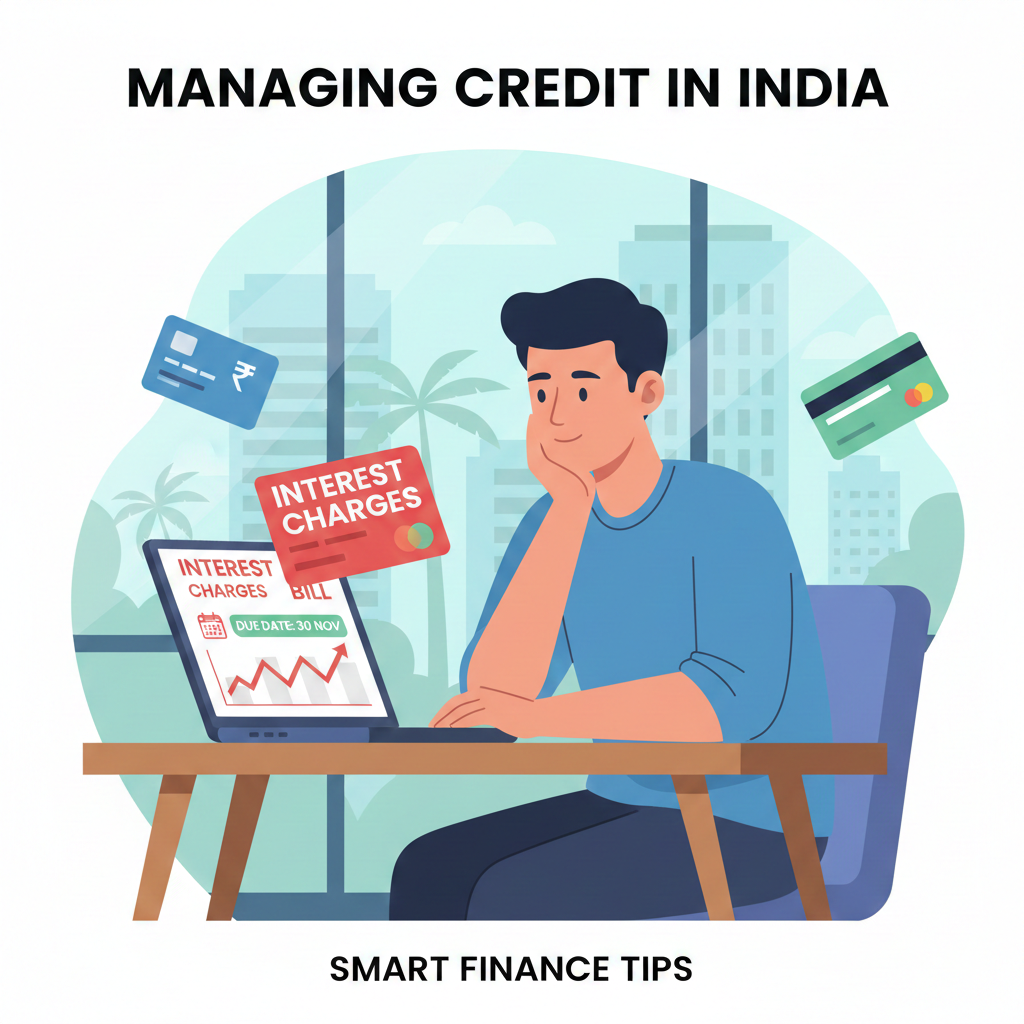
✨ Meet Aarav — 28, marketing professional, Pune. He got his first credit card two years ago. “Interest? I always pay in full, why worry?” he thought. But last Diwali, he spent ₹78,000 on gifts, a new phone, and dinner. He paid ₹70,000 before the due date, thinking “just ₹8,000 remaining — they’ll charge a little interest, maybe a couple hundred rupees.”
📉 The next statement arrived: interest charges: ₹2,912 on just ₹8,000 leftover. Aarav was shocked. How did this happen? Let’s walk through his statement and decode the labyrinth of Indian credit card interest — because it’s not what most people expect.
⚖️ The two faces of interest
In India, credit card interest is often called the “monthly interest rate” (usually 1.5% to 3.5% per month). But that’s a trap — it’s not simple interest; it’s a complex structure with a free period that vanishes the moment you don’t pay 100%.
🧾 Aarav’s card terms (typical for India)
📆 Monthly interest
⏱️ Free credit period
💰 Late payment fee
📅 The billing cycle — where Aarav slipped
Let’s reconstruct Aarav’s transaction timeline. His statement is generated on the 5th of every month, and the due date is usually 20th of the same month (or 25th, depending on bank).
- 🔹 Oct 20 – Aarav buys Diwali gifts: ₹32,000
- 🔹 Oct 25 – New phone (EMI opted separately, but that’s another story) — ₹38,000
- 🔹 Oct 30 – Restaurant & fuel: ₹8,000
- 🔹 Nov 5 – Statement generated: total ₹78,000.
Due date: Nov 20.
Aarav paid ₹70,000 on 18 November (before due date). He assumed the remaining ₹8,000 would roll over with small interest. Big mistake — banks in India don’t charge interest only on the leftover; they can charge from the transaction date if the full amount isn’t cleared. And that’s exactly what happened.
⛓️ The ‘retrospective interest’ hammer
Here’s the crucial rule: when you don’t pay the full outstanding amount by the due date, you lose the entire interest-free period for all transactions — old and new. Interest is levied on the total outstanding from the date of each transaction until the payment date, and then on the remaining balance thereafter.
🔍 Breaking down Aarav’s interest calculation
Step 1 – Interest on each transaction from date of purchase to payment date (18 Nov):
- For ₹32,000 (20 Oct) → 29 days (20 Oct–18 Nov) @ 3.5% p.m.
- For ₹38,000 (25 Oct) → 24 days interest
- For ₹8,000 (30 Oct) → 19 days interest
Daily interest rate = 3.5% / 30 = 0.11666% per day.
📐 Calculation:
₹32,000 × 0.11666% × 29 = ₹1,082
₹38,000 × 0.11666% × 24 = ₹1,064
₹8,000 × 0.11666% × 19 = ₹177
Total interest on transactions (till 18 Nov) = ₹2,323
But wait — that’s not all. After 18 November, he still carried ₹8,000. That amount keeps accumulating daily interest until the next statement.
🔄 Residual interest (revolving)
From 19 Nov to 5 Dec (next statement date) — another 17 days on ₹8,000.
Then, along with this, GST at 18% is charged on total interest. And a late payment fee of ₹1,200 because the minimum amount due wasn’t cleared? Actually, he paid ₹70,000 which was above the minimum due (usually 5% = ₹3,900), so no late fee. But banks also have something called “overlimit” or “cash advance”? Not here. But still, the interest amount shocked him.
Total interest + GST: (₹2,323 + ₹159) = ₹2,482. Add 18% GST = ₹447. Total interest charges: ₹2,929 (close to his actual bill). He also noticed a service charge for “unpaid interest” – but that’s already included.
💡 Why the ‘effective rate’ can exceed 42% p.a.
Banks advertise 3–3.5% monthly, which is around 36–42% annualised. But because interest is compounded monthly on the outstanding, and because old transactions also attract interest, the effective annual rate can cross 48% in some cases. Additionally, if you keep revolving, the interest snowballs — that’s how small unpaid amounts turn into huge burdens.
⚠️ The “retail investor” blindspot
Most Indians think credit card interest works like a personal loan — only on the unpaid amount. But because of the free period forfeiture rule, you end up paying interest on amounts you already paid, from the transaction date up to the payment date.
🧠 Grace period nuance
Even if you miss the due date by a day, the entire interest-free period for that cycle is nullified. Some banks also charge interest on new purchases until the entire old debt is cleared.
🔄 The ‘average daily balance’ method
Most Indian banks use the average daily balance method for revolving credit. They sum the outstanding balance for each day of the billing cycle, divide by number of days, and apply monthly interest rate. But in Aarav’s case, because he didn’t pay full, interest is calculated on transaction-level (retrospective). The net effect is similar, but the retrospective method feels harsher. Many banks (HDFC, SBI, ICICI) use a variant: they waive interest only if full payment is received by due date. Otherwise, “interest on all transactions from the respective transaction dates” until payment.
💼 Example with two transactions (simplified)
Suppose you have a ₹10,000 transaction on 1st of month, statement on 20th, due on 10th next month. You pay ₹9,000 on due date, leave ₹1,000. Interest:
₹10,000 from 1st to payment date (say 40 days) + ₹1,000 from payment date to next statement. You pay interest on the ₹9,000 you already paid — that’s the shocker.
🚨 Aarav’s lesson & how to stay safe
Aarav realised that carrying even a small balance forward wipes out the grace period for new purchases as well. After that statement, he paid everything in full for two months to reset the cycle. Banks don’t restore the grace period until you pay total outstanding for two consecutive cycles — yes, the damage lingers.
- Always pay the total amount due, not just minimum. Even if it’s a day late, call the bank and request a waiver (as a one-time goodwill gesture).
- Set up auto-debit for full amount — but ensure sufficient balance to avoid dishonour charges.
- Understand your statement dates: purchase just after statement date to get ~50 days free.
- If you must revolve, compare with a personal loan — many are cheaper (10–16% p.a.) than credit card interest.
- GST at 18% is extra on all interest and fees — so that ₹1000 interest actually costs ₹1180.
🧘 The moral of Aarav’s story:
“Credit card interest isn’t simple — it’s designed to be sticky. The moment you treat it as ‘almost paid’, it bites.”
Always clear 100% dues. Use credit cards for convenience and rewards, never as a loan — unless you enjoy paying ~42% interest.
📊 Quick reference: Interest calculation formula
If you ever need to estimate:
+ 18% GST + any fees.
And if you think 3.5% monthly is tiny, remember that’s 0.116% daily — compounds quickly. A leftover of ₹10,000 can attract ₹350+ interest in a month, plus GST. Over a year if you keep rolling, it’s like a 50% loan.