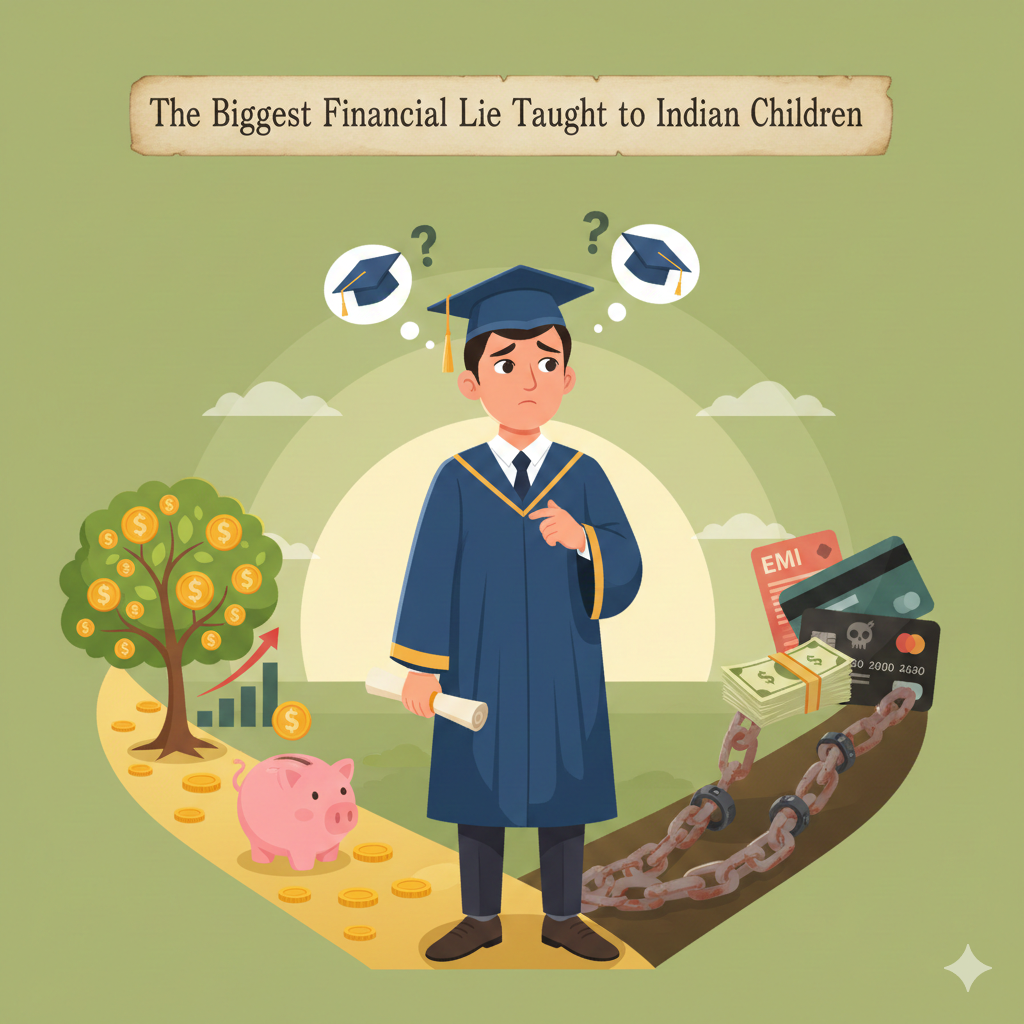
The Biggest Financial Lie Taught to Indian Children
The answer is devastatingly simple: Amit, like millions of Indian children, was fed a fundamental lie about money. Not a small lie. Not a white lie. But a life-altering, generation-spanning lie that has kept the Indian middle class perpetually trapped in financial mediocrity despite their intelligence, hard work, and qualifications.
The Lie
“Education and a Good Job Will Make You Rich”
How This Lie Gets Planted
From the moment an Indian child can understand language, they’re indoctrinated with a singular formula for life success: Study → Degree → Job → Security. Parents, teachers, relatives, society—everyone repeats this mantra like a sacred truth.
Money is never discussed as a skill to be learned. It’s presented as a consequence, a byproduct, something that “just happens” when you follow the prescribed path. “Focus on studies, beta, money will come automatically.” This one sentence has probably done more financial damage to Indian youth than any economic crisis.
Why This Lie Is So Dangerous
1. It Confuses Income with Wealth
A high salary is not the same as financial security. This distinction is never taught. Indian children grow up believing that earning ₹50,000 or ₹1 lakh per month means they’ve “made it.” They don’t understand that wealth isn’t what you earn—it’s what you keep and what your money earns for you.
I have friends earning ₹2 lakhs per month who live paycheck to paycheck. And I know people earning ₹60,000 per month who have built investment portfolios worth crores. The difference? One group was taught to earn. The other was taught to build wealth.
2. It Creates Financial Illiteracy by Design
By positioning money as something that “follows” education rather than as a skill itself requiring education, Indian children graduate into adulthood completely unprepared for financial decisions. They can solve differential equations but don’t know what a mutual fund is. They can code in five programming languages but have never read a financial statement. They have master’s degrees but don’t understand compound interest.
3. It Makes Children Fear Money Conversations
In Indian households, discussing money is considered crude, almost vulgar. “Don’t ask about salary,” “Don’t discuss prices,” “That’s not appropriate conversation.” Children learn that money is shameful, mysterious, something adults stress about behind closed doors but never discuss openly.
This creates adults who are terrified of negotiating salaries, embarrassed to ask about costs, uncomfortable discussing investments, and ashamed to admit financial struggles. The taboo around money talk ensures financial ignorance gets passed down generationally.
4. It Delays Financial Responsibility Until It’s Too Late
The Indian parenting model typically goes: Study until 24-25, then get married, then buy a house, then have children. By the time the average Indian starts thinking seriously about money, they’re 27-30 years old, already deep in EMIs and responsibilities, with zero foundation in financial literacy.
What Should Have Been Taught Instead
The Real Truth About Money:
Financial security doesn’t come from earning more—it comes from understanding money. And understanding money requires deliberate education, just like mathematics or science. It’s a skill, not a consequence.
Here’s what Indian children should be taught from age 10 onwards:
- The difference between assets and liabilities: A car is not an asset, it’s a liability. A house you live in is not an asset, it’s a liability. Assets put money in your pocket; liabilities take money out. This one concept would save Indian families from decades of bad decisions.
- Compound interest—both ways: Yes, compound interest helps your investments grow. But it also makes your credit card debt explode. Indian children graduate without understanding either side of this equation.
- The time value of money: ₹1,000 invested at age 20 is worth more than ₹10,000 invested at age 40. Starting early isn’t just beneficial, it’s exponentially powerful. Yet Indian parents tell children, “Don’t worry about money now, focus on studies.” This advice costs their children literally lakhs in lost compounding.
- Multiple income streams: Jobs are temporary, skills are permanent, but income streams are security. Children should be taught that relying on a single source of income is the riskiest financial position possible.
- Financial independence vs. high salary: The goal isn’t to earn ₹1 crore per year. The goal is to reach a point where you don’t need to earn anything because your assets generate enough income. This is freedom. Indian children are never taught to aim for freedom; they’re taught to aim for “good salary.”
The Generational Damage
This lie doesn’t just affect one generation—it creates a cascading effect. Parents who were never taught financial literacy can’t teach their children. Those children grow up, make the same mistakes, and pass the same ignorance to their kids. Three generations deep, and nobody in the family understands why they’re educated, employed, and yet perpetually struggling with money.
The tragedy deepens when you realize that many Indian parents sacrifice everything for their children’s education—they take loans, sell assets, skip medical treatments—believing that “once my child has a degree, everything will be fine.” But the child graduates into a system that values financial literacy they don’t have, expects investment decisions they can’t make, and offers financial products they don’t understand.
Breaking the Cycle
The good news? This lie can be unlearned. Financial literacy can be self-taught. It requires honesty, humility, and a willingness to admit that despite your engineering degree or medical license, you might be financially illiterate—and that’s okay, because it’s not your fault.
Start with basics: Read books on personal finance. Understand your own spending patterns. Learn about mutual funds, index funds, PPF, tax-saving instruments. Teach your children what your parents didn’t teach you. Make money conversations normal and shame-free in your household.
Most importantly, break the lie for the next generation. Tell your children the truth: “Education is important, but financial literacy is equally important. A degree will help you earn, but financial wisdom will help you keep and grow what you earn. Both matter.”
The Final Word
The biggest financial lie taught to Indian children isn’t that money doesn’t matter—it’s that money will automatically matter once you get educated. This lie has created generations of highly qualified, perpetually struggling individuals who work their entire lives without ever achieving financial freedom.
Education doesn’t make you rich. A good job doesn’t make you secure. Financial literacy, disciplined investing, and smart money management—these create wealth. Everything else just creates income, which evaporates as quickly as it arrives if you don’t know how to handle it.
Your parents weren’t lying to you maliciously. They were repeating what they were told, what worked in their time, what they believed to be true. But times have changed. The formula they gave you is outdated. It’s time to write a new one—for yourself, and for your children.
The truth will set you free, but first, you must unlearn the lie.