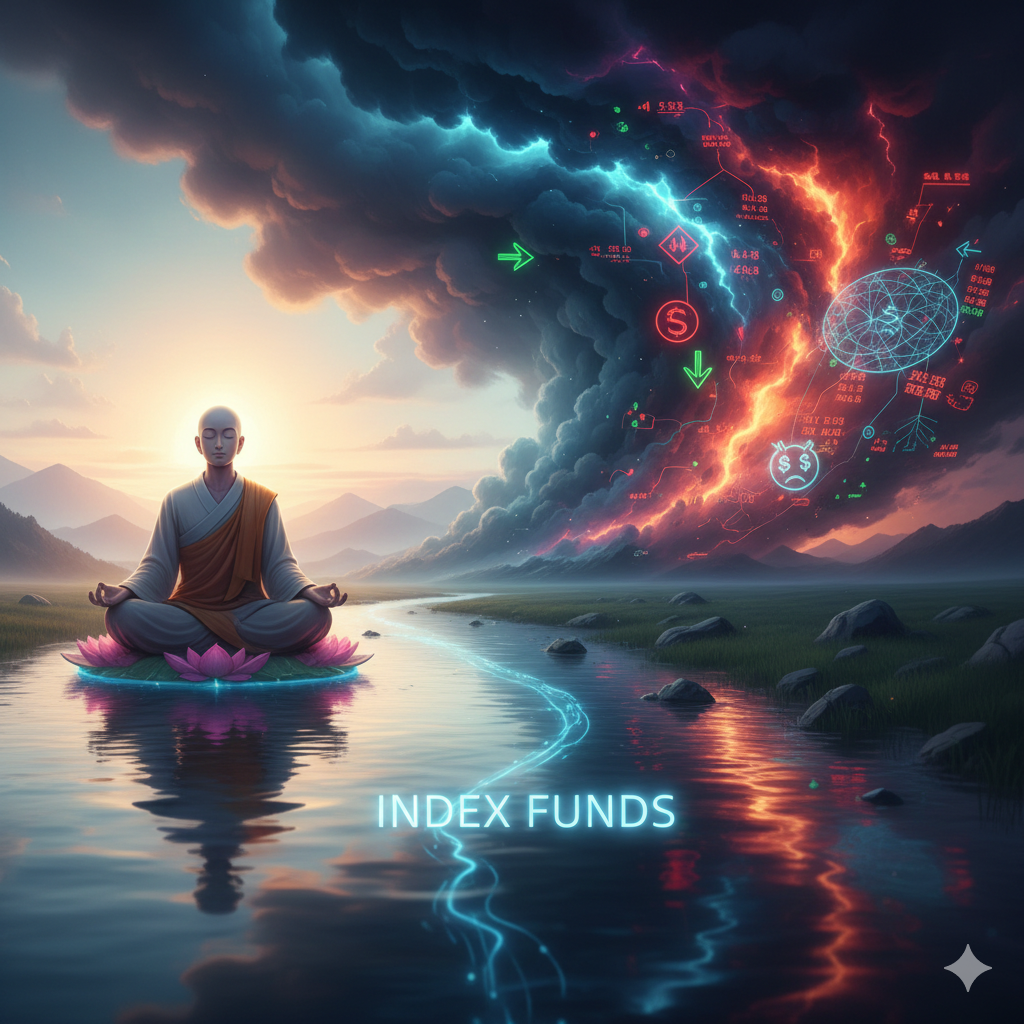
The Quiet Victory: Why Index Funds Outperform Most Investors Emotionally
In the grand theatre of financial markets, a silent revolution has been unfolding. It’s not about flashy stock picks, complex derivatives, or market-timing algorithms. It’s about a simple, mechanical, and profoundly humble instrument: the index fund. While volumes have been written on their cost efficiency and statistical superiority, the most profound victory of the index fund is not on the spreadsheet, but in the human psyche. To understand why index funds consistently outperform most investors, we must venture beyond portfolio theory into the murky depths of human emotion, cognitive bias, and our evolutionary inheritance. This is a story of how surrendering the illusion of control grants the ultimate financial freedom.
The Performance Paradox: Numbers as a Symptom
The empirical data is unequivocal. Study after study, from S&P’s SPIVA reports to decades of academic research, confirms that over the long term, a majority of actively managed funds fail to beat their benchmark index after fees. The average investor’s returns are even bleaker, often lagging the very funds they invest in due to poor timing. The index fund, by merely replicating the market, reliably lands in the top quartile of performers over 10- and 20-year periods. But this numerical outcome is merely the symptom. The disease is emotional. Active investing—the attempt to select winners and time the market—is not a financial challenge first; it is a psychological gauntlet.
The Emotional Tax of Active Investing
Every active decision carries an “emotional tax”—a psychic toll paid in stress, doubt, and cognitive effort. Consider the process: The investor must research (amidst an ocean of biased information), decide (under uncertainty), execute, and then live with the consequences. This triggers a cascade of emotional and biochemical responses.
1. The Dopamine Trap: Buying and selling feels like action. It triggers dopamine hits, the neurotransmitter associated with reward and pleasure. This creates a feedback loop where activity is confused with progress. The index fund investor, by contrast, makes few decisions—typically just periodic, automated buys. They are removed from the dopamine casino, their rewards delayed and compounded over decades, not minutes.
2. Regret Aversion & The Pain of Being Wrong: Humans feel the pain of a loss more acutely than the pleasure of an equivalent gain (loss aversion). An active pick that falls 20% isn’t just a portfolio loss; it’s a personal failure, a blow to one’s identity as a “smart investor.” This leads to “regret aversion”—holding losers too long (to avoid crystallizing the mistake) and selling winners too early (to lock in the “win”). The index fund, impersonal and amoral, owns all the losers and all the winners automatically. It has no ego, no regret. It simply rebalances, a mechanical gardener pruning by algorithm.
3. Narrative Fallacy & The Illusion of Control: We are storytelling creatures. We weave coherent narratives from random events to create a sense of understanding and control. A stock’s rise is attributed to our brilliant research; its fall is blamed on unforeseen “manipulation” or bad luck. This narrative addiction leads to overconfidence. The index fund forces a different story: “I own a piece of the productive economy. My success is tied to human ingenuity and progress, not my own fleeting cleverness.” This is a humbling and liberating narrative.
The Cognitive Burden and Decision Fatigue
Active investing is a relentless series of micro-decisions: “Is this the top?” “Should I average down?” “What did the Fed mean?” This consumes precious cognitive bandwidth, a finite resource. Decision fatigue sets in, leading to poorer choices, irritability, and mental exhaustion. The index fund strategy, once set up, is a cognitive sanctuary. It’s a “set-and-forget” system that frees the mind for relationships, hobbies, and deep work. The mental energy saved is a massive, unquantified return on investment.
The Mirror of the Market: Facing Our Reflections
The market is a terrifying mirror. In its violent gyrations, it reflects back our own greed, fear, and impatience. A 30% market crash isn’t just a price change; it’s a Rorschach test revealing our true risk tolerance. Most investors fail this test. They sell low, driven by primal fear. The active investor stares directly into this mirror every day, battling the reflected monster. The index fund investor, through a strategy of relentless consistency (dollar-cost averaging), sidesteps the mirror entirely. They are not ignoring the market’s message; they are refusing to have a daily emotional conversation with it. They acknowledge the reflection’s existence but don’t mistake it for reality. The reality is their steady ownership of assets over time.
Evolutionary Mismatch: Stone-Age Brains in an Information Age
Our brains evolved for survival on the savanna, not for evaluating P/E ratios on a smartphone buzzing with alerts. We are wired for:
– Herding: If the tribe runs, you run. (Market panic sells.)
– Recency Bias: What happened recently will continue. (Buying at peaks after bull runs.)
– Hyper-Agency: We must *do something* in the face of danger. (Selling into a crash.)
The financial media and technology ecosystem exploit these instincts mercilessly. The index fund is a technological adaptation to this mismatch. It is a pre-commitment device, like Odysseus tying himself to the mast. It acknowledges our biological fallibility and builds a system around it. It automates rationality.
The Profound Liberation of Passivity
Here lies the deep, philosophical core of the index fund’s emotional outperformance: It liberates us from the need to be right. In a culture that glorifies the individual genius, the stock-picking guru, choosing passivity feels like admitting defeat. But this is a profound misreading. It is the strategic surrender of a battle (outsmarting the market today) to win the war (financial security and mental peace over a lifetime).
This passivity creates space for a healthier relationship with money. Money becomes a tool, a quiet engine working in the background, not a scoreboard demanding daily attention or a source of identity. The investor is freed to define themselves by their work, their relationships, their contributions—not by the daily fluctuations of their net worth. This emotional capital compounds just as surely as the financial capital.
Conclusion: The Ultimate Alpha is Peace of Mind
The index fund’s true “alpha”—its excess return—is not purely financial. It is the emotional alpha of reduced stress, regained time, and freedom from the obsessive financial news cycle. It outperforms because it is perfectly suited to flawed, emotional humans. It transforms investing from a test of nerve and prognostication into a simple, boring, and profoundly effective practice of participation in economic growth.
In the end, the index fund doesn’t just outperform the average investor in the market. It outperforms the inner investor—the scared, greedy, overconfident, story-seeking homunculus in our heads. It offers a path to wealth that is not just about accumulating money, but about preserving one’s sanity and happiness along the way. The greatest investment one can make, therefore, may not be in the S&P 500, but in the emotional infrastructure that allows one to hold it through every storm, calmly and consistently. That is the quiet, triumphant wisdom of the index.