The Magic of Compounding in Mutual Funds: Complete Guide with Real Indian Examples
The Eighth Wonder of the World
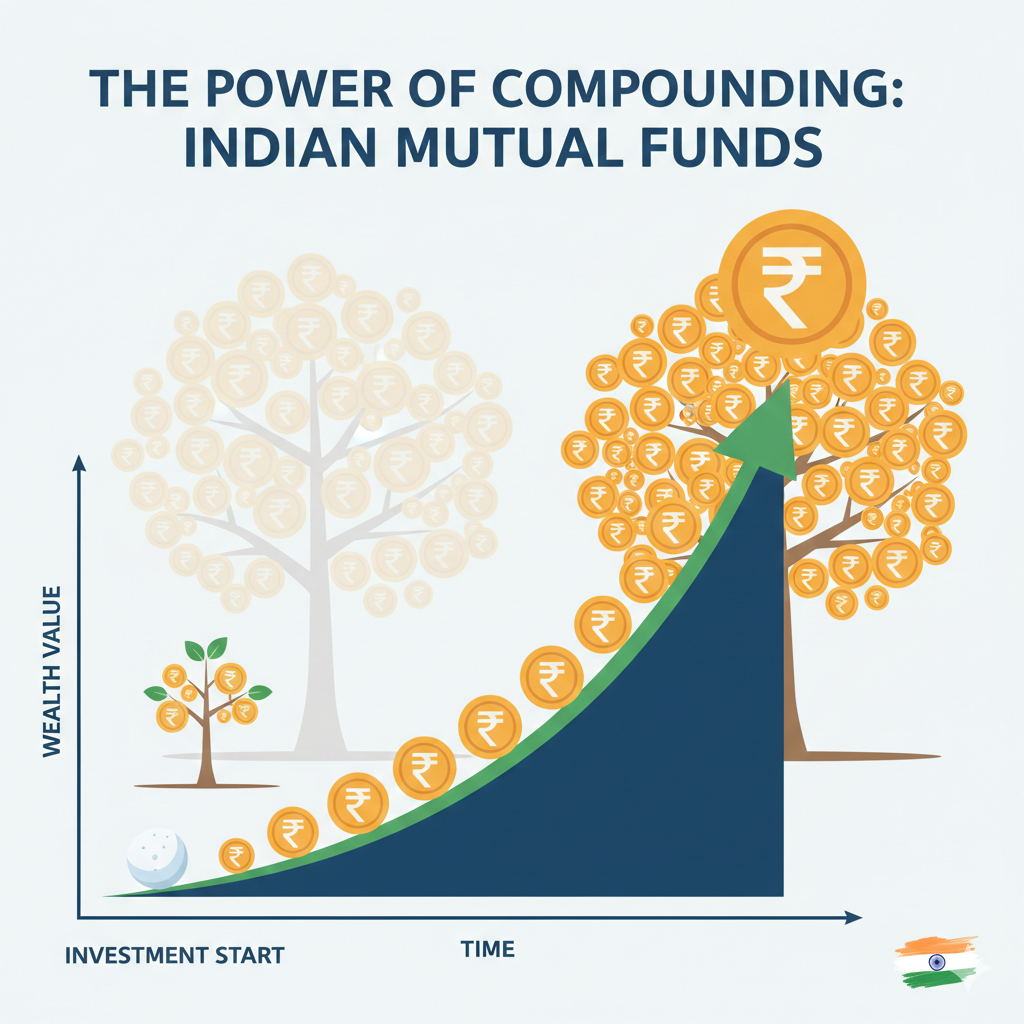
Albert Einstein famously called compound interest “the eighth wonder of the world.” But what does this mean for Indian mutual fund investors? In simple terms, compounding is the process where your investment returns start earning returns of their own. This creates a snowball effect that can transform modest monthly SIPs into substantial wealth over time.
Understanding the Mathematics of Compounding
Before diving into mutual fund examples, let’s understand the core formula that powers this phenomenon:
Where:
- A = Future value of investment
- P = Principal amount (initial investment)
- r = Annual rate of return (in decimal)
- n = Number of times interest compounds per year
- t = Number of years
Simple vs. Compound Returns: A ₹1 Lakh Example
Let’s compare ₹1,00,000 invested at 12% annual return:
| Year | Simple Interest | Compound Interest | Difference |
|---|---|---|---|
| Year 1 | ₹1,12,000 | ₹1,12,000 | ₹0 |
| Year 5 | ₹1,60,000 | ₹1,76,234 | ₹16,234 |
| Year 10 | ₹2,20,000 | ₹3,10,585 | ₹90,585 |
| Year 20 | ₹3,40,000 | ₹9,64,629 | ₹6,24,629 |
| Year 30 | ₹4,60,000 | ₹29,95,992 | ₹25,35,992 |
The difference becomes astronomical over longer periods. That’s the power of compounding!
How Compounding Works in Mutual Funds: The Indian Context
In mutual funds, compounding works through two primary mechanisms:
1. Dividend Re-investment
When you choose the “Growth Option” or “Dividend Reinvestment Option,” dividends earned by the fund are automatically used to purchase more units of the fund. These additional units then participate in future growth.
2. NAV Appreciation with Time
As the underlying stocks in the mutual fund portfolio grow, the Net Asset Value (NAV) increases. This appreciation, when held over time, compounds as the increased NAV generates further gains.
Real Indian Example: HDFC Equity Fund
Let’s examine the growth of ₹10,000 invested in HDFC Equity Fund 20 years ago (December 2003):
Initial Investment (Dec 2003): ₹10,000
Value (Dec 2023): Approximately ₹5,80,000
CAGR (Compound Annual Growth Rate): ~22%
Total Return: 5,700%
The Compounding Journey:
- First 5 years (2003-2008): ₹10,000 → ₹42,000
- Next 5 years (2008-2013): ₹42,000 → ₹1,05,000
- Next 5 years (2013-2018): ₹1,05,000 → ₹2,80,000
- Last 5 years (2018-2023): ₹2,80,000 → ₹5,80,000
Notice how the absolute gains increased dramatically in later years despite similar percentage returns. That’s compounding acceleration!
The SIP Compounding Miracle: Monthly Investments That Transform Lives
Systematic Investment Plans (SIPs) leverage compounding most effectively. Here’s why:
The ₹5,000 Monthly SIP Example
Let’s compare two investors with different time horizons:
| Parameter | Investor A (Starts at 25) | Investor B (Starts at 35) |
|---|---|---|
| Monthly SIP | ₹5,000 | ₹5,000 |
| Investment Period | 35 years (till age 60) | 25 years (till age 60) |
| Total Invested | ₹21,00,000 | ₹15,00,000 |
| Assumed Return | 12% CAGR | 12% CAGR |
| Final Value | ₹3.2 Crores | ₹94 Lakhs |
| Wealth Created | ₹2.99 Crores | ₹79 Lakhs |
The Three Pillars of Maximizing Compounding in Indian Mutual Funds
1. Time: Your Most Powerful Ally
The longer you stay invested, the more dramatic the compounding effect. Every additional year multiplies the impact exponentially.
Rule of 72: Divide 72 by your expected return to find doubling time
At 12% return: 72 ÷ 12 = 6 years (your money doubles every 6 years)
At 15% return: 72 ÷ 15 = 4.8 years (money doubles every 4.8 years)
2. Consistency: Regular Investments Matter
Regular SIPs ensure you buy units at different market levels (rupee cost averaging) and continuously add fuel to the compounding engine.
3. Reinvestment: Let Returns Generate More Returns
Always choose the “Growth Option” for long-term goals. Avoid withdrawing profits prematurely; let the entire corpus compound.
Real-Life Indian Mutual Fund Compounding Case Studies
Case Study 1: Mirae Asset Emerging Bluechip Fund
Scenario: ₹20,000 monthly SIP started in April 2010
Total Investment (April 2010 – Dec 2023): ₹33.2 lakhs
Current Value (Dec 2023): ₹2.15 Crores
Absolute Gain: ₹1.82 Crores
XIRR (Approx): 22.5%
Compounding Insight: The first ₹10 lakhs took 5 years to accumulate. The next ₹90 lakhs took just 3 years! That’s the acceleration phase of compounding.
Case Study 2: SBI Small Cap Fund
Scenario: One-time investment of ₹5 lakhs in January 2015
Investment Amount (Jan 2015): ₹5,00,000
Value (Dec 2023): ₹35,70,000
Total Gain: ₹30,70,000 (614% return)
CAGR: ~25.3%
The Compounding Pattern:
- Years 1-3: Slow growth (₹5L → ₹7.5L)
- Years 4-6: Acceleration (₹7.5L → ₹20L)
- Years 7-9: Explosive growth (₹20L → ₹35.7L)
Common Mistakes That Destroy the Power of Compounding
1. Stopping SIPs During Market Downturns
When markets fall, your SIP buys more units at lower prices. Stopping SIPs during corrections destroys the long-term compounding effect.
2. Frequent Switching Between Funds
Every time you switch funds, you reset the compounding clock. The exit load, taxes, and time out of market significantly reduce long-term returns.
3. Chasing Past Performance
Funds that have given exceptional returns recently may not sustain them. Consistent performers over 7-10+ years create better compounding.
4. Not Increasing SIPs with Income
If your SIP remains constant while your income grows, you’re missing additional compounding opportunities. Increase SIP by at least 10% annually.
The Tax Impact on Compounding
In India, mutual fund taxation affects your compounding:
- Equity Funds: 10% LTCG tax on gains above ₹1 lakh (held >1 year)
- Debt Funds: Indexation benefits for LTCG (held >3 years)
- STCG: 15% for equity (<1 year), as per income slab for debt (<3 years)
Key Insight:
Long-term holding (>3 years for debt, >1 year for equity) minimizes tax impact and maximizes compounding. Every rupee paid in tax is a rupee that stops compounding forever.
The Psychological Aspect: Why Most Investors Fail to Harness Compounding
Compounding requires patience and emotional discipline. The most significant gains occur in the last third of your investment horizon, but most investors give up during the slow initial phase.
The ₹50 Lakh Dream: Two Approaches
Trader Mindset: Tries to time markets, earns 20% one year, loses 15% next, net result ~5% CAGR
Compounder Mindset: Stays invested through cycles, earns 12% CAGR consistently
₹10,000 monthly SIP at 5% CAGR for 20 years: ₹41 lakhs
₹10,000 monthly SIP at 12% CAGR for 20 years: ₹99 lakhs
Consistency beats occasional brilliance when compounding is at work.
Start Your Compounding Journey Today
The best time to start investing was 20 years ago. The second-best time is today. Every day you delay is costing you future compounded returns.
Action Steps:
- Start a SIP today, even if it’s just ₹500/month
- Choose a good diversified equity fund with 10+ year track record
- Opt for the Growth Option
- Increase your SIP by 10% every year
- Review annually but don’t tinker unnecessarily
- Stay invested for at least 10-15 years
Conclusion: Compounding is Not Just Math, It’s a Wealth Creation Philosophy
Compounding in mutual funds is the closest thing to a financial superpower available to ordinary Indians. It transforms discipline into wealth, patience into prosperity, and regular savings into financial freedom.
Remember: In the first few years, you’ll barely notice the effects. In the next few, you’ll see steady progress. But in the final years, you’ll witness what seems like magical growth. That’s not magic—that’s compounding at work.
The formula is simple: Start Early + Invest Regularly + Stay Invested = Compounding Magic
Disclaimer: Past performance is not indicative of future returns. The examples are for illustrative purposes only. Mutual fund investments are subject to market risks. Please consult with a certified financial advisor before making investment decisions.
Sources: Data from Value Research, AMFI, and fund fact sheets. Calculations assume reinvestment of dividends and are approximate.