The Ultimate Guide to Short-Term Investing
Strategic Options to Park Your Funds for 1-3 Years with Optimal Safety & Liquidity
Short-term investing, typically defined for horizons of one to three years, requires a distinct strategy focused on capital preservation, liquidity, and modest growth. Unlike long-term portfolios, you cannot rely on time to recover from market volatility. This in-depth guide explores the best vehicles for your short-term funds, comparing returns, risks, and accessibility to help you make an informed decision.
Why Short-Term Investing is Different
Short-term goals—like building an emergency fund, saving for a down payment, a planned major purchase, or a known upcoming expense—demand safety and easy access. The primary objectives are liquidity (quick access without penalties), principal protection (minimal risk of loss), and beating inflation. The focus shifts from high growth to avoiding loss.
Top Short-Term Investment Options: A Detailed Analysis
Here is a comprehensive breakdown of the most effective short-term investment vehicles available today.
1. High-Yield Savings Accounts (HYSAs)
Best for: Emergency funds & absolute principal safety.
FDIC-insured accounts offered by online banks, often paying 10-20x the national average of traditional savings accounts. Rates fluctuate with the federal funds rate.
Current APY Range: 4.00% – 5.50% (as of 2024).
2. Money Market Accounts & Funds
Best for: Core holding with check-writing privileges.
Money Market Accounts (MMAs): FDIC-insured, similar to HYSAs but may offer limited debit/check access. Money Market Funds (MMFs): Not FDIC-insured, but invest in short-term government/corporate debt. Extremely low risk, with a stable NAV ($1 per share).
3. Certificates of Deposit (CDs)
Best for: Known time horizons where you can lock in a rate.
Time deposits with fixed terms (3 months to 5 years) and fixed interest rates. Penalties apply for early withdrawal. Consider CD ladders—buying multiple CDs with staggered maturity dates—to balance rate and liquidity.
4. Treasury Securities
Best for: Tax-efficient, ultra-safe government backing.
Treasury Bills (T-Bills): Maturities from 4 weeks to 1 year. Sold at a discount and pay face value at maturity. Interest is exempt from state/local tax. Treasury Notes: 2-10 year terms, pay semi-annual interest. Can be sold early on the secondary market.
5. Ultra-Short Bond Funds & ETFs
Best for: Potentially higher yield than savings with modest risk.
Mutual funds or ETFs investing in bonds with very short maturities (under one year). Higher yield than MMFs but carries slight principal fluctuation risk. Provides daily liquidity.
6. Municipal Bonds (Short-Term)
Best for: High-income investors in high-tax states.
Debt issued by states/cities. Interest is often exempt from federal and sometimes state tax. Short-term muni ETFs or individual bonds near maturity offer lower risk. Credit risk varies.
Comparative Analysis: Risk, Return & Liquidity
| Investment | Risk Profile | Liquidity | Potential Return | Best Suited For |
|---|---|---|---|---|
| High-Yield Savings | Very Low (FDIC) | Excellent | Moderate (Variable) | Emergency fund, first $10-25k |
| CDs | Very Low (FDIC) | Poor (Penalty) | Moderate (Fixed) | Known future expense (1-3 yrs) |
| Treasury Bills | Extremely Low (U.S. Govt) | Good (Secondary Market) | Low-Moderate | Tax-sensitive, safety-first |
| Money Market Funds | Very Low | Excellent | Moderate | Parking funds, checking alternative |
| Ultra-Short Bond ETFs | Low to Moderate | Excellent | Moderate+ | Seeking slightly higher yield, accept tiny fluctuations |
Crucial Factors in Your Decision
- Time Horizon: If you need money in <12 months, stick to HYSAs, MMFs, or T-Bills. For 1-3 years, consider CDs, short-term bonds, or a ladder.
- Risk Tolerance: Can you tolerate a 1-2% drop in principal? If not, avoid even ultra-short bond funds.
- Tax Considerations: Interest from Treasuries is state-tax exempt. Municipal bond interest is often federal-tax exempt. Calculate the Tax-Equivalent Yield.
- Inflation: Ensure your after-tax return outpaces inflation (aim for >3-4% currently).
Building Your Short-Term Investment Strategy
A Step-by-Step Action Plan
- Define the Goal & Timeline: Be specific with the amount needed and the date.
- Layer Your Allocation:
- Tier 1 (Immediate Access): Keep 30-50% in a HYSA or MMA for unexpected needs.
- Tier 2 (1-2 Year Horizon): Allocate 30-50% to a CD ladder or T-Bill ladder.
- Tier 3 (2-3 Year Horizon): Consider 10-20% in a diversified ultra-short bond ETF for a yield boost.
- Automate & Monitor: Set up automatic transfers. Review rates and your strategy every 6 months.
- Reinvest Maturities: As CDs or T-Bills mature, reinvest at the longest duration your timeline allows to capture prevailing rates.
⚠️ What to AVOID in Short-Term Investing
Do not gamble with short-term money. Avoid individual stocks, long-term bonds (high interest rate risk), cryptocurrencies, and speculative assets. Their volatility can lead to significant losses right when you need the cash.
Key Takeaway
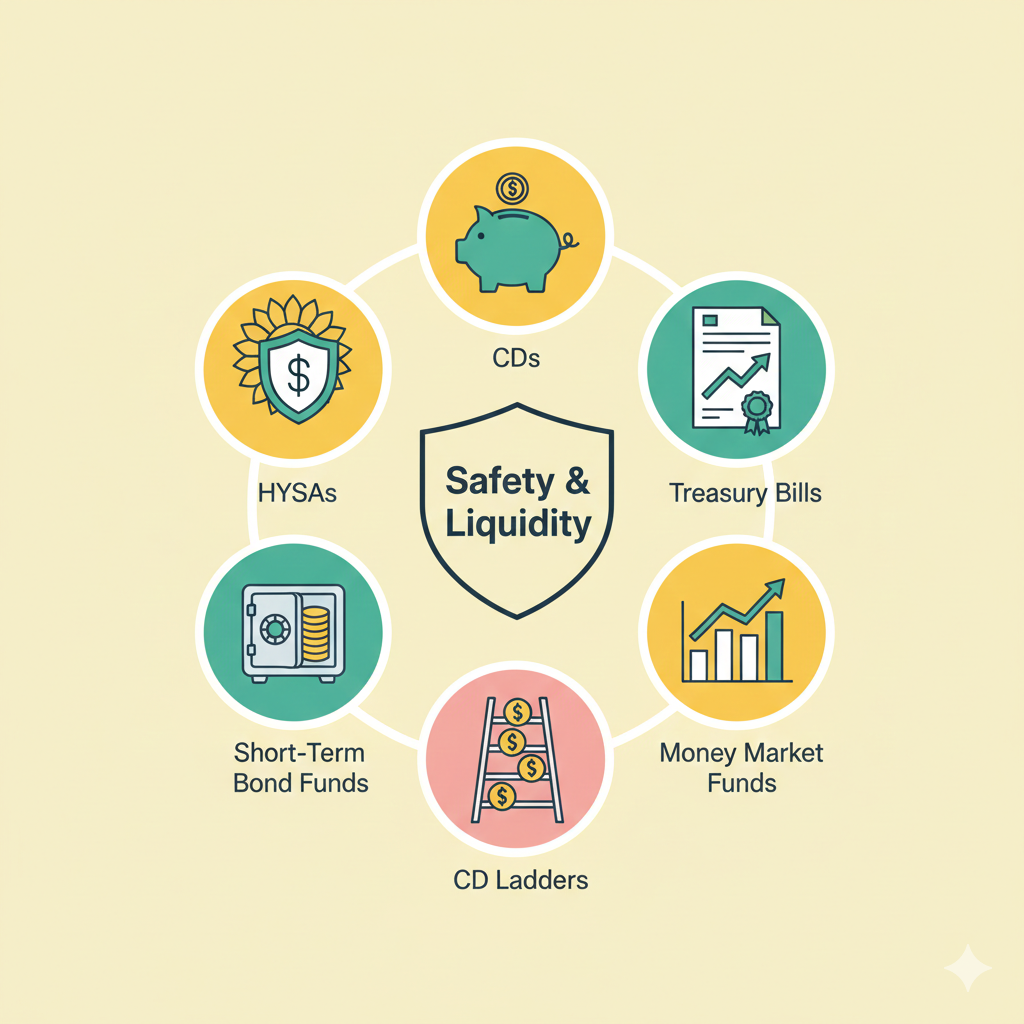
The optimal short-term investment portfolio is boring but strategic. It prioritizes the preservation of capital and guaranteed access over spectacular returns. By using a combination of HYSAs, CDs, Treasury securities, and money market instruments, you can construct a ladder that provides liquidity, safety, and a return that protects your purchasing power from inflation. Start by parking your funds in a high-yield savings account, then build a CD or Treasury ladder as your core strategy for time-specific goals.