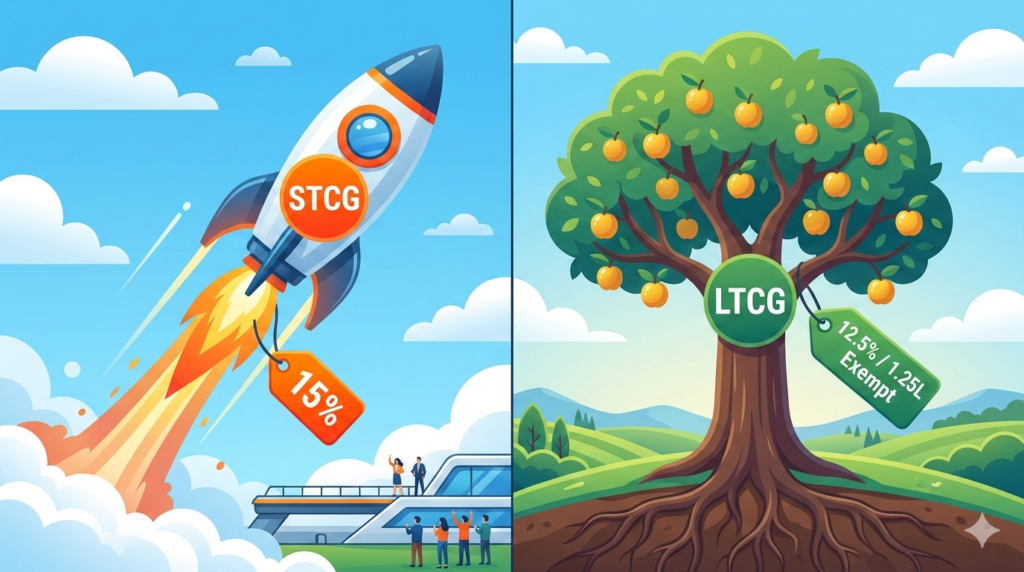
📈 Mutual Fund Taxation Deep Dive: Only STCG & No Other Income
Complete guide on how short-term capital gains are taxed when you have zero additional income – including rules, tables, and LTCG comparison.
Imagine you’re an investor who dipped into equity mutual funds this year, booked profits within 12 months, and have no salary, no business income — nothing else. How much tax will you pay? Will you get to use the basic exemption limit? What about long-term gains? This blog unravels every layer of mutual fund taxation for such a scenario. We’ll cover both Short-Term Capital Gains (STCG) and Long-Term Capital Gains (LTCG) in detail, with practical tables and examples.
🔍 Short-Term Capital Gains (STCG) – The Core Analysis
When you sell your equity mutual fund units within 12 months of purchase, any profit is termed STCG. As per current tax rules (FY 2024-25 / AY 2025-26), STCG on equity funds is taxed at 15% plus applicable surcharge and cess (effective ~15.6% for most individuals). But here’s the twist: this 15% rate applies irrespective of your income slab. Even if your total income (including STCG) is below the basic exemption limit, you still pay 15% on those gains? Not exactly – the interplay with the basic exemption limit saves you tax when your total income is low.
🧮 Scenario: Only STCG and no other income
Suppose you are a student or a homemaker with zero salary. You invested ₹2,00,000 in an equity fund, sold after 8 months for ₹3,20,000. Your STCG = ₹1,20,000. Your total income = ₹1,20,000 (since no other income). Now, how is this taxed?
Step-by-step computation:
- Step 1: Compute total income = STCG + any other income = ₹1,20,000.
- Step 2: Basic exemption limit for an individual below 60 years is ₹2,50,000 (for FY 2024-25).
- Step 3: Since total income (₹1,20,000) is less than ₹2,50,000, you might think no tax. But STCG is special – it’s not simply clubbed with slab rates.
- Step 4: The Income Tax Act says: STCG u/s 111A is taxed at 15% on the gains, but first, you can adjust the basic exemption against your other income (non-STCG). Here, other income = ₹0. So the entire basic exemption of ₹2.5L remains unutilized.
- Step 5: You can then deduct the unutilized basic exemption from your STCG? No, that’s a common confusion! STCG u/s 111A is taxable at a special rate, and you cannot reduce the gains by the exemption limit. However, if your total income (including STCG) is below the exemption limit, you do not have to pay tax because of the rebate under section 87A.
Rebate under section 87A
For resident individuals with total income ≤ ₹5,00,000 (after deductions), a rebate of up to ₹12,500 is available under section 87A. This effectively makes the tax liability zero if the tax on income (including STCG) is less than or equal to ₹12,500. In our example, total income ₹1,20,000, tax on STCG @15% = ₹18,000 (without cess). But since total income < ₹5L, you claim 87A rebate. However, rebate cannot exceed tax payable. The actual tax after rebate becomes ₹0 because tax of ₹18,000 is reduced by ₹12,500? Wait — that would still leave ₹5,500 tax. Let's do accurate calculation.
📊 Example with numbers: STCG ₹1,20,000
| Particulars | Amount (₹) |
|---|---|
| Short Term Capital Gains (STCG u/s 111A) | 1,20,000 |
| Total Income (A) | 1,20,000 |
| Tax on STCG @15% | 18,000 |
| Add: Health & Education Cess @4% | 720 |
| Total tax before rebate | 18,720 |
| Less: Rebate u/s 87A (if total income ≤ ₹5,00,000) | (12,500) |
| Net Tax Payable | 6,220 |
You still pay ₹6,220 because after rebate, the remaining tax is positive. But wait — many online calculators show zero tax for income under ₹2.5L? That’s because they assume income is from slab rate sources (like interest), not special rate gains. For STCG, the 15% rate is applied first, and then 87A rebate kicks in. So you will pay some tax if STCG > ₹92,500 approximately? Let’s find the breakeven.
🎯 Breakeven: How much STCG is tax-free if no other income?
Since rebate u/s 87A is ₹12,500, and tax on STCG is 15% + cess = 15.6% effectively. So if STCG = X, tax = 0.156X. To make tax zero after rebate: 0.156X ≤ 12,500 → X ≤ 80,128. So if your STCG is up to ₹80,128, tax ≤ ₹12,500, rebate wipes it out. For STCG above that, you pay 15.6% on the gains beyond ₹80,128.
⏳ Long-Term Capital Gains (LTCG) on Mutual Funds
Now, if you held your equity mutual fund for more than 12 months, gains are LTCG. The rules changed significantly in Budget 2024 (proposed amendments). As per the latest:
- LTCG on equity-oriented funds taxed at 12.5% (without indexation benefit) for gains accrued after 23rd July 2024.
- Exemption limit: LTCG up to ₹1,25,000 per year is tax-free.
- Gains above ₹1.25 lakh are taxed at 12.5% (plus cess = effective ~13%).
🌿 Example: Only LTCG and no other income
Suppose you sold after 15 months and made a LTCG of ₹2,00,000. You have no other income. Your tax computation:
| Particulars | Amount (₹) |
|---|---|
| Long-Term Capital Gains (LTCG) | 2,00,000 |
| Less: Exemption u/s 112A (standard deduction for LTCG) | (1,25,000) |
| Taxable LTCG | 75,000 |
| Tax @12.5% | 9,375 |
| Add: Cess @4% | 375 |
| Total Tax Payable | 9,750 |
Notice there’s no 87A rebate adjustment because LTCG is also special rate, but the ₹1.25L exemption already reduces the taxable pool. If your LTCG is less than ₹1.25L, you pay zero tax.
📋 Side-by-side comparison: STCG vs LTCG (no other income)
| Parameter | Short-Term (holding ≤12 months) | Long-Term (holding >12 months) |
|---|---|---|
| Tax Rate | 15% + cess (effective 15.6%) | 12.5% + cess (effective 13%) |
| Basic exemption adjustment | Cannot reduce gains by ₹2.5L; but 87A rebate available if total income ≤ ₹5L | Separate exemption of ₹1.25L on LTCG itself; also 87A rebate can apply if total income (including LTCG) ≤ ₹5L? Actually, 87A rebate applies to total tax, but since LTCG already has its own exemption, the math overlaps. |
| Tax-free threshold (approx) | STCG up to ₹80,128 (due to 87A rebate) | LTCG up to ₹1,25,000 (direct exemption) |
| Best for low-income investor | If gains are modest, holds well | More generous exemption, lower rate |
📌 Important nuances & strategy
- Debt mutual funds: Taxation differs – STCG is as per income slab; LTCG (if held >3 years) is 20% with indexation. In our “no other income” scenario, STCG on debt funds could be zero if total income (including gains) < ₹2.5L, because slab rate applies. But this post focuses on equity-oriented funds.
- Grandfathering & historical rates: For LTCG accrued before 23rd July 2024, old rules (10% over ₹1L) may apply. But for simplicity, we’ve taken new regime.
- STCG on foreign ETFs / international funds: Some international mutual funds are treated as debt for taxation – be careful.
- Surcharge: If your total income (including STCG) crosses ₹50L, surcharge applies. For our no-other-income scenario, unlikely.
📘 Pro tip: If you are a non-earning individual (like a student or spouse with nil income), harvesting short-term gains within ~₹80,000 can be completely tax-free. For long-term, you can book up to ₹1.25L gains without tax. Use this to rebalance portfolios efficiently.
📝 Filing ITR with only capital gains
If you have only STCG or LTCG, you must file ITR-2. You’ll report gains under Schedule CG. Even if tax is zero, filing is mandatory if total income exceeds basic exemption limit (₹2.5L) or if you have gains that require disclosure. For STCG below ₹80k and no other income, total income < ₹2.5L, but you might still need to file if you want to claim refund of TDS (if any) or carry forward losses. In the scenario of only STCG of, say, ₹50,000 – total income ₹50,000 < ₹2.5L, no tax, but filing is optional? Actually, if your income is below exemption and no tax, you are not required to file, but it’s wise to file to create a financial trail.
❓ Frequently Asked Questions
Q: Can I adjust my STCG against the basic exemption of ₹2.5L?
A: No. STCG u/s 111A is taxable at a special rate. It cannot be reduced by the non-availability of basic exemption. However, you can claim rebate 87A, which effectively reduces tax.
Q: I have STCG of ₹90,000 and no other income. Do I need to pay tax?
A: Tax on STCG = 15.6% of 90,000 = ₹14,040. After 87A rebate (₹12,500), you pay ₹1,540. So yes, small tax payable. Consider harvesting before crossing the threshold.
Q: How is LTCG more beneficial for low-income earners?
A: LTCG has a dedicated ₹1.25L exemption, so you can realize gains up to that limit completely tax-free. Plus the rate is lower. If you can hold funds for >1 year, LTCG is far more tax-efficient.
🔚 Final verdict
For a mutual fund investor with only short-term capital gains and no other income, the tax liability is not zero for all amounts. Up to ~₹80,000 STCG, you pay nothing due to 87A rebate. Beyond that, the effective rate is ~15.6%. For long-term gains, up to ₹1.25L is completely tax-free, and thereafter 13% kicks in. Understanding these nuances helps you plan redemptions and optimize taxes. Always consult a tax professional for your specific situation.
Disclaimer: This article is for educational purposes based on tax laws applicable for FY 2024-25 (AY 2025-26) as per current knowledge. Amendments after 23rd July 2024 are included. Please verify with official IT resources.