
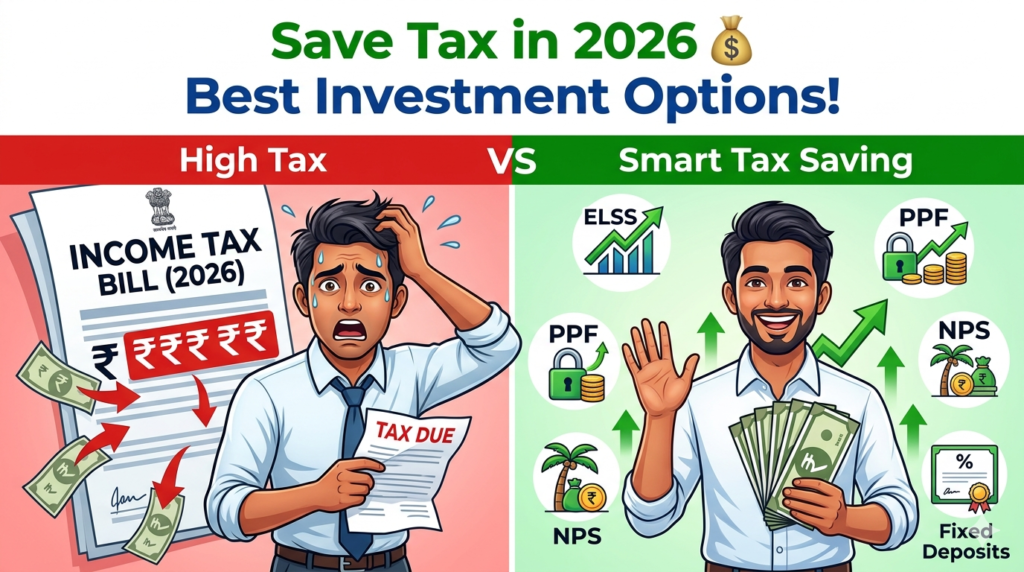
Best Tax Saving Investments in India (2026)
Your complete, no-nonsense guide to legally keeping more of your hard-earned money — because the taxman cometh, but you don’t have to let him take everything.
- Why tax planning in India matters more than ever in 2026
- Old vs New Tax Regime — which one saves you more?
- Top 8 tax-saving investments: ELSS, PPF, EPF, NPS, FD, ULIP, SSY, SCSS
- Section 80C, 80CCD, 80D deductions — explained in plain English
- Full comparison table: returns, lock-in, risk & tax treatment
- Smart strategies & common mistakes to dodge
- 7 FAQs for fast answers
Introduction: The Annual Ritual of Financial Panic
Every year, somewhere around January, a peculiar epidemic sweeps through India’s salaried class. HR departments send out that one dreaded email — “Submit your investment proofs by [date]” — and suddenly, perfectly sane adults start Googling “tax saving options India 2026” at 11 PM like they’re defusing a bomb.
Sound familiar? You’re not alone. For millions of Indians, tax planning is less of a financial strategy and more of a last-minute panic purchase — the fiscal equivalent of buying a raincoat while already soaked.
But here’s the good news: tax planning doesn’t have to be a scramble. Done right, it’s one of the most powerful wealth-building tools in your financial arsenal. The Indian government, in its infinite (and occasionally baffling) wisdom, has embedded a treasure chest of tax-saving instruments into the law — instruments that don’t just save tax but also grow your wealth over time.
This guide is your comprehensive, jargon-busted, expert-backed roadmap to the best tax saving investments in India for 2026. We’ll cover everything from the market-linked thrill of ELSS funds to the humble, rock-steady comfort of PPF — so you can make informed decisions instead of panic-buying insurance you don’t need.
Let’s dive in. Your future self (and your wallet) will thank you.
Why Tax Planning is Important in India (2026 Context)
India’s personal income tax rates aren’t exactly gentle. Under the Old Tax Regime, a person earning ₹15 lakh annually can face a tax liability of over ₹2.62 lakh. That’s roughly the price of a decent two-wheeler — vanishing into thin air every year.
Effective tax planning can bring that number down dramatically — legally, ethically, and without involving any offshore accounts or creative accounting. Here’s why it matters more than ever in 2026:
- Inflation is real: Every rupee paid unnecessarily as tax is a rupee that could have compounded in an investment over decades.
- Section 80C alone saves up to ₹46,800: (₹1.5 lakh × 31.2% for those in the 30% slab + cess). That’s a round-trip flight to Europe.
- The New Tax Regime is the default: Since FY 2023-24, the New Regime became the default. If you’re not planning actively, you may be forfeiting lakhs in deductions.
- Goal-linked savings: Most tax-saving instruments — PPF, NPS, ELSS — also double as powerful wealth-creation vehicles.
Start your tax planning in April, not January. Investing ₹12,500/month in ELSS from April gives you 12 SIP instalments + rupee-cost averaging benefits. Dumping ₹1.5 lakh in March? That’s just panic, not planning.
Old vs New Tax Regime in 2026 — Which One Saves You More?
This is the great Indian tax debate of our times — more hotly contested than pineapple on pizza. The Union Budget 2025 made the New Tax Regime even more attractive with revised slabs and a higher rebate, but the Old Regime still wins for those with high deductions.
New Tax Regime Slabs (FY 2025-26)
| Income Slab | Tax Rate (New Regime) |
|---|---|
| Up to ₹4 lakh | NIL |
| ₹4 lakh – ₹8 lakh | 5% |
| ₹8 lakh – ₹12 lakh | 10% |
| ₹12 lakh – ₹16 lakh | 15% |
| ₹16 lakh – ₹20 lakh | 20% |
| ₹20 lakh – ₹24 lakh | 25% |
| Above ₹24 lakh | 30% |
Under the New Regime, there is no Section 80C deduction, no HRA exemption, no standard deduction beyond ₹75,000. It’s simpler — but not always cheaper.
The general rule: If your total deductions (80C + 80D + HRA + others) exceed approximately ₹3.75 lakh, the Old Regime tends to save more tax. If not, the New Regime may be better. Always calculate both before deciding — and consult a CA for your specific situation.
The New Tax Regime is the default from FY 2023-24 onwards. If you want to use the Old Regime and claim deductions, you must explicitly opt for it when filing your ITR. Miss this, and your ELSS, PPF contributions won’t save you a single rupee in tax.
The Best Tax Saving Investments in India for 2026
Here’s our in-depth breakdown of the top tax-saving options available to Indian taxpayers under Section 80C, 80CCD, and other provisions for FY 2025-26 (AY 2026-27).
ELSS is the rockstar of tax-saving investments — high potential returns, the shortest lock-in in the 80C universe, and actual market participation. If you’re not afraid of a little volatility (and have a horizon of 5+ years), ELSS deserves a top spot in your portfolio.
ELSS funds invest primarily in equities. Long-term capital gains (LTCG) above ₹1.25 lakh are taxed at 12.5% from FY 2024-25 onwards — still much better than fixed-income returns taxed at your slab rate.
✅ Pros
- Shortest lock-in (3 years) among 80C options
- Highest potential returns via equity exposure
- SIP investments possible — flexibility
- Professional fund management
❌ Cons
- Market-linked — no guaranteed returns
- LTCG tax applicable on gains above ₹1.25L
- Not suitable for very short horizons
*Historical average. Past performance is not indicative of future results.
The PPF is India’s most beloved financial institution — older than most mutual funds, trusted by grandparents and millennials alike, and backed by the sovereign guarantee of the Government of India. It’s the tax equivalent of a warm cup of chai on a rainy day: reliable, comforting, and always there.
PPF enjoys EEE (Exempt-Exempt-Exempt) tax status — your investment is tax-exempt, interest earned is tax-exempt, and the maturity amount is tax-exempt. It’s the triple whammy of tax benefits.
✅ Pros
- EEE tax status — completely tax-free
- Sovereign guarantee — zero default risk
- Partial withdrawal after 7th year
- Loan facility from 3rd–6th year
❌ Cons
- 15-year lock-in is very long
- Interest rate revised quarterly by GoI
- Limited to ₹1.5L/year investment ceiling
If you’re salaried and earn above ₹15,000/month, EPF is already saving your tax without you even asking. Your employer deducts 12% of your basic salary, contributes an equal amount, and the whole thing compounds tax-efficiently. It’s like a surprise tax-saving gift — except it’s mandatory.
Employee contributions up to ₹1.5 lakh qualify under Section 80C. Interest on EPF is tax-free up to an annual contribution of ₹2.5 lakh (₹5 lakh for govt employees). Above this threshold, interest becomes taxable.
Voluntary Provident Fund (VPF) contributions beyond the mandatory 12% also qualify under Section 80C and earn the same rate as EPF — making it one of the highest guaranteed returns in the fixed-income space.
NPS is the investment that keeps on giving — not just under Section 80C (₹1.5L), but also an exclusive additional deduction of ₹50,000 under Section 80CCD(1B). That means NPS can save you tax on up to ₹2 lakh in total, making it the only instrument with this dual deduction superpower.
At maturity (age 60), 60% of the corpus can be withdrawn tax-free. The remaining 40% must be used to purchase an annuity, which is taxable as per your slab at the time.
✅ Pros
- Additional ₹50,000 deduction under 80CCD(1B)
- Market-linked returns with equity option
- Low fund management charges
- 60% corpus withdrawal tax-free at 60
❌ Cons
- Locked till age 60 (very illiquid)
- 40% mandatory annuity is taxable
- Annuity returns tend to be modest
The humble Fixed Deposit — India’s most trusted financial instrument since before the internet existed. Tax-saving FDs offer Section 80C benefits with a 5-year lock-in. They’re simple, safe, and available at every bank. The catch? The interest you earn is fully taxable at your income tax slab rate. So if you’re in the 30% bracket, the effective return is… not that exciting.
✅ Pros
- 100% capital protection
- Guaranteed returns — no surprises
- Easy to open at any bank
- Senior citizens get 0.25–0.5% extra
❌ Cons
- Interest is fully taxable
- Effective post-tax returns are low (4–5%)
- No premature withdrawal for 5 years
ULIPs are the charismatic but complicated relatives of the financial world — they promise everything (insurance! investment! tax savings!), but the fine print is where dreams go to die. That said, modern ULIPs have improved significantly with lower charges and better fund choices. Let’s be honest about both sides.
Important 2026 update: ULIPs with annual premiums above ₹2.5 lakh no longer enjoy tax-free maturity proceeds — LTCG tax of 10% applies on gains above ₹1 lakh. For premiums below ₹2.5 lakh, maturity proceeds remain tax-free.
✅ Pros
- Combined insurance + investment in one
- Tax-free maturity (below ₹2.5L premium)
- Flexibility to switch between funds
- Improved low-cost options available now
❌ Cons
- High charges in early years (5–10%)
- Mixes insurance & investment (sub-optimal for both)
- Complex structure, hard to compare
- Salesperson incentives ≠ your incentives
Financial planners generally recommend buying term insurance separately and investing in ELSS or index funds. ULIPs make sense only if you understand the charges fully and commit for 15–20 years, not just the minimum 5-year lock-in.
SSY is one of the government’s finest schemes — a high-interest, tax-free, government-backed savings plan specifically for the girl child. If you have a daughter below 10 years of age, this should be a no-brainer in your portfolio.
The account matures when the girl turns 21, or at marriage after 18. Partial withdrawal of 50% is allowed after the girl turns 18 for education purposes. With 8.2% EEE status, SSY currently offers the highest risk-free, fully tax-free return in the market.
✅ Pros
- 8.2% — highest guaranteed tax-free rate
- EEE tax status (investment + interest + maturity)
- Sovereign guaranteed — zero risk
- Promotes girl child financial security
❌ Cons
- Only for parents/guardians of girl children
- Max 2 accounts (2 daughters only)
- Very long lock-in (21 years at most)
SCSS is arguably the best post-retirement instrument in India — a government-backed scheme offering above-average returns with quarterly interest payouts. If you’re 60 or above (or 55+ for VRS retirees), this is your financial equivalent of a comfortable armchair: steady, reliable, and well-deserved.
The interest is taxable, but a deduction up to ₹50,000 under Section 80TTB applies for senior citizens. TDS is not deducted if total interest doesn’t exceed ₹50,000 in a financial year.
✅ Pros
- 8.2% — very high for guaranteed returns
- Quarterly payouts — good for cash flow
- Max limit raised to ₹30 lakh (Budget 2023)
- Premature withdrawal allowed (with penalty)
❌ Cons
- Interest is taxable at slab rate
- Only for those aged 60+ (55+ for retirees)
- Max 2 accounts (individual + joint)
Comparison Table: All Tax Saving Options at a Glance
Here’s your at-a-glance cheat sheet for the best tax saving investments in India 2026. Bookmark this. Print it. Tattoo it somewhere — your financial adviser’s office wall, perhaps.
| Investment | Returns (Approx) | Lock-in | Risk | Tax on Returns | Best For |
|---|---|---|---|---|---|
| ELSS | 12–15%* | 3 years | Moderate-High | 12.5% LTCG (above ₹1.25L) | Young earners, wealth creation |
| PPF | 7.1% | 15 years | Zero | Tax-Free (EEE) | Long-term, risk-averse |
| EPF | 8.25% | Till retirement | Zero | Tax-Free (upto ₹2.5L) | All salaried employees |
| NPS | 9–11%* | Till age 60 | Low-Moderate | 60% tax-free; 40% annuity taxable | Retirement planning + extra 80CCD |
| Tax-Saving FD | 6.5–7.5% | 5 years | Zero | Fully Taxable | Capital preservation |
| ULIP | 8–12%* | 5 years | Moderate | Tax-free (below ₹2.5L prem.) | Those needing insurance too |
| SSY | 8.2% | 21 years | Zero | Tax-Free (EEE) | Parents with daughters under 10 |
| SCSS | 8.2% | 5 years | Zero | Taxable (80TTB benefit) | Senior citizens, retirees |
*Market-linked returns are indicative. Past performance ≠ future results. Rates as of April 2026.
Smart Strategies to Maximise Your Tax Savings in 2026
Knowing the options is step one. Using them intelligently is where the real magic happens. Here are battle-tested strategies to squeeze every last rupee of tax benefit legally.
Strategy 1: Layer Your Deductions
Section 80C’s ₹1.5 lakh is just the beginning. Stack it with:
- ₹50,000 extra via NPS (80CCD1B)
- ₹25,000–₹1 lakh via health insurance premiums (80D)
- ₹2 lakh on home loan interest (Section 24)
- HRA exemption if you’re paying rent
Combined, a salaried person in the 30% bracket can legitimately reduce taxable income by ₹5–6 lakh. That’s a tax saving of ₹1.5–1.8 lakh per year.
Strategy 2: Let EPF and PPF Handle the Safe Quota
Don’t over-invest in low-return safe instruments. Your mandatory EPF contribution likely already covers ₹50,000–₹80,000 of your 80C quota. Top up with ₹50,000–₹70,000 of ELSS and let PPF handle your risk-free long-term allocation. This gives you a balanced portfolio without duplicating effort.
Strategy 3: SIP, Not Lump Sum, in ELSS
Starting a monthly SIP in ELSS in April means your investments benefit from rupee cost averaging across 12 months — buying more units when markets dip, fewer when they rise. A March lump-sum buys all units at one price point, missing this smoothing benefit.
Strategy 4: Invest in Your Spouse’s and Child’s Name Too
Open a PPF account in your non-earning spouse’s name (funded by you — clubbing provisions don’t apply to PPF). Similarly, SSY for your daughter adds another ₹1.5 lakh per year in tax-deductible savings, growing at 8.2% EEE.
If you’re confused about Old vs New Regime, use the free tax calculators on the Income Tax India website or tools at investopedia.org.in. Plug in your numbers both ways — the difference might surprise you. Read more: Old vs New Tax Regime Calculator Guide
Common Tax-Saving Mistakes to Avoid in 2026
The financial graveyard is full of well-meaning Indians who made avoidable errors. Don’t join them.
- Mistake 1: Investing in tax-saving FDs when in the 30% bracket. Your post-tax return on a 7% FD is about 4.9% — barely above inflation. ELSS or NPS deliver far better long-term outcomes.
- Mistake 2: Buying endowment plans or money-back policies for 80C. These combine insurance and investment so poorly that they manage to be bad at both. Buy term insurance. Separately.
- Mistake 3: Forgetting the 80CCD(1B) NPS deduction. An extra ₹50,000 deduction sitting unclaimed. At 30% slab, that’s ₹15,600 left on the table.
- Mistake 4: Not accounting for employer NPS contribution (80CCD2). If your employer contributes to Tier-I NPS on your behalf (up to 10% of basic), that’s an additional deduction over and above ₹2 lakh — and it doesn’t come out of your pocket.
- Mistake 5: Investing in January–March panic mode. Tax-saving investments are not year-end emergencies. They’re year-round financial decisions.
- Mistake 6: Ignoring health insurance premiums (80D). ₹25,000 for self (₹50,000 if you’re a senior) + ₹25,000 for parents (₹50,000 if parents are seniors) — that’s up to ₹1 lakh of deductions entirely separate from 80C.
Don’t let an eager insurance agent convince you that a traditional endowment or ULIP is the “safest” option for tax saving. Calculate the internal rate of return (IRR) — often it’s barely 4–5%. A PPF or ELSS will outperform it by a significant margin over any meaningful time horizon.
Frequently Asked Questions (FAQs)
Conclusion: Tax Smart, Invest Smarter
Tax planning isn’t about running from the taxman — it’s about running towards your financial goals while legally minimising what you owe. The instruments covered in this guide aren’t just tax deductions; they are carefully designed savings vehicles that, used consistently over years, can build significant wealth.
The ideal portfolio mixes ELSS for growth, PPF or NPS for safe long-term accumulation, and SSY or SCSS where applicable. Start early in the financial year, invest via SIPs where possible, and please — for the love of compound interest — stop panic-investing in March.
“The only two certainties in life are death and taxes — but with the right plan, at least one of them loses its sting.”
Further Reading on Investopedia.org.in
- 📘 Old vs New Tax Regime — Which is Better for You in 2026?
- 📘 Best ELSS Mutual Funds to Invest in 2026
- 📘 NPS vs EPF — Complete Retirement Planning Comparison
- 📘 Section 80D: How to Save Tax on Health Insurance Premiums
- 📘 PPF Account — Opening, Interest Rate, Withdrawal Rules (2026)
Leave a Reply